


























1 / 2
0
Views
0
Plays


0.0
0
0 Likes
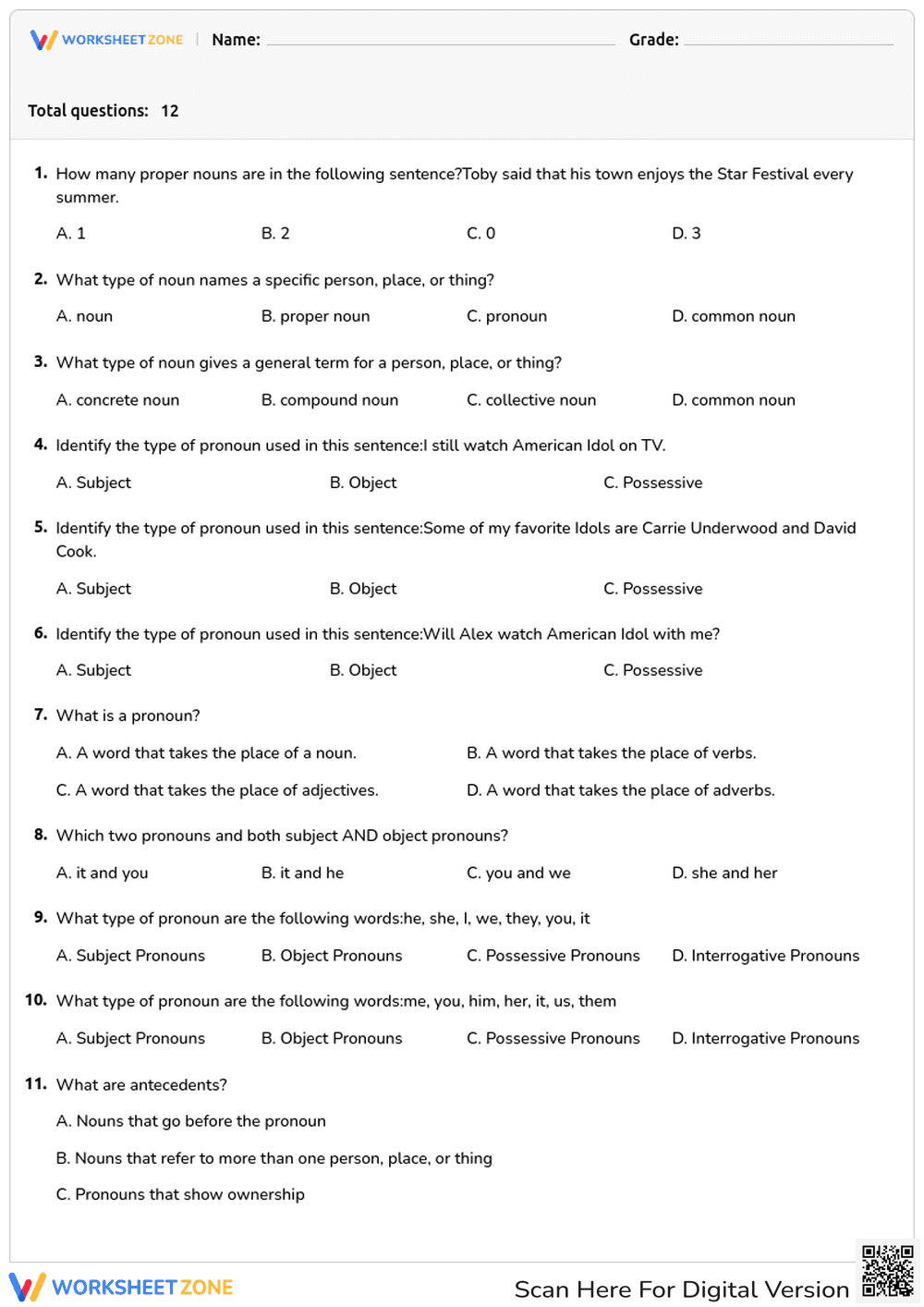
Nouns and Pronouns Quiz: Proper, Common and Types
0 Views
0 Plays
Paste this activity's link or code into your existing LMS (Google Classroom, Canvas, Teams, Schoology, Moodle, etc.).
Students can open and work on the activity right away, with no student login required.
You'll still be able to track student progress and results from your teacher account.
Information
Description
What It Is:
This is an English skills worksheet focused on pronoun-antecedent agreement. It provides definitions of 'antecedent' and examples of correct and incorrect usage. The worksheet includes examples using historical figures like James Watson, Rosalind Franklin, Francis Crick, and Maurice Wilkins. It illustrates the concept of agreement in number and gender and provides sentences to analyze for correct pronoun usage. The bottom of the worksheet focuses on indefinite pronouns like 'everybody,' 'nobody,' 'anyone,' and 'everyone.'
Grade Level Suitability:
This worksheet is suitable for grades 6-9. The content requires a foundational understanding of grammar and sentence structure, making it appropriate for middle school students reinforcing these concepts. The historical examples add a layer of complexity suitable for this age range.
Why Use It:
This worksheet helps students understand and practice pronoun-antecedent agreement, a critical skill for clear and grammatically correct writing. It reinforces the importance of agreement in number and gender and clarifies common areas of confusion, particularly with indefinite pronouns. The real-world examples using notable scientists add an engaging element.
How to Use It:
Students should begin by reading the definitions and examples provided at the top of the worksheet. Then, they can analyze the sentences provided to identify the pronoun and its antecedent. Students can determine if the pronoun and antecedent agree in number and gender. The worksheet can be used for individual practice, group work, or as part of a grammar lesson.
Target Users:
This worksheet is ideal for middle school students learning or reviewing pronoun-antecedent agreement. It is also beneficial for students who struggle with grammar and writing mechanics. Teachers can use it as a supplemental resource to reinforce classroom instruction.
This is an English skills worksheet focused on pronoun-antecedent agreement. It provides definitions of 'antecedent' and examples of correct and incorrect usage. The worksheet includes examples using historical figures like James Watson, Rosalind Franklin, Francis Crick, and Maurice Wilkins. It illustrates the concept of agreement in number and gender and provides sentences to analyze for correct pronoun usage. The bottom of the worksheet focuses on indefinite pronouns like 'everybody,' 'nobody,' 'anyone,' and 'everyone.'
Grade Level Suitability:
This worksheet is suitable for grades 6-9. The content requires a foundational understanding of grammar and sentence structure, making it appropriate for middle school students reinforcing these concepts. The historical examples add a layer of complexity suitable for this age range.
Why Use It:
This worksheet helps students understand and practice pronoun-antecedent agreement, a critical skill for clear and grammatically correct writing. It reinforces the importance of agreement in number and gender and clarifies common areas of confusion, particularly with indefinite pronouns. The real-world examples using notable scientists add an engaging element.
How to Use It:
Students should begin by reading the definitions and examples provided at the top of the worksheet. Then, they can analyze the sentences provided to identify the pronoun and its antecedent. Students can determine if the pronoun and antecedent agree in number and gender. The worksheet can be used for individual practice, group work, or as part of a grammar lesson.
Target Users:
This worksheet is ideal for middle school students learning or reviewing pronoun-antecedent agreement. It is also beneficial for students who struggle with grammar and writing mechanics. Teachers can use it as a supplemental resource to reinforce classroom instruction.


