


























1 / 2
0
Views
0
Downloads

0 Likes
Identifying Odd and Even Numbers Using Models
0 Views
0 Downloads
Paste this activity's link or code into your existing LMS (Google Classroom, Canvas, Teams, Schoology, Moodle, etc.).
Students can open and work on the activity right away, with no student login required.
You'll still be able to track student progress and results from your teacher account.
Information
Description
What It Is:
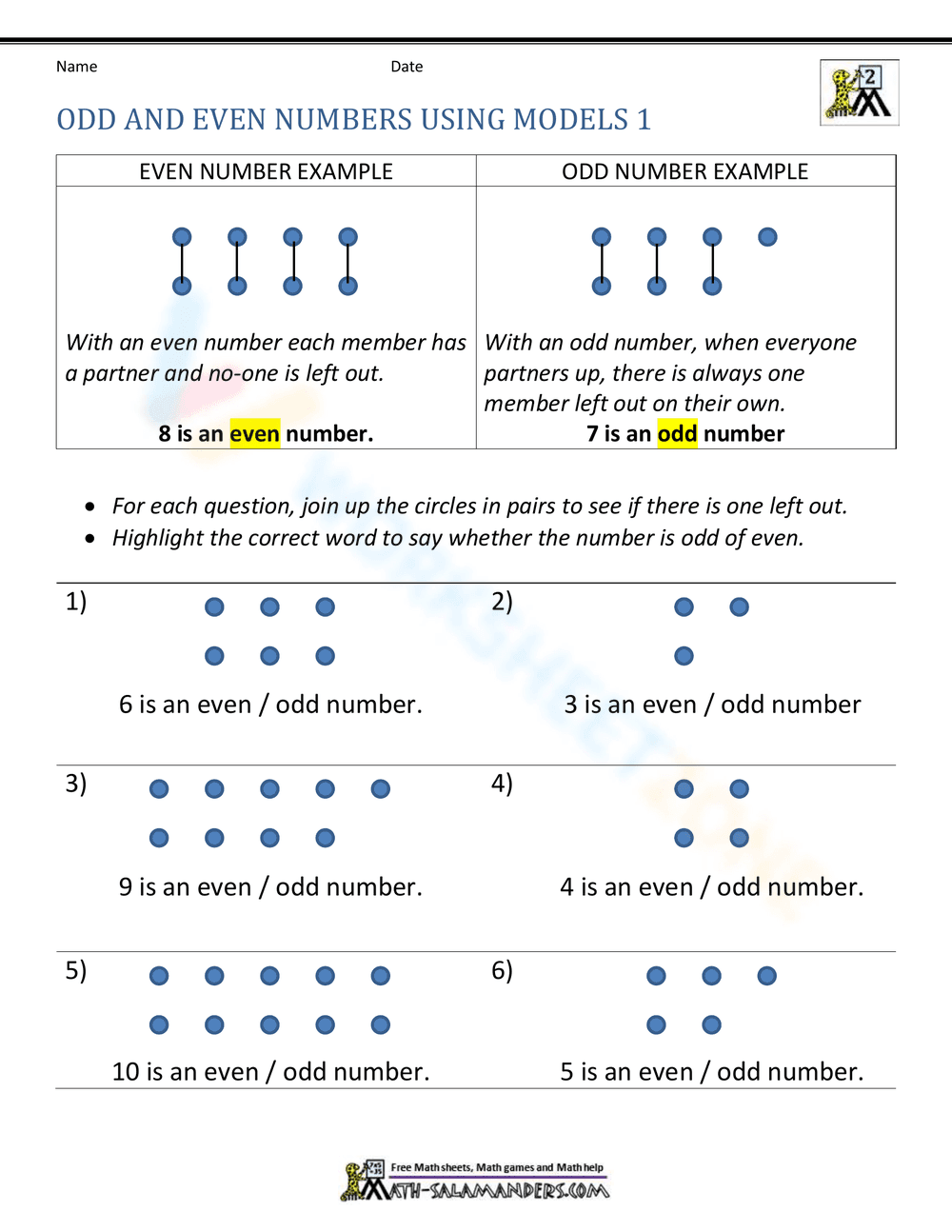
This is an educational worksheet titled 'Odd and Even Numbers Using Models 1'. It uses visual models of circles to represent numbers. The worksheet provides examples of even and odd numbers, showing how even numbers can be paired up with no leftovers, while odd numbers always have one left over. Students are instructed to pair up the circles in each problem and highlight whether the given number is even or odd. The worksheet includes six problems with numbers ranging from 3 to 10.
Grade Level Suitability:
This worksheet is suitable for 1st and 2nd grade. The visual representation of numbers using circles makes it easy for young learners to understand the concept of odd and even numbers. The instructions are simple and the numbers used are small, making it appropriate for early elementary students.
Why Use It:
This worksheet helps students visually understand the concept of odd and even numbers. It reinforces the idea that even numbers can be divided into pairs with no remainder, while odd numbers always have one left over. It provides a hands-on approach to learning math concepts and encourages critical thinking.
How to Use It:
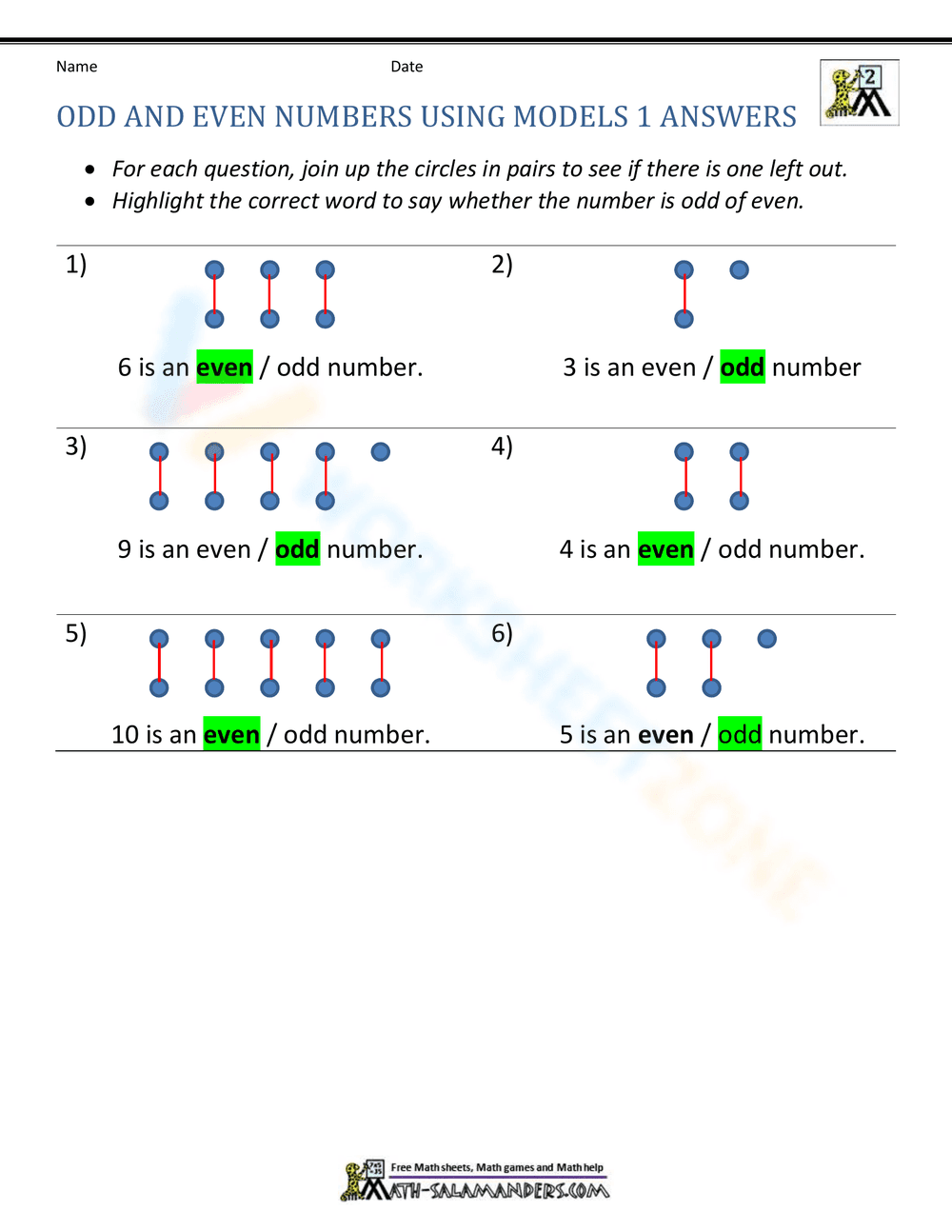
Students should first review the examples of even and odd numbers provided at the top of the worksheet. Then, for each problem, they should draw lines connecting the circles in pairs. If there is a circle left over, the number is odd; otherwise, it's even. Finally, they should highlight the correct word (even or odd) to indicate whether the number is odd or even.
Target Users:
The target users for this worksheet are elementary school students, specifically those in 1st and 2nd grade, who are learning about odd and even numbers. It is also suitable for students who benefit from visual aids and hands-on activities. It can be used in the classroom or at home for extra practice.
This is an educational worksheet titled 'Odd and Even Numbers Using Models 1'. It uses visual models of circles to represent numbers. The worksheet provides examples of even and odd numbers, showing how even numbers can be paired up with no leftovers, while odd numbers always have one left over. Students are instructed to pair up the circles in each problem and highlight whether the given number is even or odd. The worksheet includes six problems with numbers ranging from 3 to 10.
Grade Level Suitability:
This worksheet is suitable for 1st and 2nd grade. The visual representation of numbers using circles makes it easy for young learners to understand the concept of odd and even numbers. The instructions are simple and the numbers used are small, making it appropriate for early elementary students.
Why Use It:
This worksheet helps students visually understand the concept of odd and even numbers. It reinforces the idea that even numbers can be divided into pairs with no remainder, while odd numbers always have one left over. It provides a hands-on approach to learning math concepts and encourages critical thinking.
How to Use It:
Students should first review the examples of even and odd numbers provided at the top of the worksheet. Then, for each problem, they should draw lines connecting the circles in pairs. If there is a circle left over, the number is odd; otherwise, it's even. Finally, they should highlight the correct word (even or odd) to indicate whether the number is odd or even.
Target Users:
The target users for this worksheet are elementary school students, specifically those in 1st and 2nd grade, who are learning about odd and even numbers. It is also suitable for students who benefit from visual aids and hands-on activities. It can be used in the classroom or at home for extra practice.


