


























1 / 2
0
Views
0
Downloads


0.0
0
0 Likes
Exploring Organic Molecules Worksheet
0 Views
0 Downloads
Paste this activity's link or code into your existing LMS (Google Classroom, Canvas, Teams, Schoology, Moodle, etc.).
Students can open and work on the activity right away, with no student login required.
You'll still be able to track student progress and results from your teacher account.
Information
Description
What It Is:
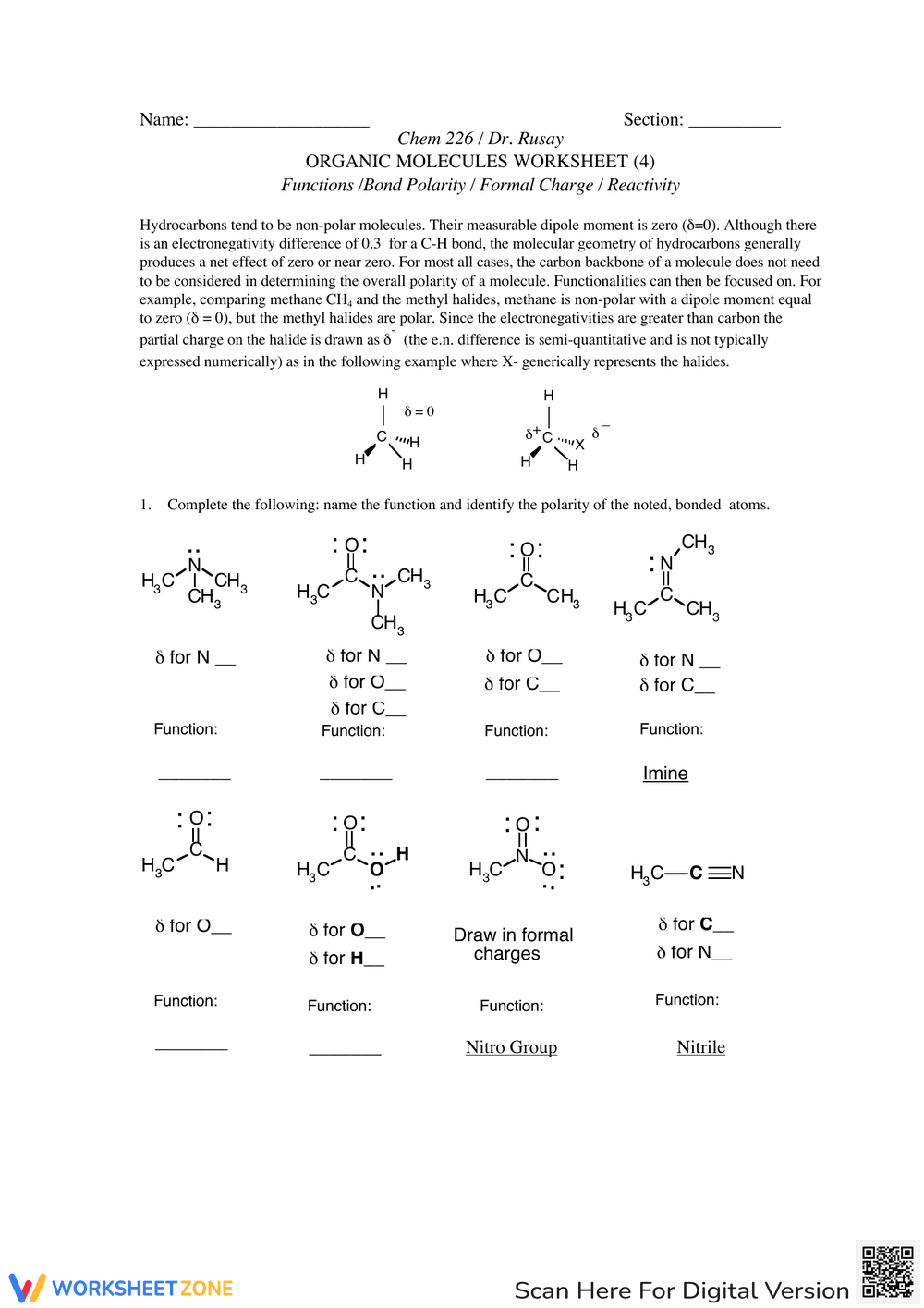
This is an organic chemistry worksheet focused on organic molecules. It requires students to complete tasks related to bond polarity, formal charge, and reactivity. Specifically, students are asked to identify the partial charge (δ) on indicated atoms within various organic molecules and name the functional group. Examples include molecules with nitrogen, oxygen, and carbon atoms, leading to identification of functional groups like imines, nitro groups, and nitriles.
Grade Level Suitability:
This worksheet is most suitable for college-level organic chemistry students (Grades 11-12 and above). The content requires a solid understanding of electronegativity, molecular structure, and functional group identification, concepts typically covered in introductory organic chemistry courses.
Why Use It:
This worksheet helps students practice identifying partial charges in molecules based on electronegativity differences, reinforcing their understanding of bond polarity. It also reinforces the ability to recognize and name common organic functional groups. These skills are crucial for understanding reaction mechanisms and predicting reactivity in organic chemistry.
How to Use It:
Students should first review the principles of electronegativity and how it relates to bond polarity. Then, for each molecule, they need to determine the partial charges on the indicated atoms based on the electronegativity differences between the atoms. Finally, they should identify and name the functional group present in each molecule. The section 'Draw in formal charges' requires students to calculate and draw formal charges on a nitro group.
Target Users:
The target users are students enrolled in organic chemistry courses at the high school or college level. It would be beneficial for students who need additional practice in identifying functional groups and understanding bond polarity concepts.
This is an organic chemistry worksheet focused on organic molecules. It requires students to complete tasks related to bond polarity, formal charge, and reactivity. Specifically, students are asked to identify the partial charge (δ) on indicated atoms within various organic molecules and name the functional group. Examples include molecules with nitrogen, oxygen, and carbon atoms, leading to identification of functional groups like imines, nitro groups, and nitriles.
Grade Level Suitability:
This worksheet is most suitable for college-level organic chemistry students (Grades 11-12 and above). The content requires a solid understanding of electronegativity, molecular structure, and functional group identification, concepts typically covered in introductory organic chemistry courses.
Why Use It:
This worksheet helps students practice identifying partial charges in molecules based on electronegativity differences, reinforcing their understanding of bond polarity. It also reinforces the ability to recognize and name common organic functional groups. These skills are crucial for understanding reaction mechanisms and predicting reactivity in organic chemistry.
How to Use It:
Students should first review the principles of electronegativity and how it relates to bond polarity. Then, for each molecule, they need to determine the partial charges on the indicated atoms based on the electronegativity differences between the atoms. Finally, they should identify and name the functional group present in each molecule. The section 'Draw in formal charges' requires students to calculate and draw formal charges on a nitro group.
Target Users:
The target users are students enrolled in organic chemistry courses at the high school or college level. It would be beneficial for students who need additional practice in identifying functional groups and understanding bond polarity concepts.


