


























1 / 2
0
Views
0
Downloads

0 Likes
Osmosis Practice Worksheet: Real-World Scenarios
0 Views
0 Downloads
Paste this activity's link or code into your existing LMS (Google Classroom, Canvas, Teams, Schoology, Moodle, etc.).
Students can open and work on the activity right away, with no student login required.
You'll still be able to track student progress and results from your teacher account.
Information
Description
What It Is:
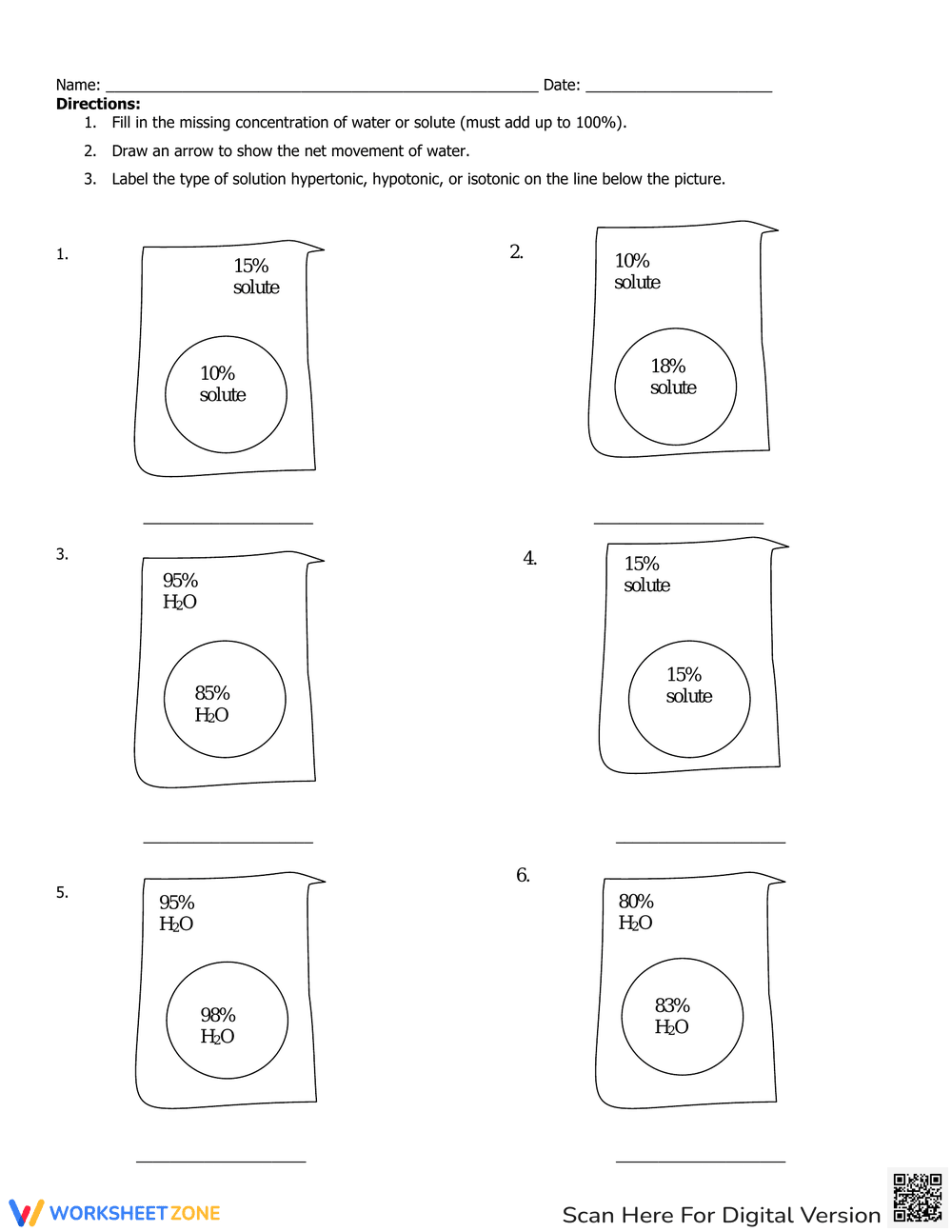
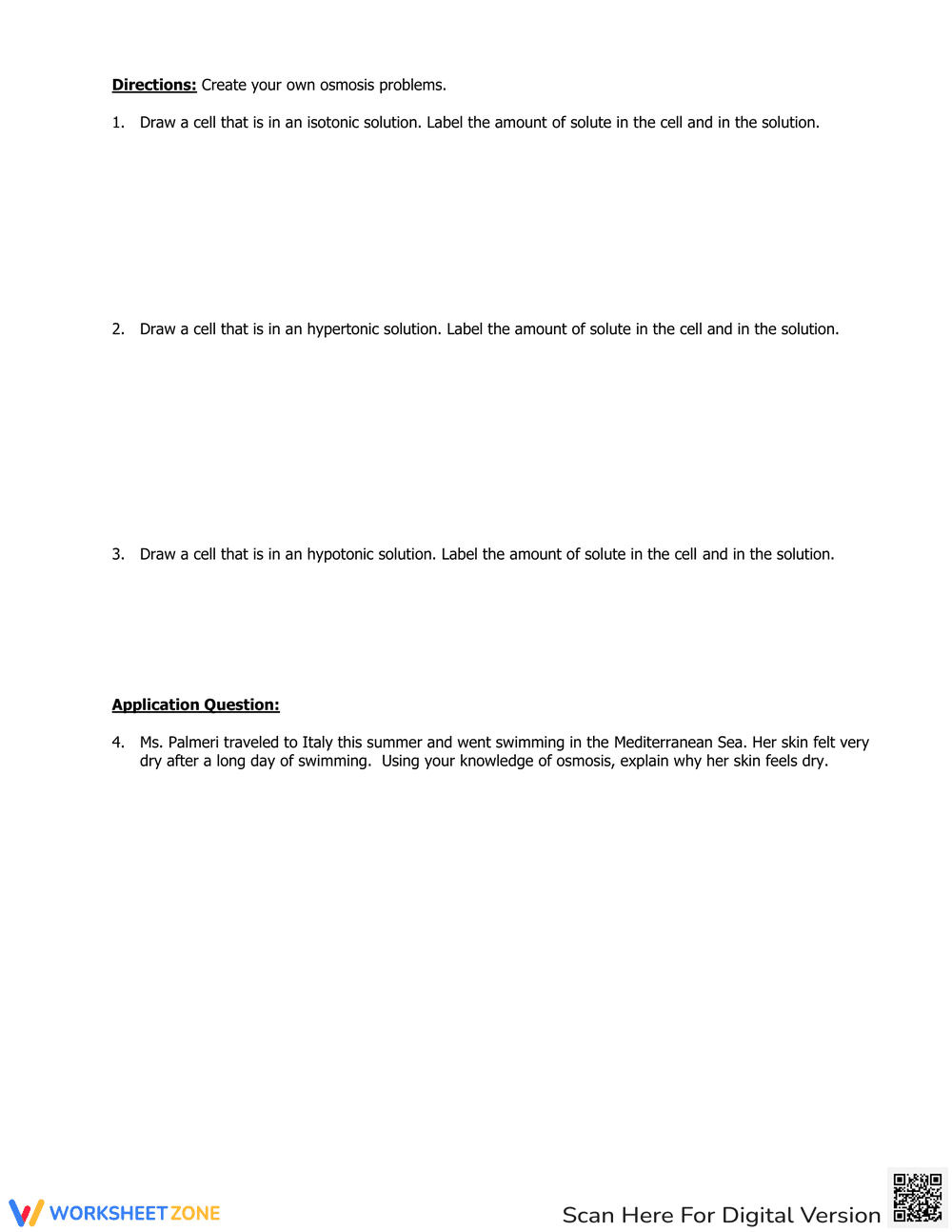
This is a science worksheet focusing on osmosis and solutions. Students are asked to fill in missing concentrations of solute or water to reach 100%, draw arrows indicating the net movement of water, and classify solutions as hypertonic, hypotonic, or isotonic based on the concentrations of solute inside and outside a cell represented by a circle within a beaker. The worksheet presents six different scenarios with varying concentrations.
Grade Level Suitability:
This worksheet is suitable for grades 9-12, specifically high school biology or introductory chemistry courses. The concepts of osmosis, concentration gradients, and tonicity require a foundational understanding of cell biology and chemistry principles, making it appropriate for older students.
Why Use It:
This worksheet reinforces understanding of osmosis and the movement of water across semi-permeable membranes. It helps students visualize concentration gradients and apply their knowledge to determine the tonicity of solutions. It promotes critical thinking and problem-solving skills by requiring students to calculate concentrations and predict water movement.
How to Use It:
Students should first read the directions carefully. For each of the six scenarios, they must calculate the missing concentration (either water or solute) ensuring the total equals 100%. Then, based on the relative concentrations inside and outside the cell (represented by the circle), they should draw an arrow indicating the net movement of water. Finally, they must label each solution as hypertonic, hypotonic, or isotonic on the line provided below each beaker.
Target Users:
The target users are high school students studying biology or chemistry, particularly those learning about cell transport, osmosis, and solutions. It's also useful for teachers looking for a concise and practical activity to assess student understanding of these concepts.
This is a science worksheet focusing on osmosis and solutions. Students are asked to fill in missing concentrations of solute or water to reach 100%, draw arrows indicating the net movement of water, and classify solutions as hypertonic, hypotonic, or isotonic based on the concentrations of solute inside and outside a cell represented by a circle within a beaker. The worksheet presents six different scenarios with varying concentrations.
Grade Level Suitability:
This worksheet is suitable for grades 9-12, specifically high school biology or introductory chemistry courses. The concepts of osmosis, concentration gradients, and tonicity require a foundational understanding of cell biology and chemistry principles, making it appropriate for older students.
Why Use It:
This worksheet reinforces understanding of osmosis and the movement of water across semi-permeable membranes. It helps students visualize concentration gradients and apply their knowledge to determine the tonicity of solutions. It promotes critical thinking and problem-solving skills by requiring students to calculate concentrations and predict water movement.
How to Use It:
Students should first read the directions carefully. For each of the six scenarios, they must calculate the missing concentration (either water or solute) ensuring the total equals 100%. Then, based on the relative concentrations inside and outside the cell (represented by the circle), they should draw an arrow indicating the net movement of water. Finally, they must label each solution as hypertonic, hypotonic, or isotonic on the line provided below each beaker.
Target Users:
The target users are high school students studying biology or chemistry, particularly those learning about cell transport, osmosis, and solutions. It's also useful for teachers looking for a concise and practical activity to assess student understanding of these concepts.


