


























1 / 2
0
Views
0
Downloads


0 Likes
Learn About Passive Transport
0 Views
0 Downloads
Paste this activity's link or code into your existing LMS (Google Classroom, Canvas, Teams, Schoology, Moodle, etc.).
Students can open and work on the activity right away, with no student login required.
You'll still be able to track student progress and results from your teacher account.
Information
Description
What It Is:
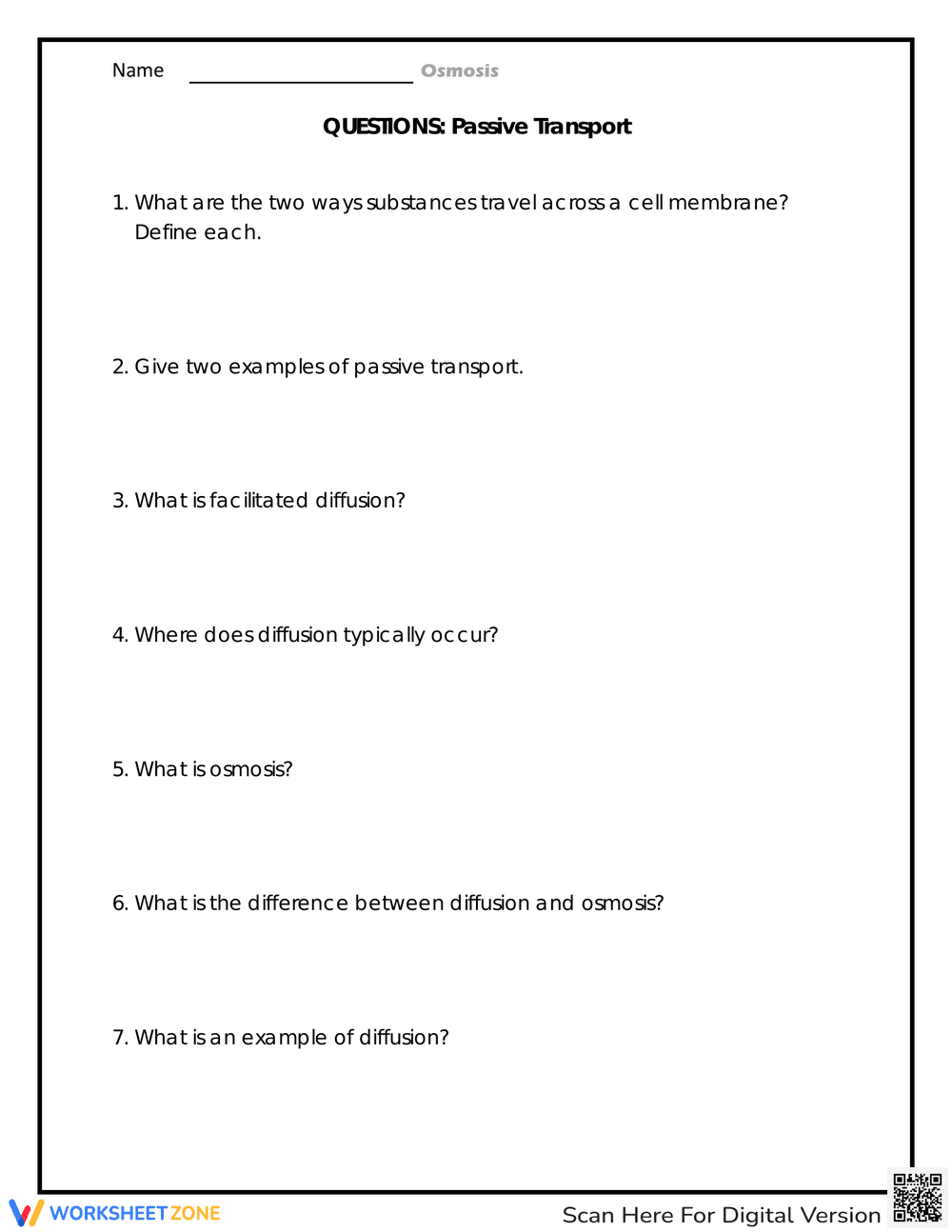
This is an educational worksheet focusing on passive transport, specifically diffusion and osmosis. It contains explanatory text about cell membranes, active and passive transport, diffusion examples (perfume spreading), facilitated diffusion, and osmosis examples (water moving into root hair cells). It includes a diagram at the top right, likely illustrating transport processes.
Grade Level Suitability:
Suitable for grades 7-9. The vocabulary and concepts related to cell biology and molecular movement are appropriate for middle school life science classes. The explanations are detailed enough for these grades.
Why Use It:
This worksheet helps students understand the concepts of passive transport, diffusion, facilitated diffusion, and osmosis. It provides real-world examples to illustrate these processes, making them easier to grasp. It reinforces the understanding of how molecules move across cell membranes.
How to Use It:
Students can read the provided text to learn about passive transport, diffusion, and osmosis. The worksheet can be used as a reading comprehension activity, followed by a class discussion. Students can also use it as a study guide. The name and osmosis fields at the top allow for student identification and potential grading.
Target Users:
This worksheet is ideal for middle school students studying cell biology, life science teachers looking for supplementary materials, and homeschool educators teaching biology concepts.
This is an educational worksheet focusing on passive transport, specifically diffusion and osmosis. It contains explanatory text about cell membranes, active and passive transport, diffusion examples (perfume spreading), facilitated diffusion, and osmosis examples (water moving into root hair cells). It includes a diagram at the top right, likely illustrating transport processes.
Grade Level Suitability:
Suitable for grades 7-9. The vocabulary and concepts related to cell biology and molecular movement are appropriate for middle school life science classes. The explanations are detailed enough for these grades.
Why Use It:
This worksheet helps students understand the concepts of passive transport, diffusion, facilitated diffusion, and osmosis. It provides real-world examples to illustrate these processes, making them easier to grasp. It reinforces the understanding of how molecules move across cell membranes.
How to Use It:
Students can read the provided text to learn about passive transport, diffusion, and osmosis. The worksheet can be used as a reading comprehension activity, followed by a class discussion. Students can also use it as a study guide. The name and osmosis fields at the top allow for student identification and potential grading.
Target Users:
This worksheet is ideal for middle school students studying cell biology, life science teachers looking for supplementary materials, and homeschool educators teaching biology concepts.


