


























1 / 3
0
Views
0
Downloads


0.0
0
0 Likes
Practice Perimeter of Rectangles Worksheet
0 Views
0 Downloads
Paste this activity's link or code into your existing LMS (Google Classroom, Canvas, Teams, Schoology, Moodle, etc.).
Students can open and work on the activity right away, with no student login required.
You'll still be able to track student progress and results from your teacher account.
Information
Description
What It Is:
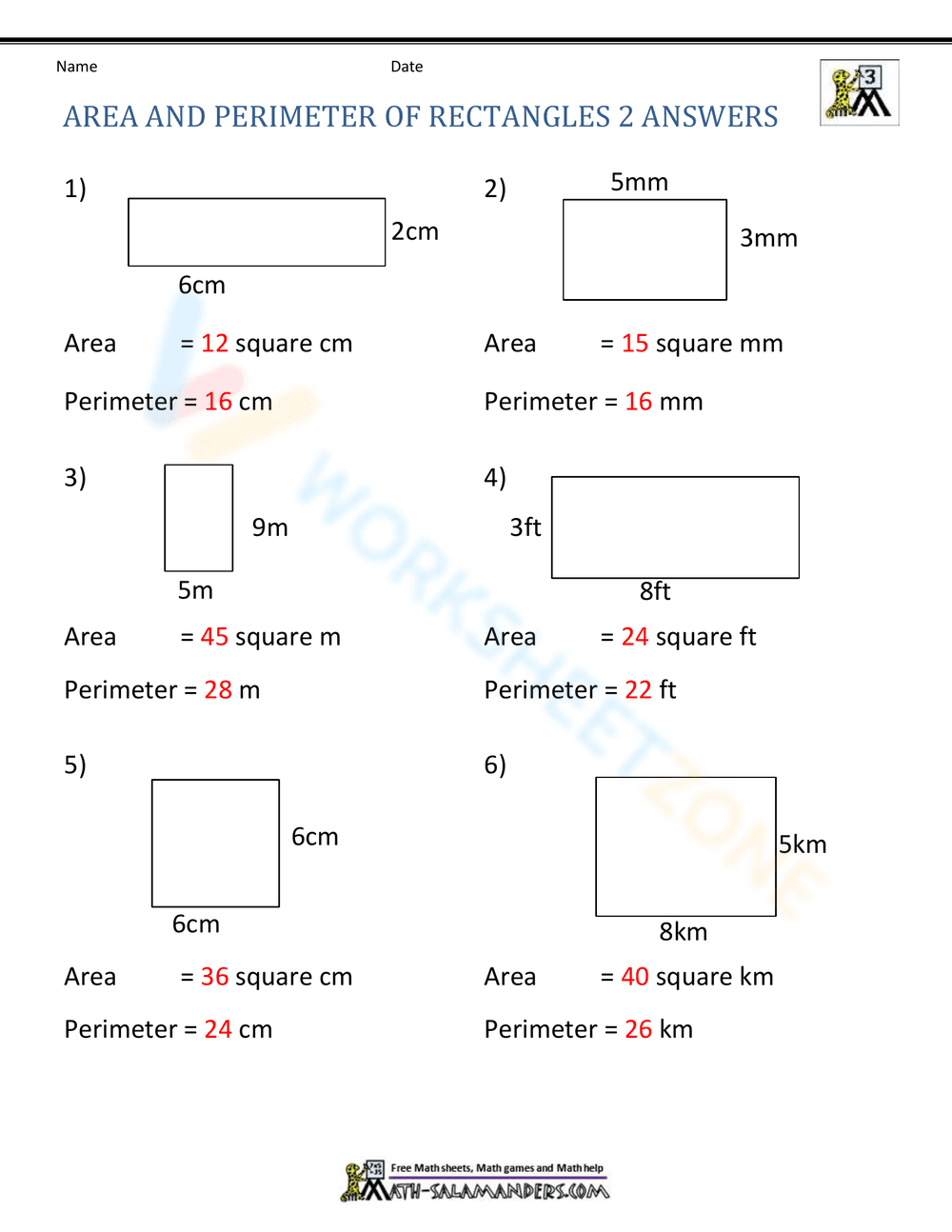
This is a math worksheet titled 'Area and Perimeter of Rectangles 2.' It presents six different rectangles with labeled side lengths (in cm, mm, m, ft, and km) and asks the student to calculate and fill in the area and perimeter of each rectangle. The rectangles are not drawn to scale.
Grade Level Suitability:
This worksheet is suitable for 3rd to 5th grade students. It requires understanding of basic multiplication and addition, as well as the concepts of area and perimeter. The use of different units (cm, mm, m, ft, km) adds a layer of complexity appropriate for upper elementary grades.
Why Use It:
This worksheet reinforces the concepts of area and perimeter of rectangles. It helps students practice applying formulas to calculate area and perimeter, and it provides practice in working with different units of measurement. It also encourages attention to detail and accurate calculations.
How to Use It:
Students should first identify the length and width of each rectangle. Then, they should calculate the area by multiplying the length and width, and calculate the perimeter by adding up the lengths of all four sides. Finally, they should write their answers in the provided blanks, including the correct units (square cm, cm, etc.).
Target Users:
This worksheet is ideal for elementary school students learning about area and perimeter. It is also suitable for students who need extra practice with these concepts or for review purposes. Teachers can use it as part of a lesson, as homework, or as a quick assessment.
This is a math worksheet titled 'Area and Perimeter of Rectangles 2.' It presents six different rectangles with labeled side lengths (in cm, mm, m, ft, and km) and asks the student to calculate and fill in the area and perimeter of each rectangle. The rectangles are not drawn to scale.
Grade Level Suitability:
This worksheet is suitable for 3rd to 5th grade students. It requires understanding of basic multiplication and addition, as well as the concepts of area and perimeter. The use of different units (cm, mm, m, ft, km) adds a layer of complexity appropriate for upper elementary grades.
Why Use It:
This worksheet reinforces the concepts of area and perimeter of rectangles. It helps students practice applying formulas to calculate area and perimeter, and it provides practice in working with different units of measurement. It also encourages attention to detail and accurate calculations.
How to Use It:
Students should first identify the length and width of each rectangle. Then, they should calculate the area by multiplying the length and width, and calculate the perimeter by adding up the lengths of all four sides. Finally, they should write their answers in the provided blanks, including the correct units (square cm, cm, etc.).
Target Users:
This worksheet is ideal for elementary school students learning about area and perimeter. It is also suitable for students who need extra practice with these concepts or for review purposes. Teachers can use it as part of a lesson, as homework, or as a quick assessment.


