


























0
Views
0
Downloads

0.0
0
0 Likes
Periodic Trends Worksheet
0 Views
0 Downloads
Paste this activity's link or code into your existing LMS (Google Classroom, Canvas, Teams, Schoology, Moodle, etc.).
Students can open and work on the activity right away, with no student login required.
You'll still be able to track student progress and results from your teacher account.
Information
Description
What It Is:
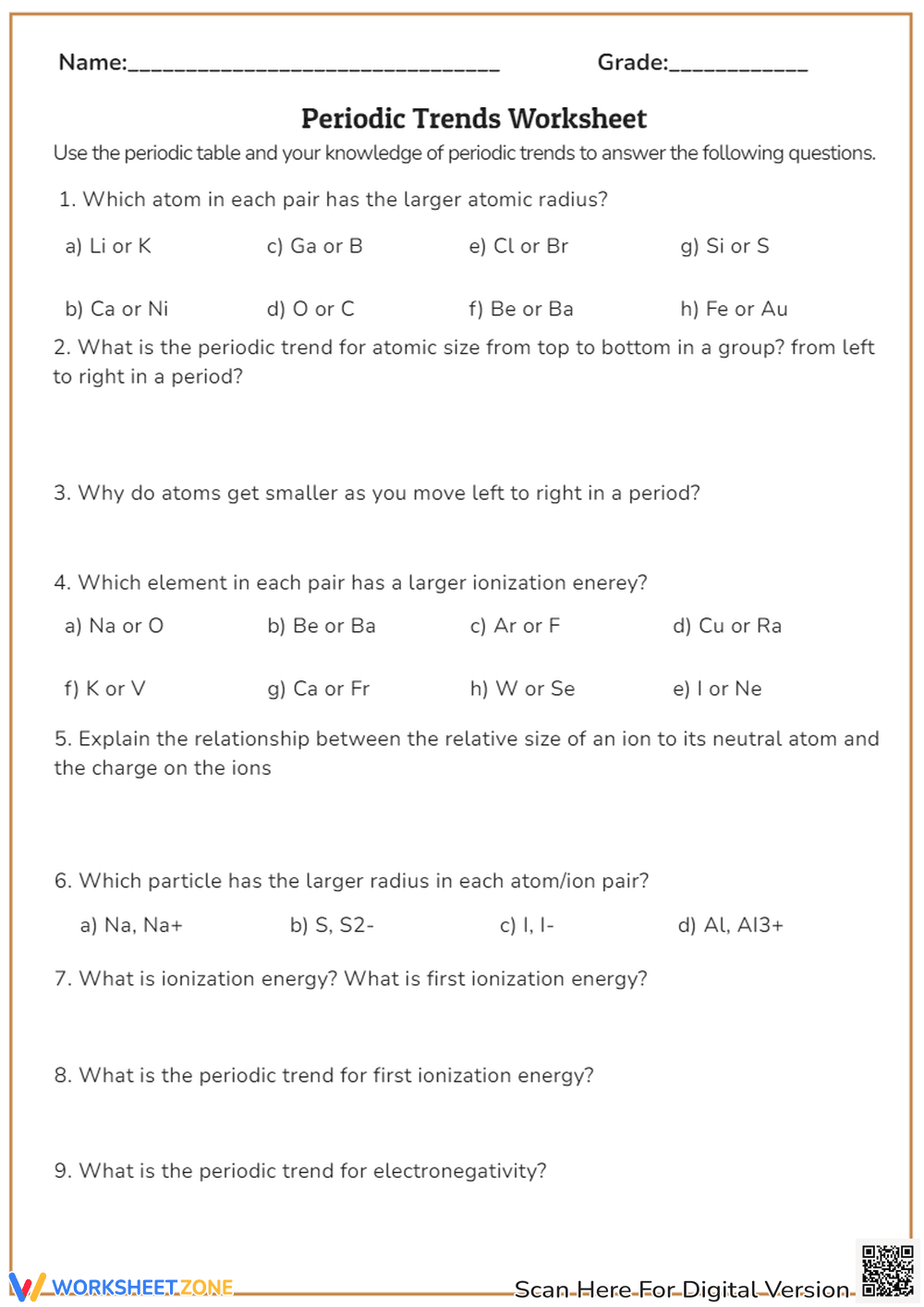
This is a 'Periodic Trends Worksheet' designed to test students' knowledge of periodic trends. The worksheet includes questions about atomic radius, ionization energy, and electronegativity. Students are asked to compare elements and ions, explain trends, and define terms related to the periodic table. Specific questions include comparing atomic radii of element pairs, explaining periodic trends for atomic size and ionization energy, and defining ionization energy.
Grade Level Suitability:
This worksheet is suitable for high school students, specifically grades 9-12, particularly those studying chemistry. The concepts covered require a solid understanding of atomic structure and the periodic table, making it appropriate for a high school chemistry curriculum.
Why Use It:
This worksheet helps students reinforce their understanding of periodic trends, including atomic radius, ionization energy, and electronegativity. It encourages critical thinking by requiring students to compare elements and explain the underlying principles behind the observed trends. It also helps students develop their problem-solving skills in the context of chemistry.
How to Use It:
Students should use their knowledge of the periodic table and periodic trends to answer the questions. They may need to consult a periodic table and their textbook or notes. For questions involving comparisons, students should identify the relevant trend and use it to determine which element or ion has the larger radius or ionization energy. For explanation questions, students should provide a clear and concise explanation of the underlying principles.
Target Users:
The target users are high school chemistry students who are learning about periodic trends. It is also suitable for teachers looking for a worksheet to assess their students' understanding of these concepts. Homeschooling parents teaching chemistry could also find this useful.
This is a 'Periodic Trends Worksheet' designed to test students' knowledge of periodic trends. The worksheet includes questions about atomic radius, ionization energy, and electronegativity. Students are asked to compare elements and ions, explain trends, and define terms related to the periodic table. Specific questions include comparing atomic radii of element pairs, explaining periodic trends for atomic size and ionization energy, and defining ionization energy.
Grade Level Suitability:
This worksheet is suitable for high school students, specifically grades 9-12, particularly those studying chemistry. The concepts covered require a solid understanding of atomic structure and the periodic table, making it appropriate for a high school chemistry curriculum.
Why Use It:
This worksheet helps students reinforce their understanding of periodic trends, including atomic radius, ionization energy, and electronegativity. It encourages critical thinking by requiring students to compare elements and explain the underlying principles behind the observed trends. It also helps students develop their problem-solving skills in the context of chemistry.
How to Use It:
Students should use their knowledge of the periodic table and periodic trends to answer the questions. They may need to consult a periodic table and their textbook or notes. For questions involving comparisons, students should identify the relevant trend and use it to determine which element or ion has the larger radius or ionization energy. For explanation questions, students should provide a clear and concise explanation of the underlying principles.
Target Users:
The target users are high school chemistry students who are learning about periodic trends. It is also suitable for teachers looking for a worksheet to assess their students' understanding of these concepts. Homeschooling parents teaching chemistry could also find this useful.


