


























1 / 2
0
Views
0
Downloads

0.0
0
0 Likes
Phonics: CH and TCH Consonant Clusters
0 Views
0 Downloads
Paste this activity's link or code into your existing LMS (Google Classroom, Canvas, Teams, Schoology, Moodle, etc.).
Students can open and work on the activity right away, with no student login required.
You'll still be able to track student progress and results from your teacher account.
Information
Description
What It Is:
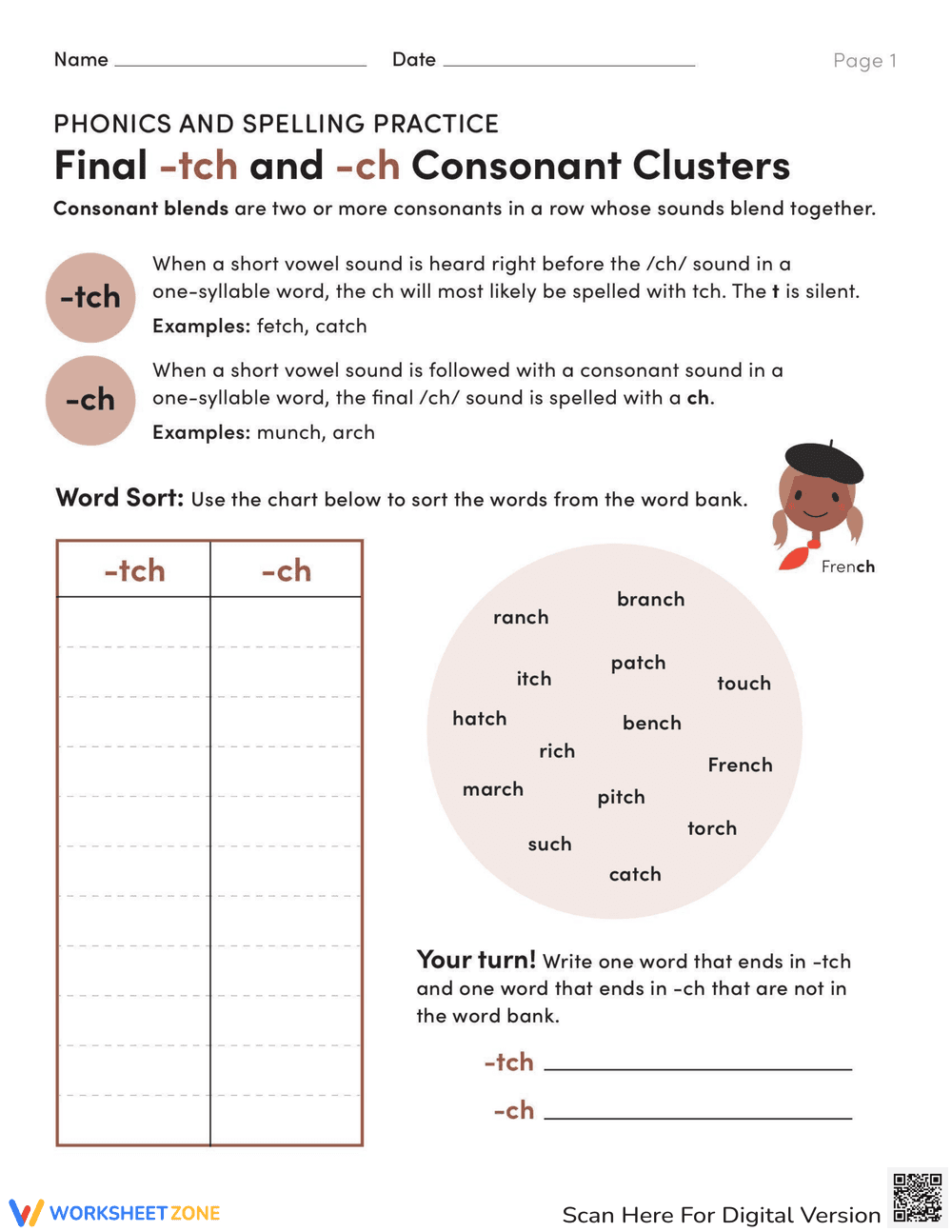
This is a phonics and spelling practice worksheet focusing on final consonant clusters -tch and -ch. It explains the rules for when to use each cluster, providing examples like 'fetch, catch' for -tch and 'munch, arch' for -ch. The worksheet includes a word sort activity where students categorize words like 'ranch,' 'patch,' 'itch,' 'hatch,' 'rich,' 'march,' 'such,' 'catch,' 'branch,' 'touch,' 'bench,' 'French,' 'pitch,' and 'torch' into columns labeled -tch and -ch. Finally, there's a section where students write their own examples of words ending in -tch and -ch.
Grade Level Suitability:
This worksheet is suitable for 1st to 3rd grade students. It reinforces phonics rules and spelling patterns related to consonant clusters, which are typically taught within these grade levels. The word sort activity and writing prompts are appropriate for this age group.
Why Use It:
This worksheet helps students understand and apply the rules for using -tch and -ch consonant clusters at the end of words. It improves phonemic awareness, spelling skills, and vocabulary. The activities promote active learning and reinforce the concepts through practice.
How to Use It:
First, review the explanations and examples of -tch and -ch. Next, have students sort the words from the word bank into the correct columns (-tch or -ch). Finally, ask them to write their own words ending in -tch and -ch, ensuring they are not from the provided word bank.
Target Users:
This worksheet is designed for elementary school students in grades 1-3 who are learning about phonics, spelling, and consonant clusters. It's also beneficial for students who need extra practice with these concepts or for ESL students learning English pronunciation and spelling.
This is a phonics and spelling practice worksheet focusing on final consonant clusters -tch and -ch. It explains the rules for when to use each cluster, providing examples like 'fetch, catch' for -tch and 'munch, arch' for -ch. The worksheet includes a word sort activity where students categorize words like 'ranch,' 'patch,' 'itch,' 'hatch,' 'rich,' 'march,' 'such,' 'catch,' 'branch,' 'touch,' 'bench,' 'French,' 'pitch,' and 'torch' into columns labeled -tch and -ch. Finally, there's a section where students write their own examples of words ending in -tch and -ch.
Grade Level Suitability:
This worksheet is suitable for 1st to 3rd grade students. It reinforces phonics rules and spelling patterns related to consonant clusters, which are typically taught within these grade levels. The word sort activity and writing prompts are appropriate for this age group.
Why Use It:
This worksheet helps students understand and apply the rules for using -tch and -ch consonant clusters at the end of words. It improves phonemic awareness, spelling skills, and vocabulary. The activities promote active learning and reinforce the concepts through practice.
How to Use It:
First, review the explanations and examples of -tch and -ch. Next, have students sort the words from the word bank into the correct columns (-tch or -ch). Finally, ask them to write their own words ending in -tch and -ch, ensuring they are not from the provided word bank.
Target Users:
This worksheet is designed for elementary school students in grades 1-3 who are learning about phonics, spelling, and consonant clusters. It's also beneficial for students who need extra practice with these concepts or for ESL students learning English pronunciation and spelling.


