


























0
Views
0
Downloads

0.0
0
0 Likes
Understanding Plot Diagrams
0 Views
0 Downloads
Paste this activity's link or code into your existing LMS (Google Classroom, Canvas, Teams, Schoology, Moodle, etc.).
Students can open and work on the activity right away, with no student login required.
You'll still be able to track student progress and results from your teacher account.
Information
Description
What It Is:
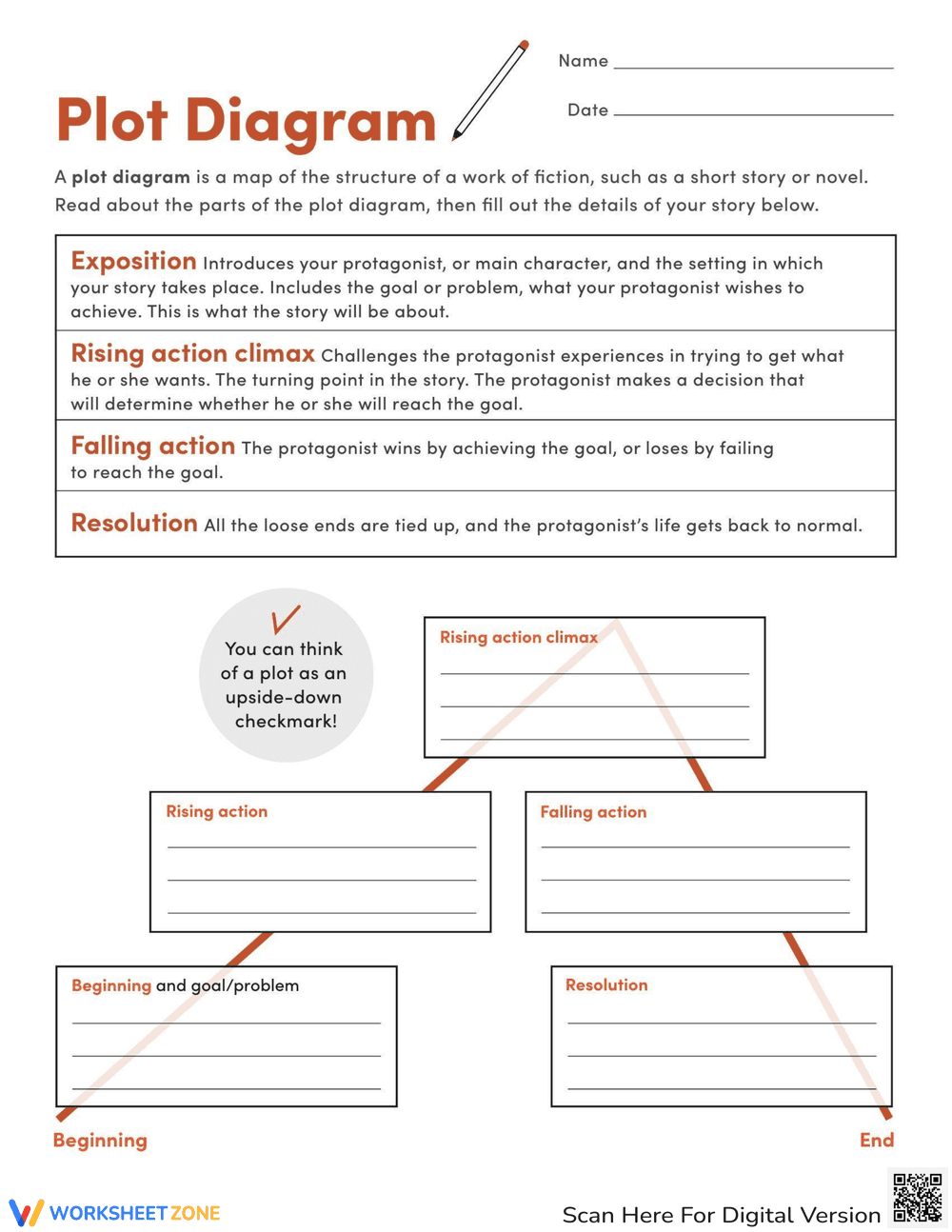
This is a 'Plot Diagram' worksheet designed to help students understand the structure of a story. It includes definitions of key plot elements: Exposition, Rising Action, Rising Action Climax, Falling Action, and Resolution. Below the definitions is a diagram shaped like an upside-down checkmark, with labeled boxes for students to fill in the details of their own story, corresponding to each plot element. The diagram starts with 'Beginning and goal/problem' and ends with 'End'.
Grade Level Suitability:
This worksheet is suitable for grades 4-7. The definitions are simple enough for upper elementary students to understand, while the concept of plot structure is relevant for middle school students learning about narrative writing.
Why Use It:
Using this worksheet helps students visually organize and understand the key components of a story's plot. It promotes critical thinking and analytical skills as students identify and summarize the exposition, rising action, climax, falling action, and resolution in a narrative. It also aids in creative writing by providing a framework for developing a coherent and engaging plot.
How to Use It:
First, read the definitions of each plot element. Then, choose a story, either one that you've read or one you're creating. For each box in the diagram, write a brief summary of that plot element as it appears in the story. Start with the 'Beginning and goal/problem' and work your way through the 'Rising action climax,' 'Falling action,' and finally, the 'Resolution' at the 'End.'
Target Users:
This worksheet is designed for elementary and middle school students learning about story structure. It is also helpful for teachers looking for a visual aid to teach plot development and for students who need assistance in organizing their thoughts when writing stories.
This is a 'Plot Diagram' worksheet designed to help students understand the structure of a story. It includes definitions of key plot elements: Exposition, Rising Action, Rising Action Climax, Falling Action, and Resolution. Below the definitions is a diagram shaped like an upside-down checkmark, with labeled boxes for students to fill in the details of their own story, corresponding to each plot element. The diagram starts with 'Beginning and goal/problem' and ends with 'End'.
Grade Level Suitability:
This worksheet is suitable for grades 4-7. The definitions are simple enough for upper elementary students to understand, while the concept of plot structure is relevant for middle school students learning about narrative writing.
Why Use It:
Using this worksheet helps students visually organize and understand the key components of a story's plot. It promotes critical thinking and analytical skills as students identify and summarize the exposition, rising action, climax, falling action, and resolution in a narrative. It also aids in creative writing by providing a framework for developing a coherent and engaging plot.
How to Use It:
First, read the definitions of each plot element. Then, choose a story, either one that you've read or one you're creating. For each box in the diagram, write a brief summary of that plot element as it appears in the story. Start with the 'Beginning and goal/problem' and work your way through the 'Rising action climax,' 'Falling action,' and finally, the 'Resolution' at the 'End.'
Target Users:
This worksheet is designed for elementary and middle school students learning about story structure. It is also helpful for teachers looking for a visual aid to teach plot development and for students who need assistance in organizing their thoughts when writing stories.


