


























0
Views
0
Downloads

0.0
0
0 Likes
Practice Counting Money: Financial Literacy Worksheet
0 Views
0 Downloads
Paste this activity's link or code into your existing LMS (Google Classroom, Canvas, Teams, Schoology, Moodle, etc.).
Students can open and work on the activity right away, with no student login required.
You'll still be able to track student progress and results from your teacher account.
Information
Description
What It Is:
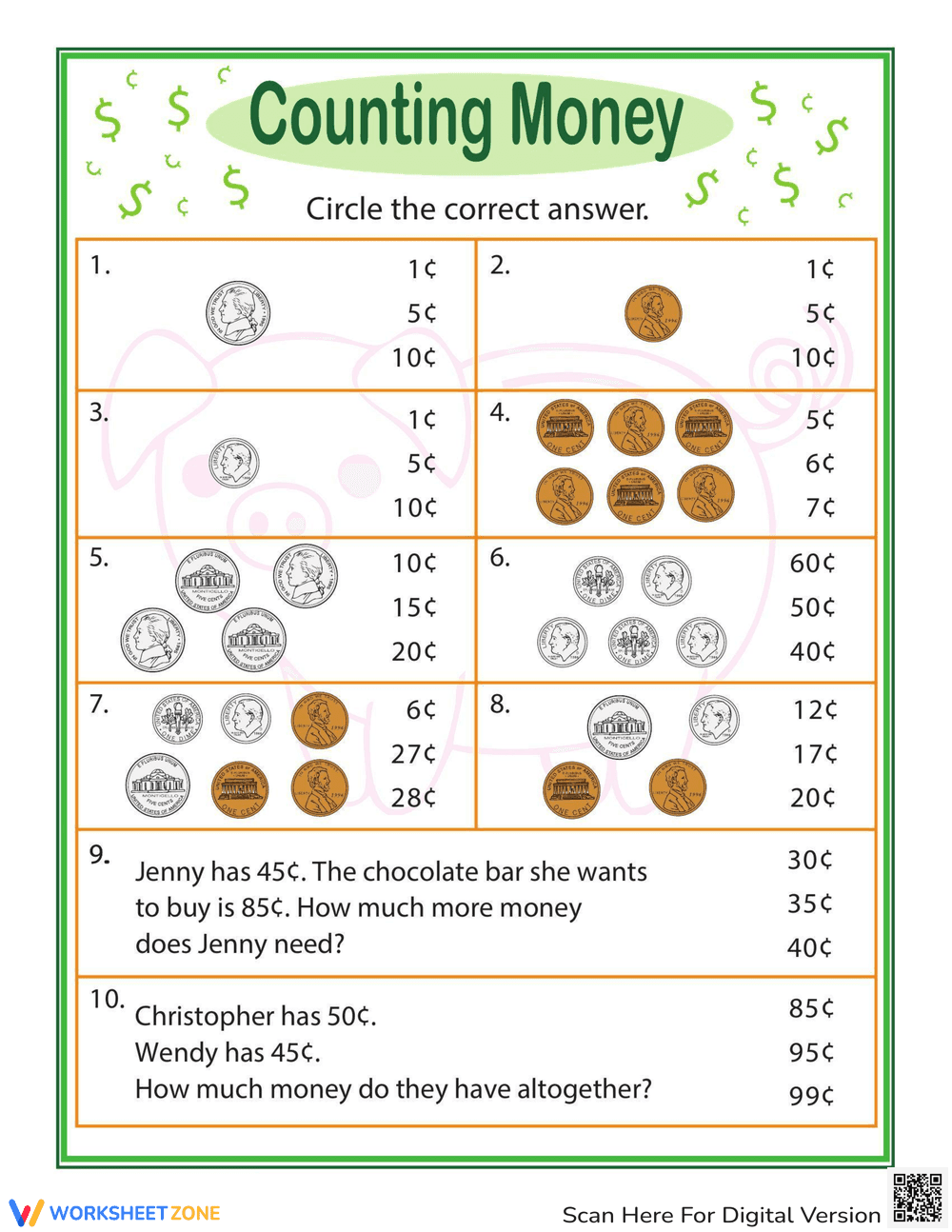
This is a math worksheet focused on counting money. It includes problems where students must identify the total value of groups of coins (pennies, nickels, and dimes). Some problems also require students to calculate the difference between two amounts to determine how much more money is needed, or the sum of two amounts to determine the total money available. Students circle the correct answer from a list of three choices.
Grade Level Suitability:
This worksheet is most suitable for 1st and 2nd grade students. The problems involve simple addition and subtraction related to money, making it appropriate for students learning to count and calculate with coins.
Why Use It:
This worksheet helps students develop essential money-counting skills, improves their addition and subtraction abilities, and provides practice in solving word problems related to money. It reinforces the values of different coins and how to combine them to reach a specific amount.
How to Use It:
Students should first identify the value of each coin in the group, then add the values together to find the total amount. For word problems, students need to read the problem carefully, identify the relevant information, and perform the correct operation (addition or subtraction) to solve for the unknown. Finally, circle the correct answer from the provided options.
Target Users:
This worksheet is ideal for elementary school students in grades 1-2, especially those who are learning to count money, add and subtract small amounts, and solve basic word problems. It can be used by teachers in the classroom, parents for homeschooling, or tutors for supplemental instruction.
This is a math worksheet focused on counting money. It includes problems where students must identify the total value of groups of coins (pennies, nickels, and dimes). Some problems also require students to calculate the difference between two amounts to determine how much more money is needed, or the sum of two amounts to determine the total money available. Students circle the correct answer from a list of three choices.
Grade Level Suitability:
This worksheet is most suitable for 1st and 2nd grade students. The problems involve simple addition and subtraction related to money, making it appropriate for students learning to count and calculate with coins.
Why Use It:
This worksheet helps students develop essential money-counting skills, improves their addition and subtraction abilities, and provides practice in solving word problems related to money. It reinforces the values of different coins and how to combine them to reach a specific amount.
How to Use It:
Students should first identify the value of each coin in the group, then add the values together to find the total amount. For word problems, students need to read the problem carefully, identify the relevant information, and perform the correct operation (addition or subtraction) to solve for the unknown. Finally, circle the correct answer from the provided options.
Target Users:
This worksheet is ideal for elementary school students in grades 1-2, especially those who are learning to count money, add and subtract small amounts, and solve basic word problems. It can be used by teachers in the classroom, parents for homeschooling, or tutors for supplemental instruction.


