


























0
Views
0
Downloads

0.0
0
0 Likes
Predicting Emotions in Others
0 Views
0 Downloads
Paste this activity's link or code into your existing LMS (Google Classroom, Canvas, Teams, Schoology, Moodle, etc.).
Students can open and work on the activity right away, with no student login required.
You'll still be able to track student progress and results from your teacher account.
Information
Description
What It Is:
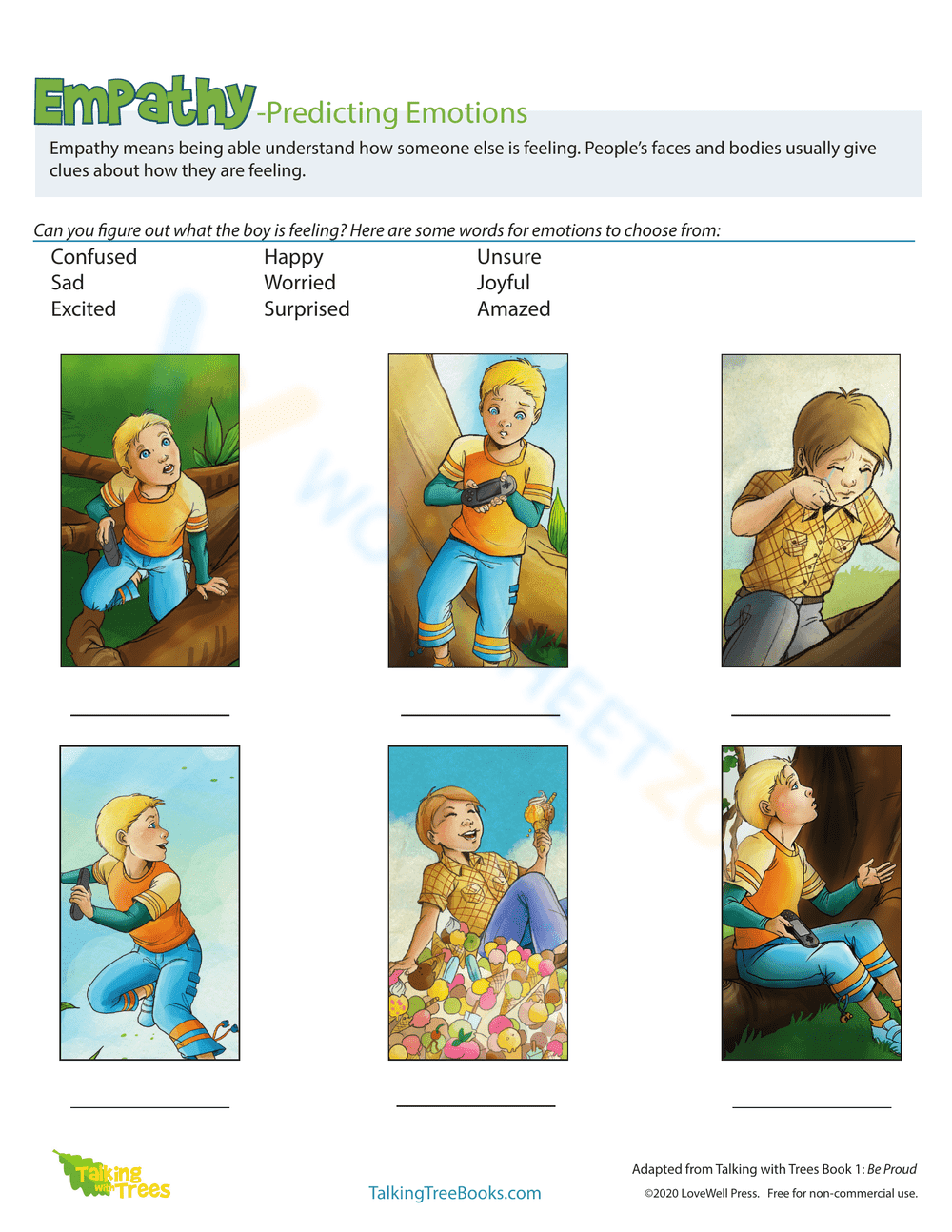
This is an empathy-building worksheet focused on predicting emotions. It presents six different cartoon illustrations of a boy in various situations and with different facial expressions and body language. Below each picture, there is a blank line. At the top of the worksheet, there is a list of emotions (Confused, Sad, Excited, Happy, Worried, Surprised, Unsure, Joyful, Amazed) for students to choose from to label the emotion displayed in each image.
Grade Level Suitability:
This worksheet is suitable for grades 1-3. The illustrations are simple and clear, and the list of emotions is age-appropriate. The activity requires basic reading comprehension and the ability to recognize and name common emotions.
Why Use It:
This worksheet helps children develop empathy by encouraging them to observe and interpret facial expressions and body language to understand how someone else might be feeling. It reinforces emotional vocabulary and promotes social-emotional learning.
How to Use It:
Students should look at each picture and analyze the boy's facial expression and body language. Then, they should choose the emotion from the provided list that best matches what they observe and write it on the blank line below the picture.
Target Users:
This worksheet is ideal for elementary school students, particularly those in grades 1-3, and children who are working on developing their social-emotional skills and empathy. It can also be used in special education settings to help students with emotional recognition.
This is an empathy-building worksheet focused on predicting emotions. It presents six different cartoon illustrations of a boy in various situations and with different facial expressions and body language. Below each picture, there is a blank line. At the top of the worksheet, there is a list of emotions (Confused, Sad, Excited, Happy, Worried, Surprised, Unsure, Joyful, Amazed) for students to choose from to label the emotion displayed in each image.
Grade Level Suitability:
This worksheet is suitable for grades 1-3. The illustrations are simple and clear, and the list of emotions is age-appropriate. The activity requires basic reading comprehension and the ability to recognize and name common emotions.
Why Use It:
This worksheet helps children develop empathy by encouraging them to observe and interpret facial expressions and body language to understand how someone else might be feeling. It reinforces emotional vocabulary and promotes social-emotional learning.
How to Use It:
Students should look at each picture and analyze the boy's facial expression and body language. Then, they should choose the emotion from the provided list that best matches what they observe and write it on the blank line below the picture.
Target Users:
This worksheet is ideal for elementary school students, particularly those in grades 1-3, and children who are working on developing their social-emotional skills and empathy. It can also be used in special education settings to help students with emotional recognition.


