


























1 / 2
0
Views
0
Downloads

0.0
0
0 Likes
Predicting Chemical Reactions Products Worksheet
0 Views
0 Downloads
Paste this activity's link or code into your existing LMS (Google Classroom, Canvas, Teams, Schoology, Moodle, etc.).
Students can open and work on the activity right away, with no student login required.
You'll still be able to track student progress and results from your teacher account.
Information
Description
What It Is:
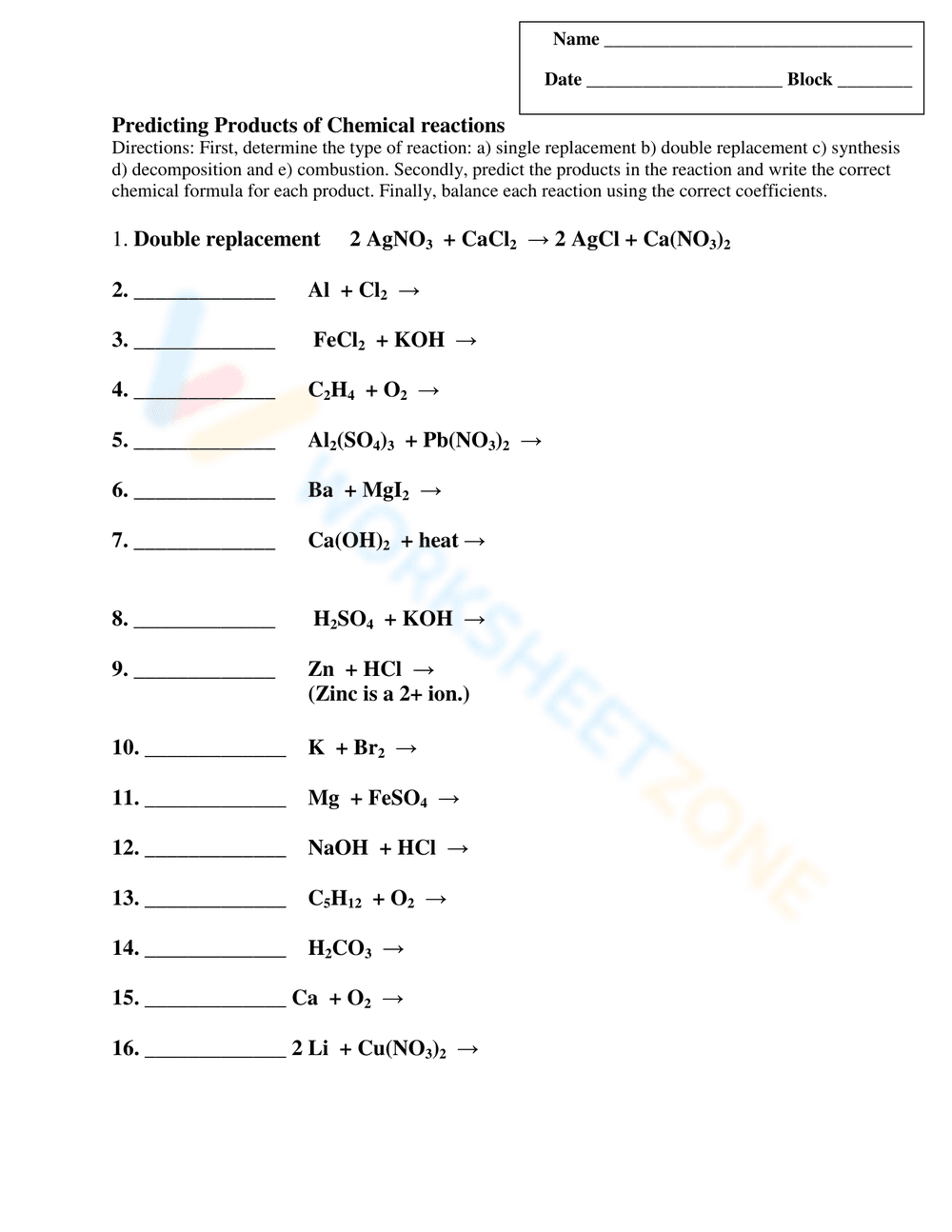
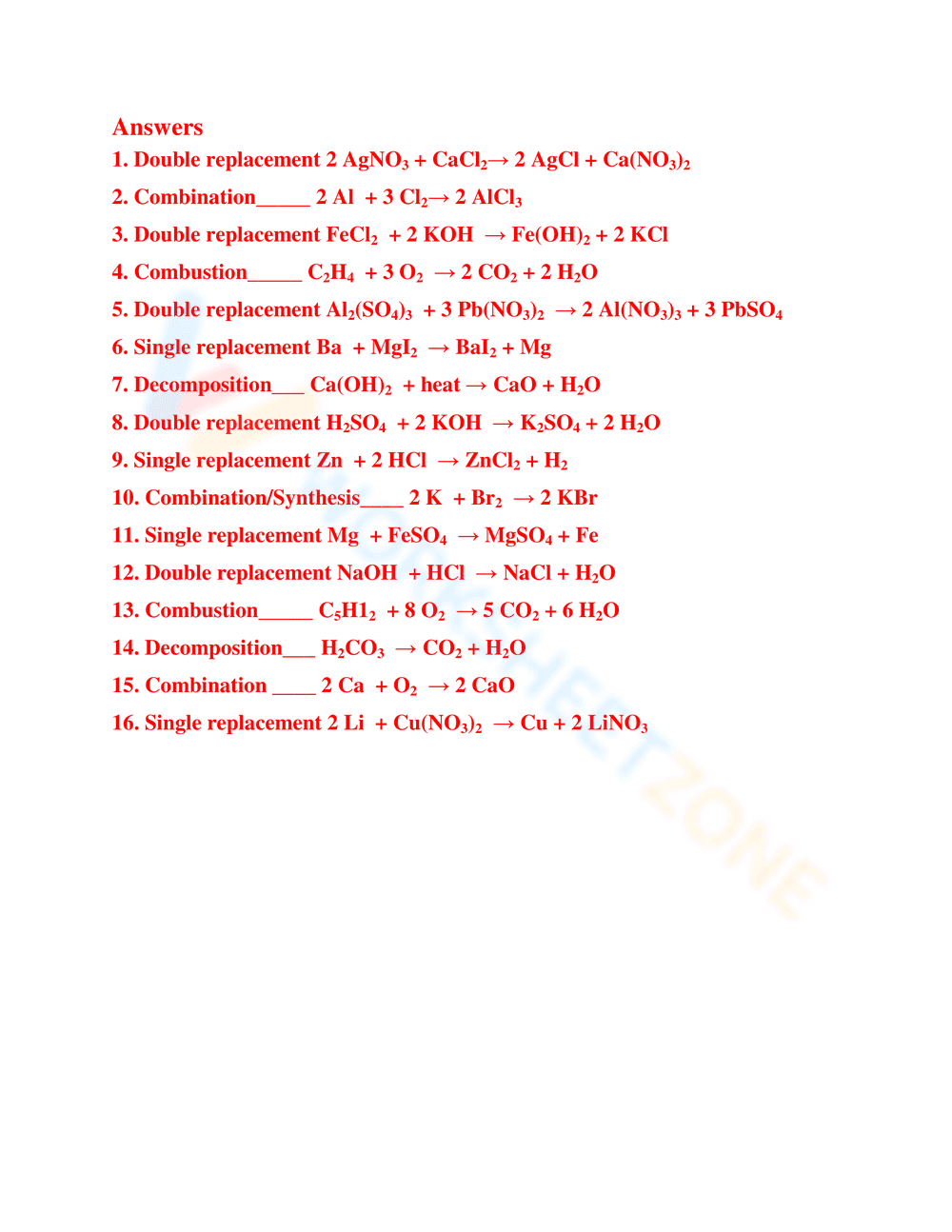
This is a chemistry worksheet focused on predicting the products of chemical reactions. Students are asked to identify the type of reaction (single replacement, double replacement, synthesis, decomposition, or combustion), predict the products, write the correct chemical formulas, and balance the reactions using coefficients. The worksheet includes example problems like 2 AgNO3 + CaCl2 -> 2 AgCl + Ca(NO3)2 and blank spaces for students to complete other reactions like Al + Cl2, FeCl2 + KOH, C2H6 + O2, Al2(SO4)3 + Pb(NO3)2, Ba + MgI2, Ca(OH)2 + heat, H2SO4 + KOH, Zn + HCl (Zinc is a 2+ ion.), K + Br2, Mg + FeSO4, NaOH + HCl, C5H12 + O2, H2CO3, Ca + O2, and 2 Li + Cu(NO3)2. A space for name, date, and block is provided at the top.
Grade Level Suitability:
This worksheet is suitable for high school chemistry, specifically grades 9-12. The content requires a basic understanding of chemical formulas, reaction types, and balancing equations, which are typically covered in high school chemistry courses.
Why Use It:
This worksheet helps students develop critical thinking skills by applying their knowledge of chemical reactions to predict products. It reinforces understanding of reaction types, chemical formulas, and balancing equations. It promotes problem-solving skills and the ability to apply chemical principles to real-world scenarios.
How to Use It:
Students should first read the directions carefully. They need to identify the type of chemical reaction presented. Then, using their knowledge of chemical principles, they should predict the products of the reaction and write the correct chemical formulas. Finally, they should balance the entire equation using the correct coefficients to ensure the law of conservation of mass is obeyed.
Target Users:
The target users are high school chemistry students who are learning about chemical reactions and stoichiometry. This worksheet is also useful for chemistry teachers looking for practice problems to reinforce these concepts.
This is a chemistry worksheet focused on predicting the products of chemical reactions. Students are asked to identify the type of reaction (single replacement, double replacement, synthesis, decomposition, or combustion), predict the products, write the correct chemical formulas, and balance the reactions using coefficients. The worksheet includes example problems like 2 AgNO3 + CaCl2 -> 2 AgCl + Ca(NO3)2 and blank spaces for students to complete other reactions like Al + Cl2, FeCl2 + KOH, C2H6 + O2, Al2(SO4)3 + Pb(NO3)2, Ba + MgI2, Ca(OH)2 + heat, H2SO4 + KOH, Zn + HCl (Zinc is a 2+ ion.), K + Br2, Mg + FeSO4, NaOH + HCl, C5H12 + O2, H2CO3, Ca + O2, and 2 Li + Cu(NO3)2. A space for name, date, and block is provided at the top.
Grade Level Suitability:
This worksheet is suitable for high school chemistry, specifically grades 9-12. The content requires a basic understanding of chemical formulas, reaction types, and balancing equations, which are typically covered in high school chemistry courses.
Why Use It:
This worksheet helps students develop critical thinking skills by applying their knowledge of chemical reactions to predict products. It reinforces understanding of reaction types, chemical formulas, and balancing equations. It promotes problem-solving skills and the ability to apply chemical principles to real-world scenarios.
How to Use It:
Students should first read the directions carefully. They need to identify the type of chemical reaction presented. Then, using their knowledge of chemical principles, they should predict the products of the reaction and write the correct chemical formulas. Finally, they should balance the entire equation using the correct coefficients to ensure the law of conservation of mass is obeyed.
Target Users:
The target users are high school chemistry students who are learning about chemical reactions and stoichiometry. This worksheet is also useful for chemistry teachers looking for practice problems to reinforce these concepts.


