


























1 / 2
0
Views
0
Downloads


0.0
0
0 Likes
Prokaryotic vs Eukaryotic Cells Worksheet
0 Views
0 Downloads
Paste this activity's link or code into your existing LMS (Google Classroom, Canvas, Teams, Schoology, Moodle, etc.).
Students can open and work on the activity right away, with no student login required.
You'll still be able to track student progress and results from your teacher account.
Information
Description
What It Is:
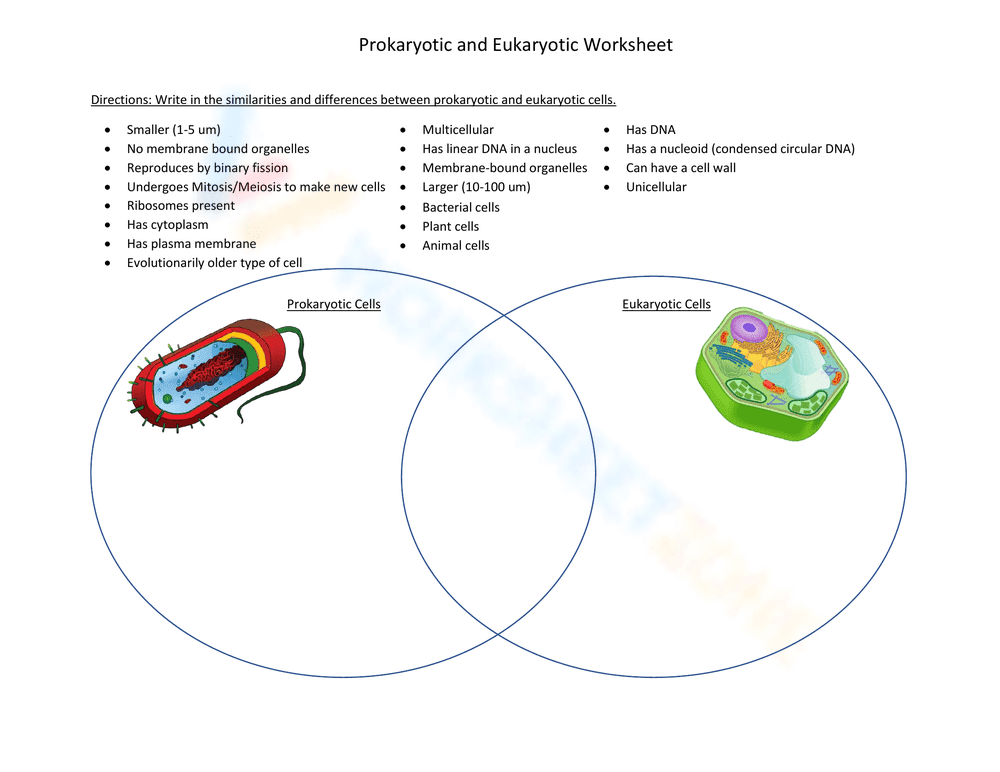
This is a worksheet focused on comparing and contrasting prokaryotic and eukaryotic cells. It includes a Venn diagram for students to visually organize similarities and differences. The worksheet lists key characteristics of each cell type, such as size, presence of membrane-bound organelles, DNA structure, and examples of organisms. It also features labeled illustrations of a prokaryotic cell and a eukaryotic cell.
Grade Level Suitability:
This worksheet is suitable for middle school (grades 6-8) and high school (grades 9-12) biology students. The content covers fundamental concepts in cell biology, making it appropriate for introductory courses. The Venn diagram format helps students organize information, which is a useful skill for these grade levels.
Why Use It:
This worksheet reinforces understanding of the differences and similarities between prokaryotic and eukaryotic cells, which is a core concept in biology. It promotes critical thinking and analysis by requiring students to categorize information. The visual aid of the Venn diagram helps with information retention and comprehension.
How to Use It:
Students should read the list of characteristics provided on the worksheet. Then, they should analyze each characteristic and determine whether it applies to prokaryotic cells, eukaryotic cells, or both. Based on this analysis, students should write the characteristics in the appropriate section of the Venn diagram. Students can also use the illustrations of the cells as a visual reference.
Target Users:
This worksheet is designed for students learning about cell biology, specifically the differences between prokaryotic and eukaryotic cells. It is also useful for teachers looking for a supplementary activity to reinforce these concepts. Homeschooling parents could also utilize this worksheet for their science curriculum.
This is a worksheet focused on comparing and contrasting prokaryotic and eukaryotic cells. It includes a Venn diagram for students to visually organize similarities and differences. The worksheet lists key characteristics of each cell type, such as size, presence of membrane-bound organelles, DNA structure, and examples of organisms. It also features labeled illustrations of a prokaryotic cell and a eukaryotic cell.
Grade Level Suitability:
This worksheet is suitable for middle school (grades 6-8) and high school (grades 9-12) biology students. The content covers fundamental concepts in cell biology, making it appropriate for introductory courses. The Venn diagram format helps students organize information, which is a useful skill for these grade levels.
Why Use It:
This worksheet reinforces understanding of the differences and similarities between prokaryotic and eukaryotic cells, which is a core concept in biology. It promotes critical thinking and analysis by requiring students to categorize information. The visual aid of the Venn diagram helps with information retention and comprehension.
How to Use It:
Students should read the list of characteristics provided on the worksheet. Then, they should analyze each characteristic and determine whether it applies to prokaryotic cells, eukaryotic cells, or both. Based on this analysis, students should write the characteristics in the appropriate section of the Venn diagram. Students can also use the illustrations of the cells as a visual reference.
Target Users:
This worksheet is designed for students learning about cell biology, specifically the differences between prokaryotic and eukaryotic cells. It is also useful for teachers looking for a supplementary activity to reinforce these concepts. Homeschooling parents could also utilize this worksheet for their science curriculum.


