


























0
Views
0
Downloads

0.0
0
0 Likes
Create a Pros and Cons Chart
0 Views
0 Downloads
Paste this activity's link or code into your existing LMS (Google Classroom, Canvas, Teams, Schoology, Moodle, etc.).
Students can open and work on the activity right away, with no student login required.
You'll still be able to track student progress and results from your teacher account.
Information
Description
What It Is:
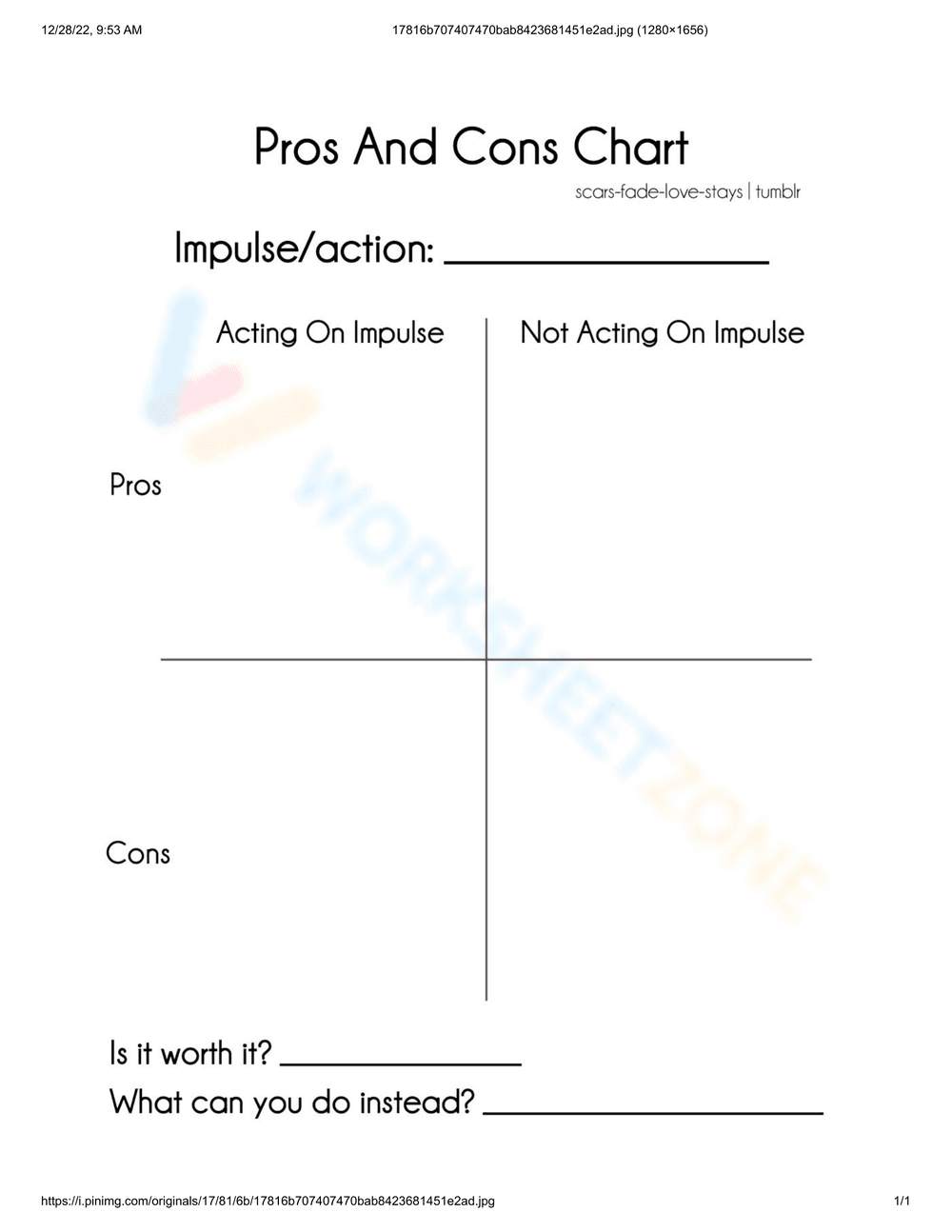
This is a worksheet titled 'Pros and Cons Chart' designed to help analyze an impulse or action. It features a table with four quadrants labeled 'Acting On Impulse' and 'Not Acting On Impulse' across the top, and 'Pros' and 'Cons' down the side. Below the table are two questions: 'Is it worth it?' and 'What can you do instead?'. It's designed for decision-making and impulse control.
Grade Level Suitability:
This worksheet is suitable for late elementary through high school (grades 4-12). Younger students can use it with guidance to consider simple choices, while older students can use it for more complex decisions and self-reflection. The open-ended nature of the prompts makes it adaptable for various levels.
Why Use It:
This worksheet helps students develop critical thinking skills by weighing the potential advantages and disadvantages of their actions. It promotes self-awareness and encourages thoughtful decision-making, especially in situations where they might be tempted to act impulsively. It helps in planning and considering alternative actions.
How to Use It:
First, identify the 'Impulse/action' you want to analyze and write it at the top. Then, fill in each quadrant of the table with the pros and cons of acting on that impulse and not acting on that impulse. Finally, answer the questions 'Is it worth it?' and 'What can you do instead?' based on your analysis.
Target Users:
This worksheet is ideal for students, adolescents, and adults who want to improve their decision-making skills, manage impulsive behaviors, or simply think more carefully about their choices. Counselors and educators can use it in individual or group settings to facilitate discussions about responsible decision-making.
This is a worksheet titled 'Pros and Cons Chart' designed to help analyze an impulse or action. It features a table with four quadrants labeled 'Acting On Impulse' and 'Not Acting On Impulse' across the top, and 'Pros' and 'Cons' down the side. Below the table are two questions: 'Is it worth it?' and 'What can you do instead?'. It's designed for decision-making and impulse control.
Grade Level Suitability:
This worksheet is suitable for late elementary through high school (grades 4-12). Younger students can use it with guidance to consider simple choices, while older students can use it for more complex decisions and self-reflection. The open-ended nature of the prompts makes it adaptable for various levels.
Why Use It:
This worksheet helps students develop critical thinking skills by weighing the potential advantages and disadvantages of their actions. It promotes self-awareness and encourages thoughtful decision-making, especially in situations where they might be tempted to act impulsively. It helps in planning and considering alternative actions.
How to Use It:
First, identify the 'Impulse/action' you want to analyze and write it at the top. Then, fill in each quadrant of the table with the pros and cons of acting on that impulse and not acting on that impulse. Finally, answer the questions 'Is it worth it?' and 'What can you do instead?' based on your analysis.
Target Users:
This worksheet is ideal for students, adolescents, and adults who want to improve their decision-making skills, manage impulsive behaviors, or simply think more carefully about their choices. Counselors and educators can use it in individual or group settings to facilitate discussions about responsible decision-making.


