


























1 / 3
0
Views
0
Downloads



0 Likes
Work with Rational and Irrational Numbers
0 Views
0 Downloads
Paste this activity's link or code into your existing LMS (Google Classroom, Canvas, Teams, Schoology, Moodle, etc.).
Students can open and work on the activity right away, with no student login required.
You'll still be able to track student progress and results from your teacher account.
Information
Description
What It Is:
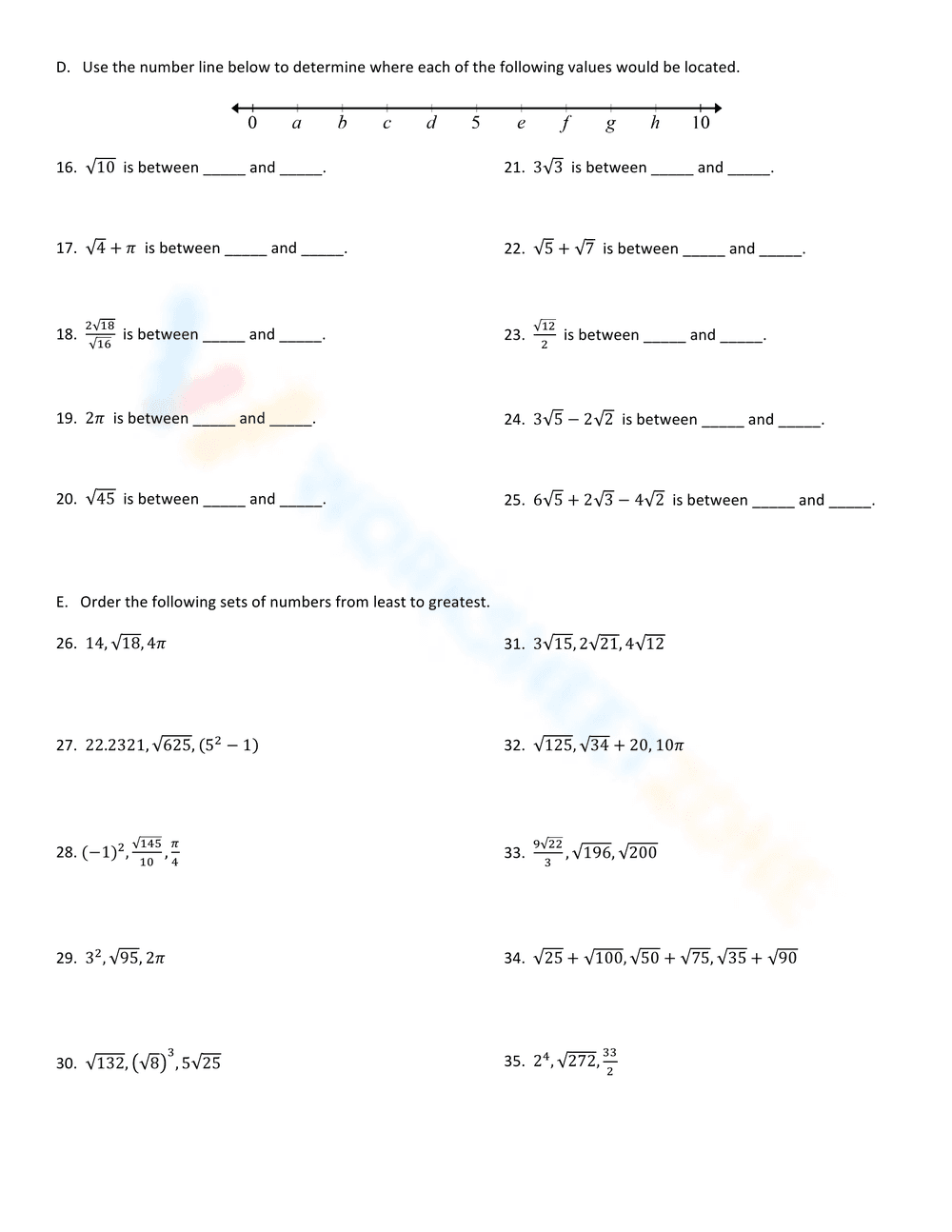
This is an educational worksheet focusing on rational and irrational numbers. It includes definitions and explanations of the concepts, examples of irrational numbers like √3 and 2π, and a worked example classifying numbers (2.371732..., 0.625, 12.56637...) as rational or irrational based on whether they can be written as a fraction and if their decimal representation terminates or repeats. A calculator tip is also provided, showing how to convert decimals to fractions on TI-83/84 calculators.
Grade Level Suitability:
This worksheet is suitable for 11th grade, as indicated by the title and the included PSSA preparation program. The content and complexity of classifying rational and irrational numbers, along with the calculator usage, align with the math curriculum for this grade level.
Why Use It:
This worksheet helps students understand the difference between rational and irrational numbers. It reinforces the concept that irrational numbers cannot be expressed as fractions with integers and have non-repeating, non-terminating decimal representations. The worksheet provides a clear example of how to classify numbers and offers a practical calculator tip for converting decimals to fractions.
How to Use It:
Students can read the definitions and explanations to understand the concepts of rational and irrational numbers. They can then work through the provided example to understand the classification process. Students can then practice classifying additional numbers. The calculator tip can be used to verify answers.
Target Users:
The target users are 11th-grade students learning about rational and irrational numbers, particularly those preparing for the PSSA exam. It can also be used by teachers as a classroom resource or for homework assignments, or by students needing extra practice with these concepts.
This is an educational worksheet focusing on rational and irrational numbers. It includes definitions and explanations of the concepts, examples of irrational numbers like √3 and 2π, and a worked example classifying numbers (2.371732..., 0.625, 12.56637...) as rational or irrational based on whether they can be written as a fraction and if their decimal representation terminates or repeats. A calculator tip is also provided, showing how to convert decimals to fractions on TI-83/84 calculators.
Grade Level Suitability:
This worksheet is suitable for 11th grade, as indicated by the title and the included PSSA preparation program. The content and complexity of classifying rational and irrational numbers, along with the calculator usage, align with the math curriculum for this grade level.
Why Use It:
This worksheet helps students understand the difference between rational and irrational numbers. It reinforces the concept that irrational numbers cannot be expressed as fractions with integers and have non-repeating, non-terminating decimal representations. The worksheet provides a clear example of how to classify numbers and offers a practical calculator tip for converting decimals to fractions.
How to Use It:
Students can read the definitions and explanations to understand the concepts of rational and irrational numbers. They can then work through the provided example to understand the classification process. Students can then practice classifying additional numbers. The calculator tip can be used to verify answers.
Target Users:
The target users are 11th-grade students learning about rational and irrational numbers, particularly those preparing for the PSSA exam. It can also be used by teachers as a classroom resource or for homework assignments, or by students needing extra practice with these concepts.


