


























1 / 2
0
Views
0
Downloads


0 Likes
Reaction Product Chemistry Worksheet
0 Views
0 Downloads
Paste this activity's link or code into your existing LMS (Google Classroom, Canvas, Teams, Schoology, Moodle, etc.).
Students can open and work on the activity right away, with no student login required.
You'll still be able to track student progress and results from your teacher account.
Information
Description
What It Is:
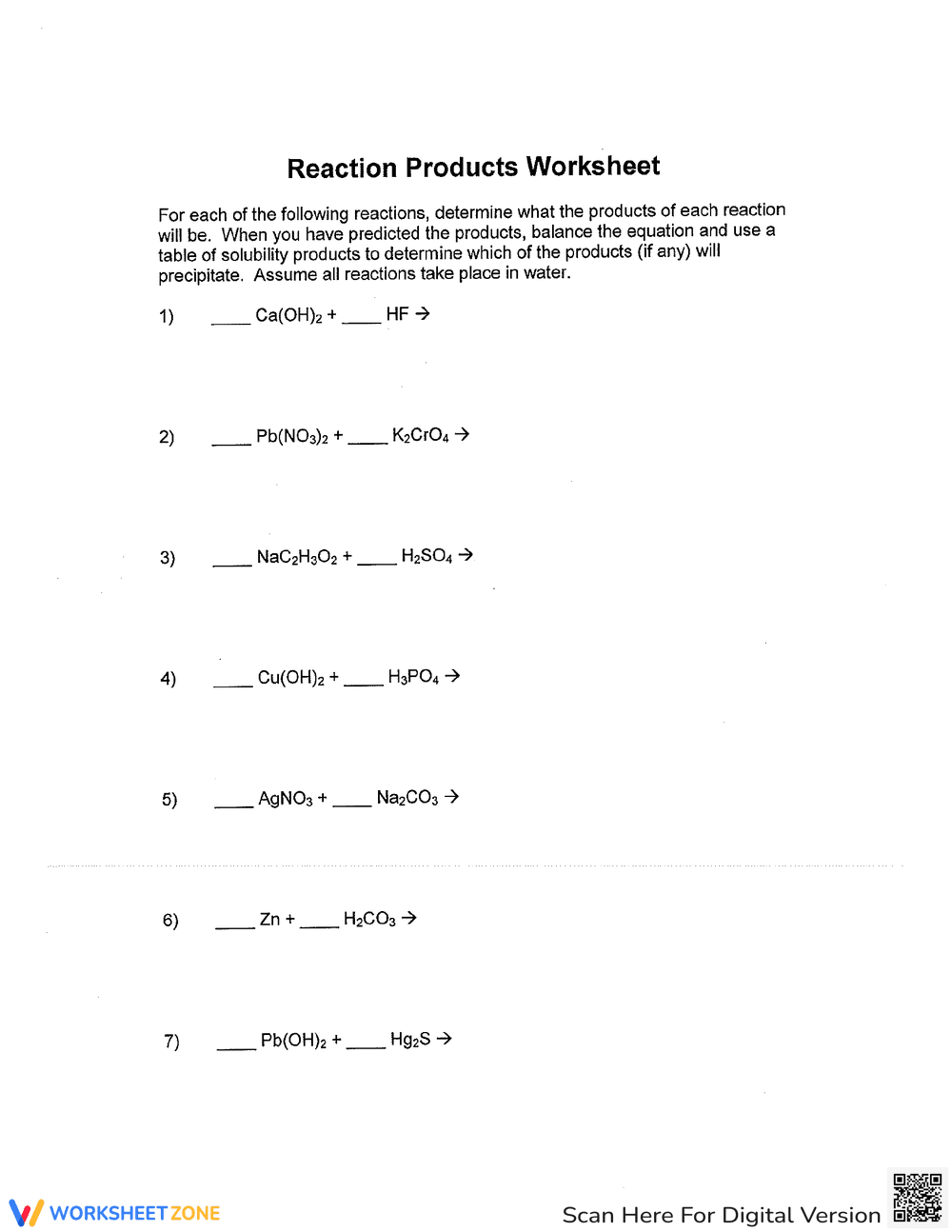
This is a chemistry worksheet focused on predicting the products of chemical reactions. Students are given a series of incomplete chemical equations with the reactants provided. The task involves determining the products, balancing the equations, and identifying any precipitates using solubility rules. There are seven reactions provided using various chemical formulas such as Ca(OH)₂, HF, Pb(NO₃)₂, K₂CrO₄, NaC₂H₃O₂, H₂SO₄, Cu(OH)₂, H₃PO₄, AgNO₃, Na₂CO₃, Zn, H₂CO₃, Pb(OH)₂, and Hg₂S.
Grade Level Suitability:
This worksheet is suitable for high school chemistry students, specifically grades 10-12. It requires an understanding of chemical reactions, balancing equations, and solubility rules, which are typically covered in high school chemistry courses.
Why Use It:
This worksheet provides practice in predicting reaction products, balancing chemical equations, and applying solubility rules. It reinforces key concepts in chemistry and helps students develop problem-solving skills related to chemical reactions. It also encourages the use of solubility tables to identify precipitates.
How to Use It:
Students should first predict the products of each reaction based on their knowledge of chemical reactions. Next, they should write out the complete balanced equation. Finally, they need to use a solubility table to determine if any of the products are insoluble and will form a precipitate, noting which product(s) precipitate.
Target Users:
The target users are high school chemistry students and teachers. It can be used as a classroom activity, homework assignment, or review exercise to reinforce concepts related to chemical reactions and solubility.
This is a chemistry worksheet focused on predicting the products of chemical reactions. Students are given a series of incomplete chemical equations with the reactants provided. The task involves determining the products, balancing the equations, and identifying any precipitates using solubility rules. There are seven reactions provided using various chemical formulas such as Ca(OH)₂, HF, Pb(NO₃)₂, K₂CrO₄, NaC₂H₃O₂, H₂SO₄, Cu(OH)₂, H₃PO₄, AgNO₃, Na₂CO₃, Zn, H₂CO₃, Pb(OH)₂, and Hg₂S.
Grade Level Suitability:
This worksheet is suitable for high school chemistry students, specifically grades 10-12. It requires an understanding of chemical reactions, balancing equations, and solubility rules, which are typically covered in high school chemistry courses.
Why Use It:
This worksheet provides practice in predicting reaction products, balancing chemical equations, and applying solubility rules. It reinforces key concepts in chemistry and helps students develop problem-solving skills related to chemical reactions. It also encourages the use of solubility tables to identify precipitates.
How to Use It:
Students should first predict the products of each reaction based on their knowledge of chemical reactions. Next, they should write out the complete balanced equation. Finally, they need to use a solubility table to determine if any of the products are insoluble and will form a precipitate, noting which product(s) precipitate.
Target Users:
The target users are high school chemistry students and teachers. It can be used as a classroom activity, homework assignment, or review exercise to reinforce concepts related to chemical reactions and solubility.


