


























0
Views
0
Downloads

0.0
0
0 Likes
Reactions of Acids and Bases Worksheet
0 Views
0 Downloads
Paste this activity's link or code into your existing LMS (Google Classroom, Canvas, Teams, Schoology, Moodle, etc.).
Students can open and work on the activity right away, with no student login required.
You'll still be able to track student progress and results from your teacher account.
Information
Description
What It Is:
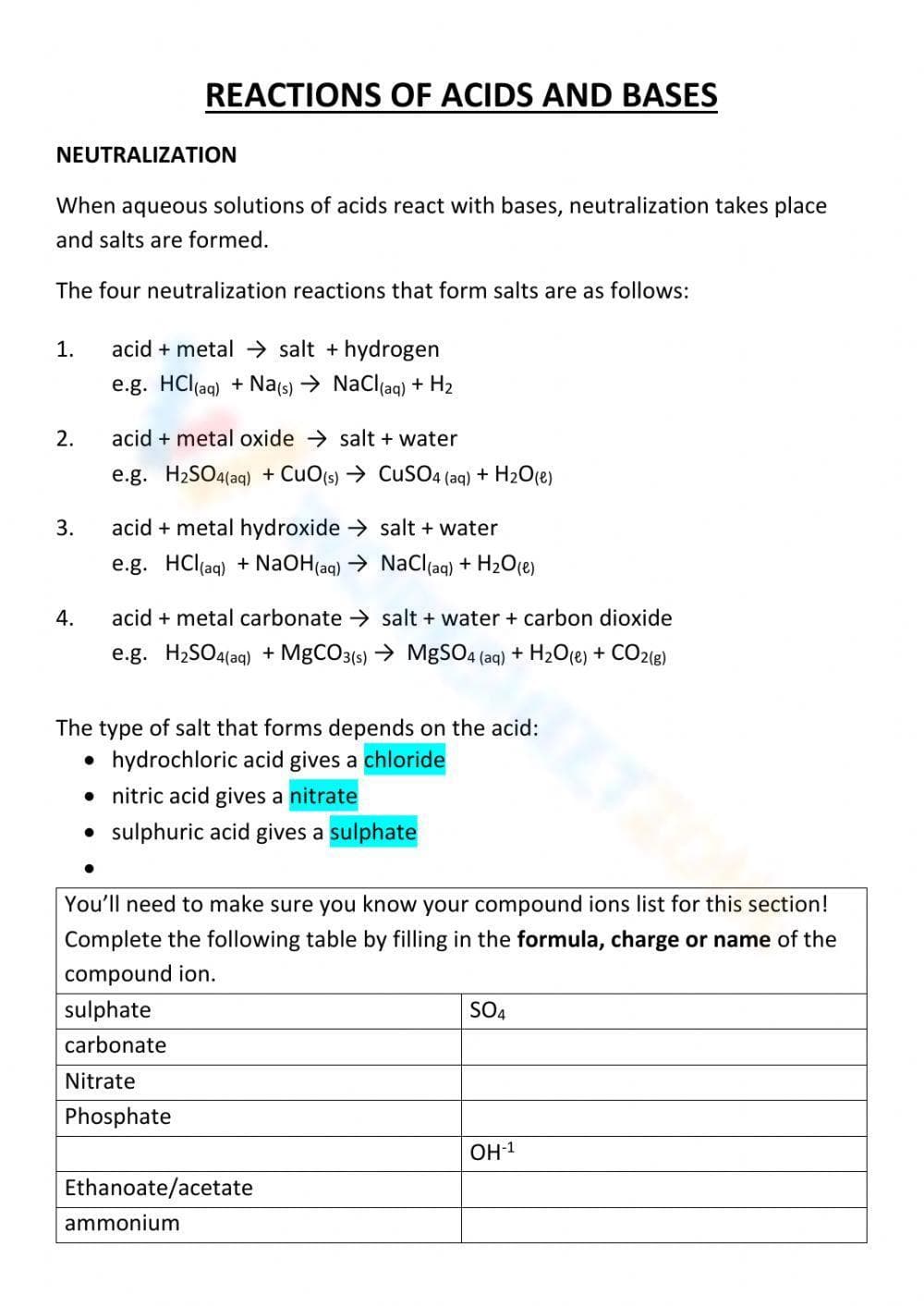
This is a chemistry worksheet focused on the reactions of acids and bases, specifically neutralization. It presents four types of neutralization reactions with examples, showing the reactants (acid + metal, acid + metal oxide, acid + metal hydroxide, acid + metal carbonate) and the products (salt + hydrogen, salt + water, salt + water + carbon dioxide). The worksheet also highlights the type of salt formed from hydrochloric, nitric, and sulphuric acids. Finally, it includes a table to complete by filling in the formula, charge or name of various compound ions like sulphate, carbonate, nitrate, phosphate, ethanoate/acetate and ammonium.
Grade Level Suitability:
This worksheet is suitable for grades 9-12, specifically high school chemistry. The concepts of acids, bases, neutralization reactions, and compound ions are typically covered in high school chemistry courses. The balancing of chemical equations and understanding of ionic charges require a foundational understanding of chemistry principles.
Why Use It:
This worksheet reinforces understanding of neutralization reactions and the products formed. It helps students connect specific acids to the salts they produce. The table completion activity strengthens knowledge of common compound ions, their formulas, and charges, which is essential for writing chemical formulas and equations. It provides practice in applying theoretical knowledge to practical problem-solving.
How to Use It:
First, review the definitions and examples of neutralization reactions provided. Then, study the relationship between the acid used and the type of salt formed. Finally, complete the table by filling in the missing formula, charge, or name for each compound ion listed. Students can use textbooks, notes, or online resources to find the correct information.
Target Users:
This worksheet is designed for high school chemistry students who are learning about acids, bases, and neutralization reactions. It is also beneficial for students who need to review or reinforce their knowledge of common compound ions and their formulas. Teachers can use it as a classroom activity, homework assignment, or review tool.
This is a chemistry worksheet focused on the reactions of acids and bases, specifically neutralization. It presents four types of neutralization reactions with examples, showing the reactants (acid + metal, acid + metal oxide, acid + metal hydroxide, acid + metal carbonate) and the products (salt + hydrogen, salt + water, salt + water + carbon dioxide). The worksheet also highlights the type of salt formed from hydrochloric, nitric, and sulphuric acids. Finally, it includes a table to complete by filling in the formula, charge or name of various compound ions like sulphate, carbonate, nitrate, phosphate, ethanoate/acetate and ammonium.
Grade Level Suitability:
This worksheet is suitable for grades 9-12, specifically high school chemistry. The concepts of acids, bases, neutralization reactions, and compound ions are typically covered in high school chemistry courses. The balancing of chemical equations and understanding of ionic charges require a foundational understanding of chemistry principles.
Why Use It:
This worksheet reinforces understanding of neutralization reactions and the products formed. It helps students connect specific acids to the salts they produce. The table completion activity strengthens knowledge of common compound ions, their formulas, and charges, which is essential for writing chemical formulas and equations. It provides practice in applying theoretical knowledge to practical problem-solving.
How to Use It:
First, review the definitions and examples of neutralization reactions provided. Then, study the relationship between the acid used and the type of salt formed. Finally, complete the table by filling in the missing formula, charge, or name for each compound ion listed. Students can use textbooks, notes, or online resources to find the correct information.
Target Users:
This worksheet is designed for high school chemistry students who are learning about acids, bases, and neutralization reactions. It is also beneficial for students who need to review or reinforce their knowledge of common compound ions and their formulas. Teachers can use it as a classroom activity, homework assignment, or review tool.


