


























0
Views
0
Downloads

0.0
0
0 Likes
Practice with Reflexive and Possessive Pronouns
0 Views
0 Downloads
Paste this activity's link or code into your existing LMS (Google Classroom, Canvas, Teams, Schoology, Moodle, etc.).
Students can open and work on the activity right away, with no student login required.
You'll still be able to track student progress and results from your teacher account.
Information
Description
What It Is:
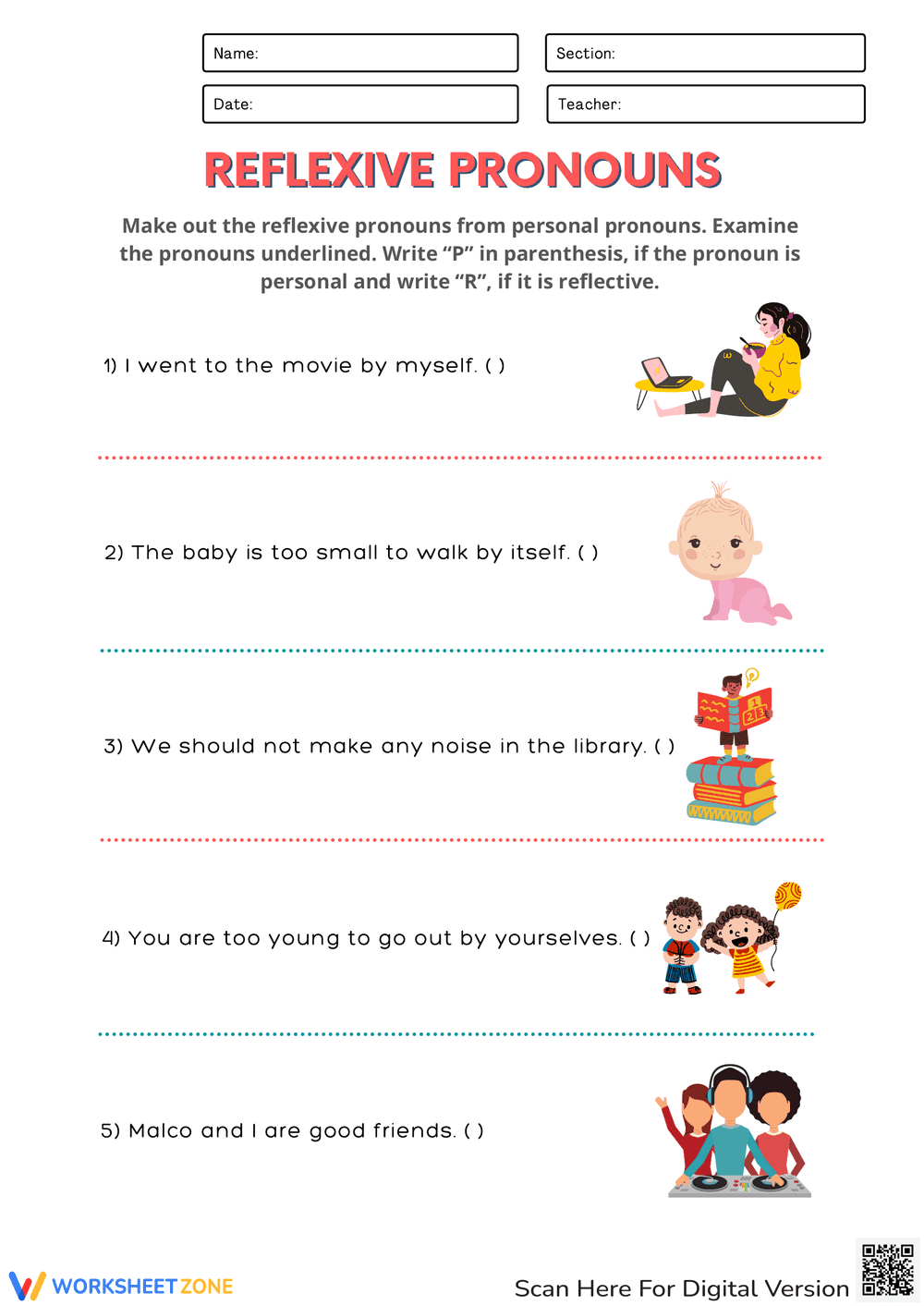
This is an educational worksheet focused on teaching the difference between personal and reflexive pronouns. The worksheet presents five sentences, each containing an underlined pronoun. The student must identify whether the underlined pronoun is personal or reflexive and write 'P' for personal or 'R' for reflexive in the provided parentheses. Each sentence is accompanied by a small, relevant illustration.
Grade Level Suitability:
This worksheet is most suitable for grades 2-4. The sentence structure is relatively simple, and the concept of personal and reflexive pronouns is typically introduced in these grade levels. The visual aids also make it engaging for younger learners.
Why Use It:
This worksheet helps students understand and differentiate between personal and reflexive pronouns. It reinforces grammar skills, improves reading comprehension, and encourages critical thinking by requiring students to analyze the function of pronouns within sentences. The illustrations add visual interest and can aid comprehension.
How to Use It:
Students should read each sentence carefully, paying close attention to the underlined pronoun. They should then determine if the pronoun is being used as a personal pronoun or a reflexive pronoun. Based on their analysis, they should write 'P' in the parenthesis if it's a personal pronoun, and 'R' if it's a reflexive pronoun.
Target Users:
This worksheet is ideal for elementary school students learning about grammar, specifically personal and reflexive pronouns. It is also beneficial for students who need extra practice identifying different types of pronouns and understanding their function in sentences. It can be used in the classroom or as a homework assignment.
This is an educational worksheet focused on teaching the difference between personal and reflexive pronouns. The worksheet presents five sentences, each containing an underlined pronoun. The student must identify whether the underlined pronoun is personal or reflexive and write 'P' for personal or 'R' for reflexive in the provided parentheses. Each sentence is accompanied by a small, relevant illustration.
Grade Level Suitability:
This worksheet is most suitable for grades 2-4. The sentence structure is relatively simple, and the concept of personal and reflexive pronouns is typically introduced in these grade levels. The visual aids also make it engaging for younger learners.
Why Use It:
This worksheet helps students understand and differentiate between personal and reflexive pronouns. It reinforces grammar skills, improves reading comprehension, and encourages critical thinking by requiring students to analyze the function of pronouns within sentences. The illustrations add visual interest and can aid comprehension.
How to Use It:
Students should read each sentence carefully, paying close attention to the underlined pronoun. They should then determine if the pronoun is being used as a personal pronoun or a reflexive pronoun. Based on their analysis, they should write 'P' in the parenthesis if it's a personal pronoun, and 'R' if it's a reflexive pronoun.
Target Users:
This worksheet is ideal for elementary school students learning about grammar, specifically personal and reflexive pronouns. It is also beneficial for students who need extra practice identifying different types of pronouns and understanding their function in sentences. It can be used in the classroom or as a homework assignment.


