


























1 / 2
0
Views
0
Downloads

0.0
0
0 Likes
Explore Segments, Bisectors, and Midpoints
0 Views
0 Downloads
Paste this activity's link or code into your existing LMS (Google Classroom, Canvas, Teams, Schoology, Moodle, etc.).
Students can open and work on the activity right away, with no student login required.
You'll still be able to track student progress and results from your teacher account.
Information
Description
What It Is:
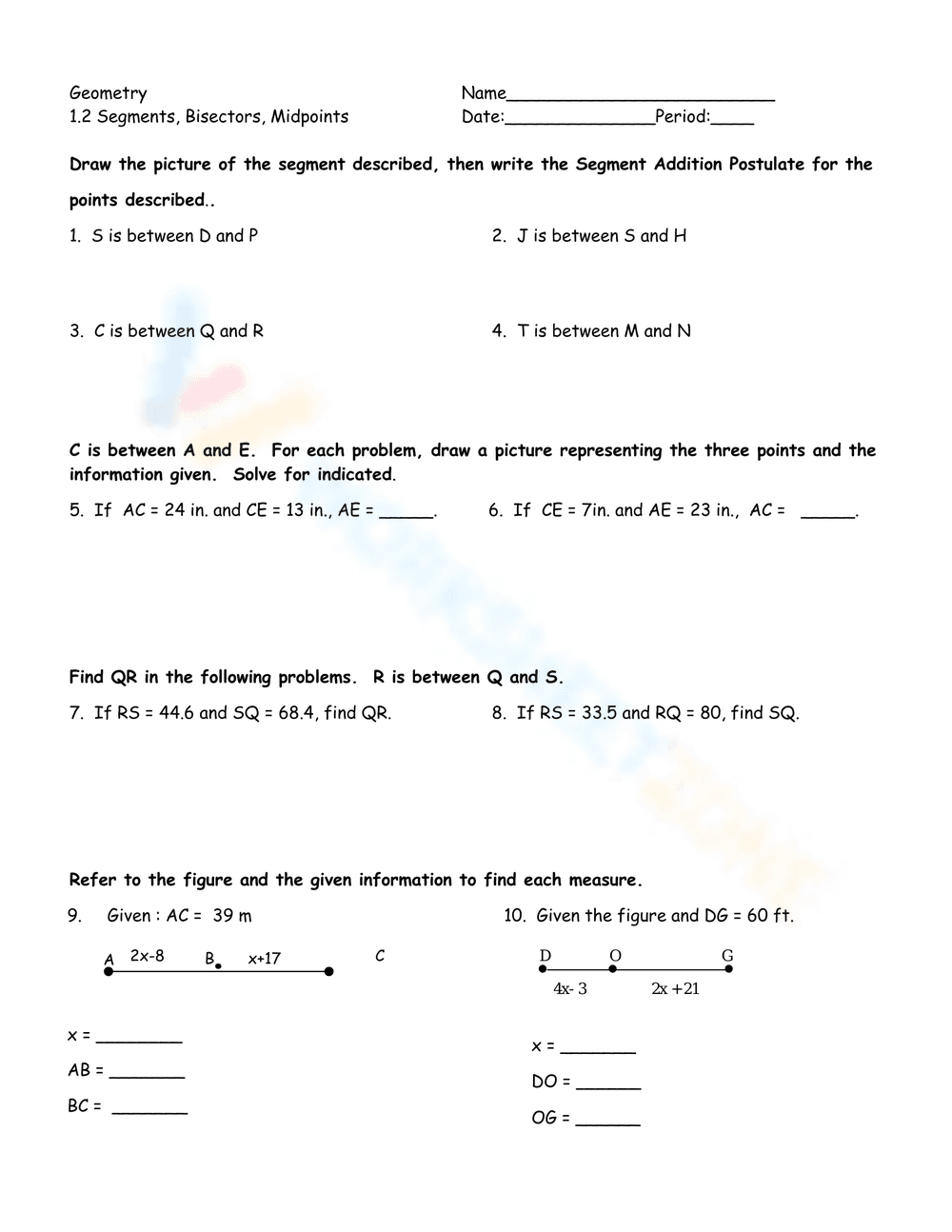
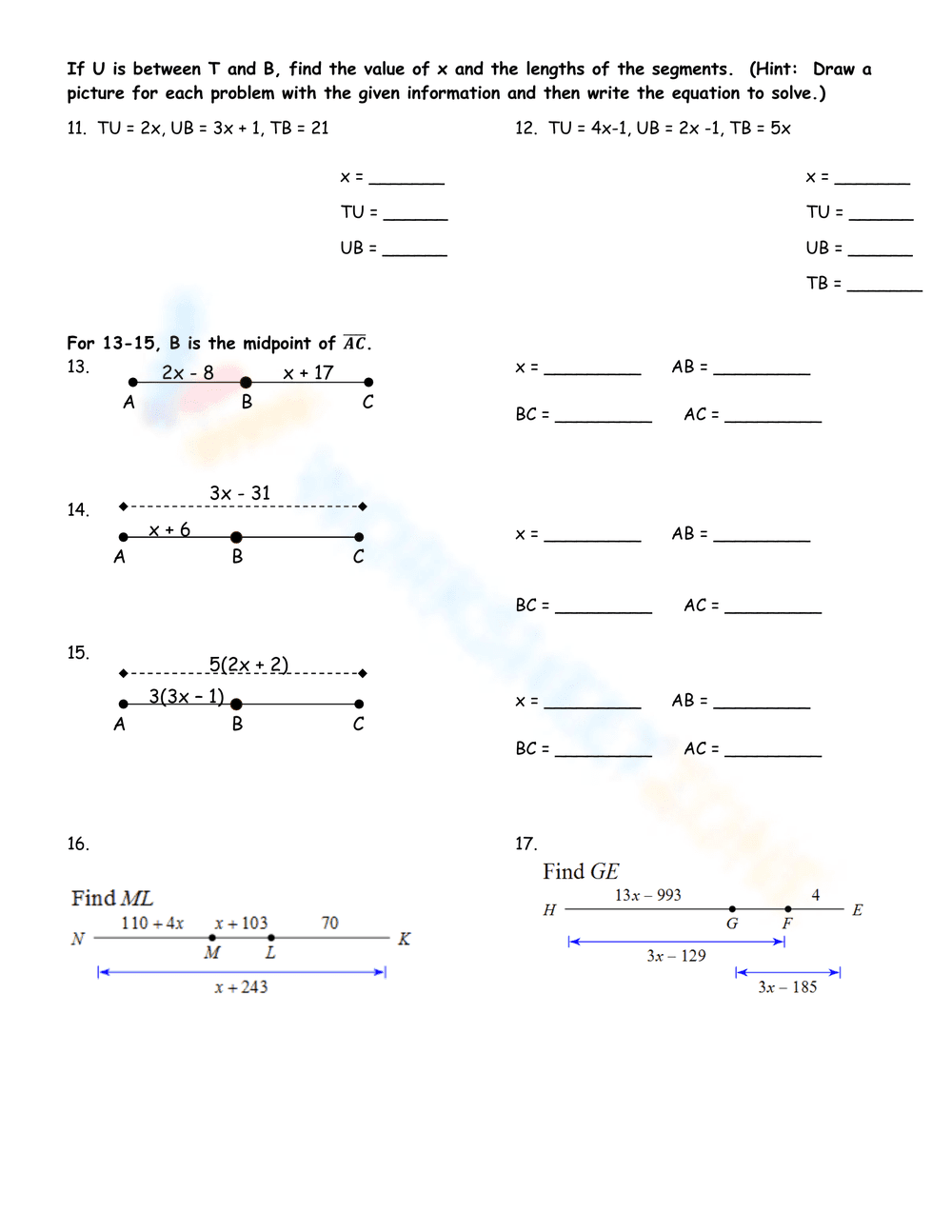
This is a geometry worksheet focusing on segments, bisectors, and midpoints. The worksheet includes problems where students need to draw segments based on descriptions (e.g., 'S is between D and P'), apply the Segment Addition Postulate, and solve for unknown segment lengths given certain conditions and diagrams. Some problems require drawing a picture representing three points with given information, and others require solving for 'x' and finding segment measures using algebraic expressions.
Grade Level Suitability:
This worksheet is suitable for high school geometry, typically grades 9-10. The concepts of segment addition, midpoints, and basic algebraic application within geometry are usually introduced at this level. The problems require a foundational understanding of geometric principles and algebraic manipulation.
Why Use It:
This worksheet reinforces understanding of the Segment Addition Postulate, develops skills in visualizing and representing geometric relationships, and provides practice in applying algebraic concepts to solve geometric problems. It helps students connect geometric concepts with algebraic reasoning, improving problem-solving abilities.
How to Use It:
Students should read each problem carefully, draw the described segment or figure, label given measurements, and apply the Segment Addition Postulate to set up equations. Solve the equations to find unknown segment lengths or variable values. For problems with diagrams, use the given information and the diagram to determine relationships between segments and solve for missing measures.
Target Users:
This worksheet is designed for high school geometry students who are learning about segments, bisectors, midpoints, and the Segment Addition Postulate. It's also useful for students who need extra practice in applying algebraic skills to geometric problems. It is suitable for classroom assignments, homework, or review activities.
This is a geometry worksheet focusing on segments, bisectors, and midpoints. The worksheet includes problems where students need to draw segments based on descriptions (e.g., 'S is between D and P'), apply the Segment Addition Postulate, and solve for unknown segment lengths given certain conditions and diagrams. Some problems require drawing a picture representing three points with given information, and others require solving for 'x' and finding segment measures using algebraic expressions.
Grade Level Suitability:
This worksheet is suitable for high school geometry, typically grades 9-10. The concepts of segment addition, midpoints, and basic algebraic application within geometry are usually introduced at this level. The problems require a foundational understanding of geometric principles and algebraic manipulation.
Why Use It:
This worksheet reinforces understanding of the Segment Addition Postulate, develops skills in visualizing and representing geometric relationships, and provides practice in applying algebraic concepts to solve geometric problems. It helps students connect geometric concepts with algebraic reasoning, improving problem-solving abilities.
How to Use It:
Students should read each problem carefully, draw the described segment or figure, label given measurements, and apply the Segment Addition Postulate to set up equations. Solve the equations to find unknown segment lengths or variable values. For problems with diagrams, use the given information and the diagram to determine relationships between segments and solve for missing measures.
Target Users:
This worksheet is designed for high school geometry students who are learning about segments, bisectors, midpoints, and the Segment Addition Postulate. It's also useful for students who need extra practice in applying algebraic skills to geometric problems. It is suitable for classroom assignments, homework, or review activities.


