


























1 / 2
0
Views
0
Downloads

0 Likes
Introduction to Sound and Pitch
0 Views
0 Downloads
Paste this activity's link or code into your existing LMS (Google Classroom, Canvas, Teams, Schoology, Moodle, etc.).
Students can open and work on the activity right away, with no student login required.
You'll still be able to track student progress and results from your teacher account.
Information
Description
What It Is:
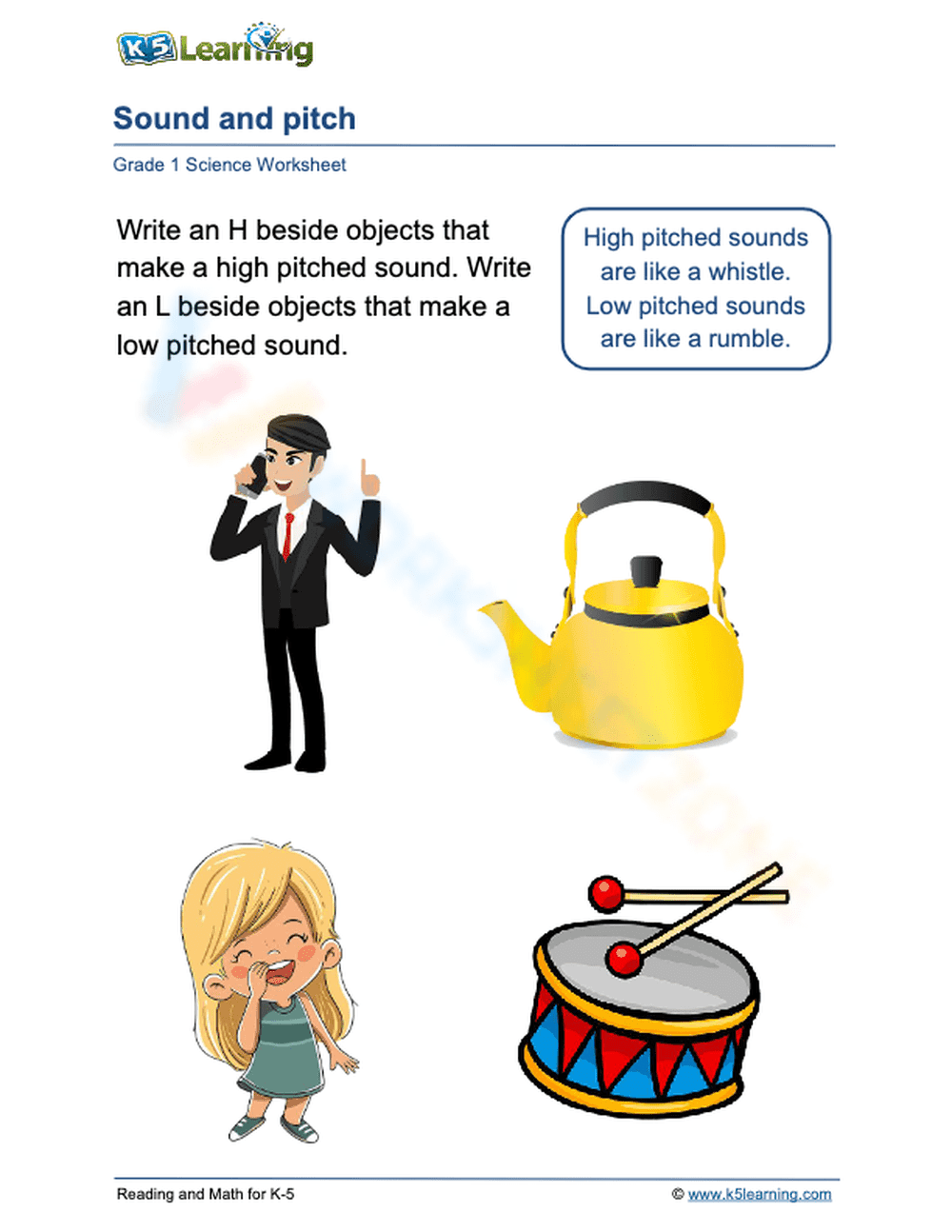
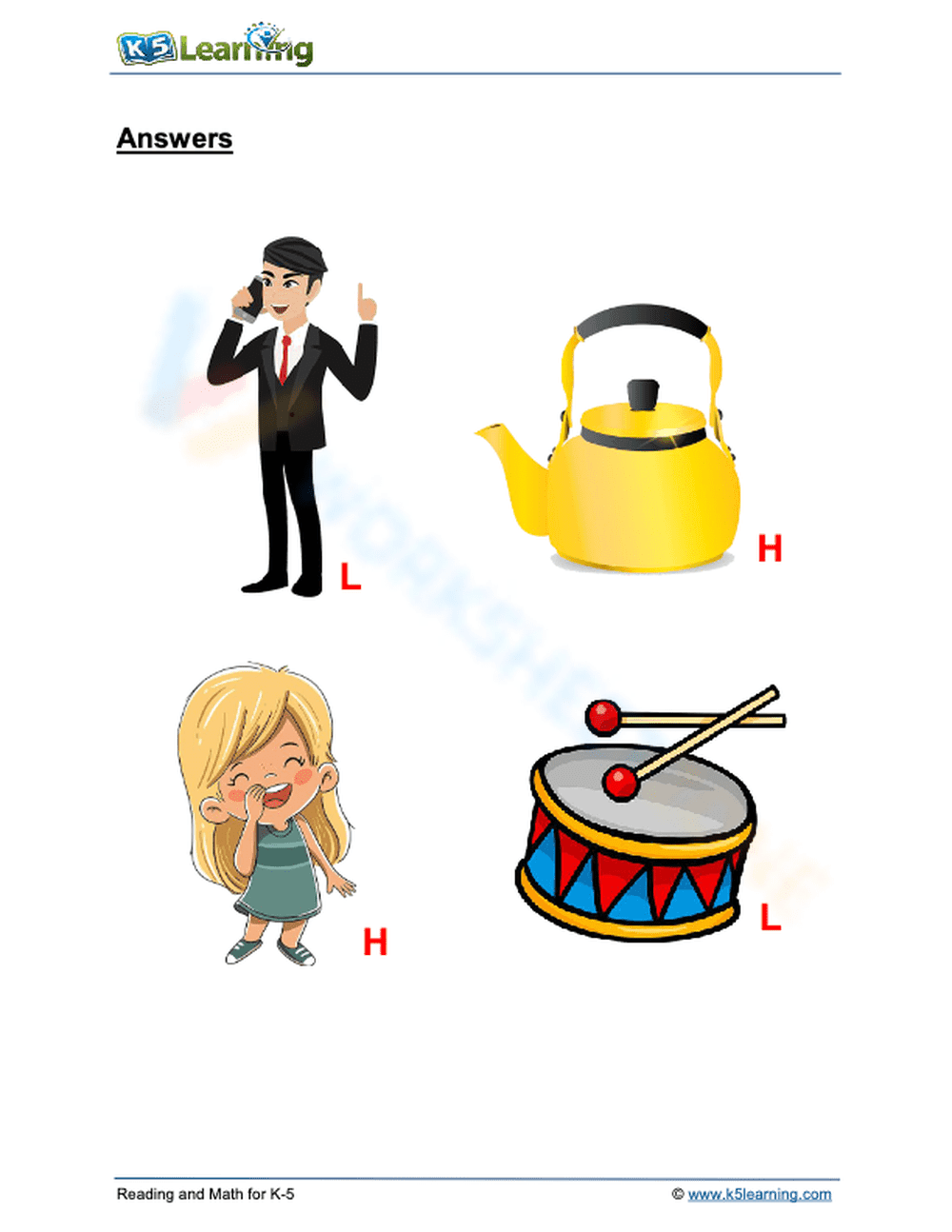
This is a Grade 1 science worksheet focused on understanding sound and pitch. The worksheet asks students to identify objects that produce high-pitched sounds and low-pitched sounds. It provides examples, stating that high-pitched sounds are like a whistle and low-pitched sounds are like a rumble. The objects pictured include a man on a phone, a tea kettle, a child laughing, and a drum. Students write 'H' next to objects that make high pitched sounds and 'L' next to objects that make low pitched sounds.
Grade Level Suitability:
This worksheet is suitable for Grade 1. The instructions are simple and the concepts are introduced in a way that is accessible to young learners. The use of visual aids (pictures) helps to reinforce the concepts of high and low pitch sounds.
Why Use It:
This worksheet helps students develop an understanding of the concepts of high and low pitch. It reinforces auditory discrimination skills and encourages students to connect sounds to real-world objects. It also introduces basic scientific vocabulary related to sound.
How to Use It:
Students should first read the instructions and the examples provided. Then, they should look at each picture and determine whether the object typically makes a high-pitched sound or a low-pitched sound. Finally, they should write 'H' next to the objects that make high-pitched sounds and 'L' next to the objects that make low-pitched sounds.
Target Users:
This worksheet is designed for Grade 1 students who are learning about sound and pitch in science. It is also suitable for use in homeschooling or as a supplemental activity for students who need extra practice with these concepts.
This is a Grade 1 science worksheet focused on understanding sound and pitch. The worksheet asks students to identify objects that produce high-pitched sounds and low-pitched sounds. It provides examples, stating that high-pitched sounds are like a whistle and low-pitched sounds are like a rumble. The objects pictured include a man on a phone, a tea kettle, a child laughing, and a drum. Students write 'H' next to objects that make high pitched sounds and 'L' next to objects that make low pitched sounds.
Grade Level Suitability:
This worksheet is suitable for Grade 1. The instructions are simple and the concepts are introduced in a way that is accessible to young learners. The use of visual aids (pictures) helps to reinforce the concepts of high and low pitch sounds.
Why Use It:
This worksheet helps students develop an understanding of the concepts of high and low pitch. It reinforces auditory discrimination skills and encourages students to connect sounds to real-world objects. It also introduces basic scientific vocabulary related to sound.
How to Use It:
Students should first read the instructions and the examples provided. Then, they should look at each picture and determine whether the object typically makes a high-pitched sound or a low-pitched sound. Finally, they should write 'H' next to the objects that make high-pitched sounds and 'L' next to the objects that make low-pitched sounds.
Target Users:
This worksheet is designed for Grade 1 students who are learning about sound and pitch in science. It is also suitable for use in homeschooling or as a supplemental activity for students who need extra practice with these concepts.


