


























0
Views
0
Downloads

0.0
0
0 Likes
Enhance Storytelling Skills with Story Slide Worksheet
0 Views
0 Downloads
Paste this activity's link or code into your existing LMS (Google Classroom, Canvas, Teams, Schoology, Moodle, etc.).
Students can open and work on the activity right away, with no student login required.
You'll still be able to track student progress and results from your teacher account.
Information
Description
What It Is:
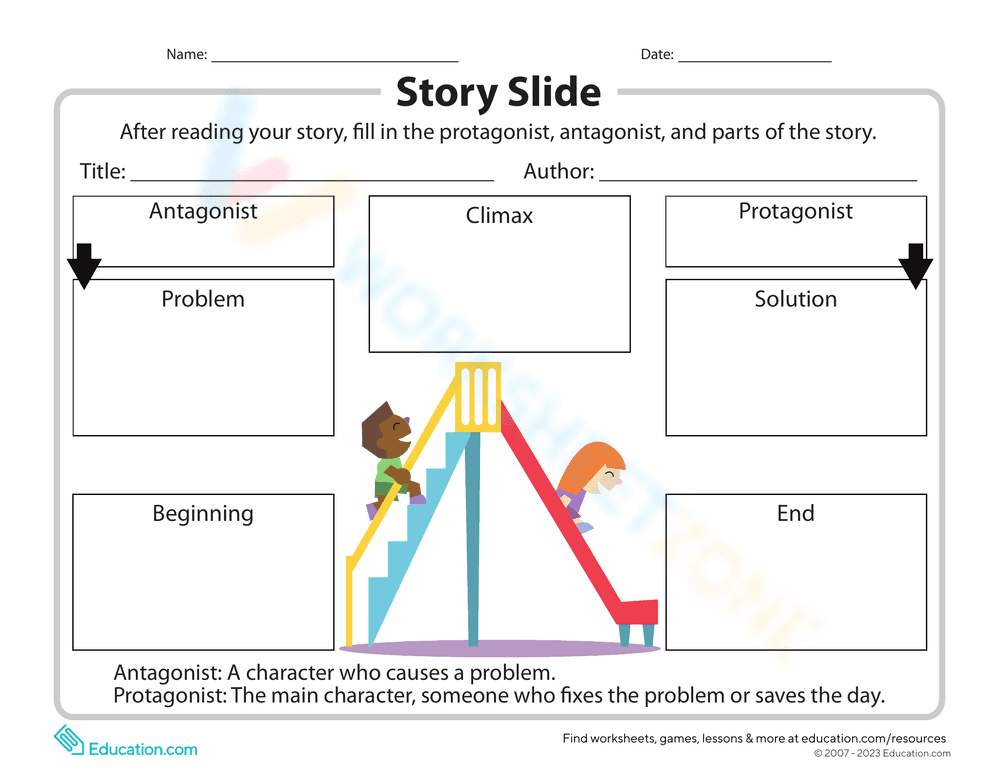
A worksheet titled 'Story Slide' designed to help students analyze story elements. It includes spaces to fill in the title and author of a story, and boxes labeled 'Antagonist,' 'Problem,' 'Climax,' 'Protagonist,' 'Solution,' 'Beginning,' and 'End.' An illustration of children on a slide is in the center. Definitions of 'Antagonist' and 'Protagonist' are provided at the bottom.
Grade Level Suitability:
Suitable for grades 2-4. The worksheet helps students break down the plot of a story into its key components, which is a foundational skill in reading comprehension for these grades. The definitions provided offer helpful scaffolding.
Why Use It:
This worksheet helps students improve reading comprehension by identifying key elements of a story, such as the protagonist, antagonist, problem, and solution. It promotes critical thinking and analytical skills by requiring students to actively engage with the text.
How to Use It:
After reading a story, students should fill in the title and author. Then, they should identify and write the antagonist, problem, climax, protagonist, solution, beginning, and end of the story in the corresponding boxes.
Target Users:
This worksheet is designed for elementary school students, particularly those in grades 2-4, who are learning to analyze stories and understand plot structure. It can also be useful for students who need extra support with reading comprehension.
A worksheet titled 'Story Slide' designed to help students analyze story elements. It includes spaces to fill in the title and author of a story, and boxes labeled 'Antagonist,' 'Problem,' 'Climax,' 'Protagonist,' 'Solution,' 'Beginning,' and 'End.' An illustration of children on a slide is in the center. Definitions of 'Antagonist' and 'Protagonist' are provided at the bottom.
Grade Level Suitability:
Suitable for grades 2-4. The worksheet helps students break down the plot of a story into its key components, which is a foundational skill in reading comprehension for these grades. The definitions provided offer helpful scaffolding.
Why Use It:
This worksheet helps students improve reading comprehension by identifying key elements of a story, such as the protagonist, antagonist, problem, and solution. It promotes critical thinking and analytical skills by requiring students to actively engage with the text.
How to Use It:
After reading a story, students should fill in the title and author. Then, they should identify and write the antagonist, problem, climax, protagonist, solution, beginning, and end of the story in the corresponding boxes.
Target Users:
This worksheet is designed for elementary school students, particularly those in grades 2-4, who are learning to analyze stories and understand plot structure. It can also be useful for students who need extra support with reading comprehension.


