


























0
Views
0
Downloads

0.0
0
0 Likes
The Animal Cell Worksheet
0 Views
0 Downloads
Paste this activity's link or code into your existing LMS (Google Classroom, Canvas, Teams, Schoology, Moodle, etc.).
Students can open and work on the activity right away, with no student login required.
You'll still be able to track student progress and results from your teacher account.
Information
Description
What It Is:
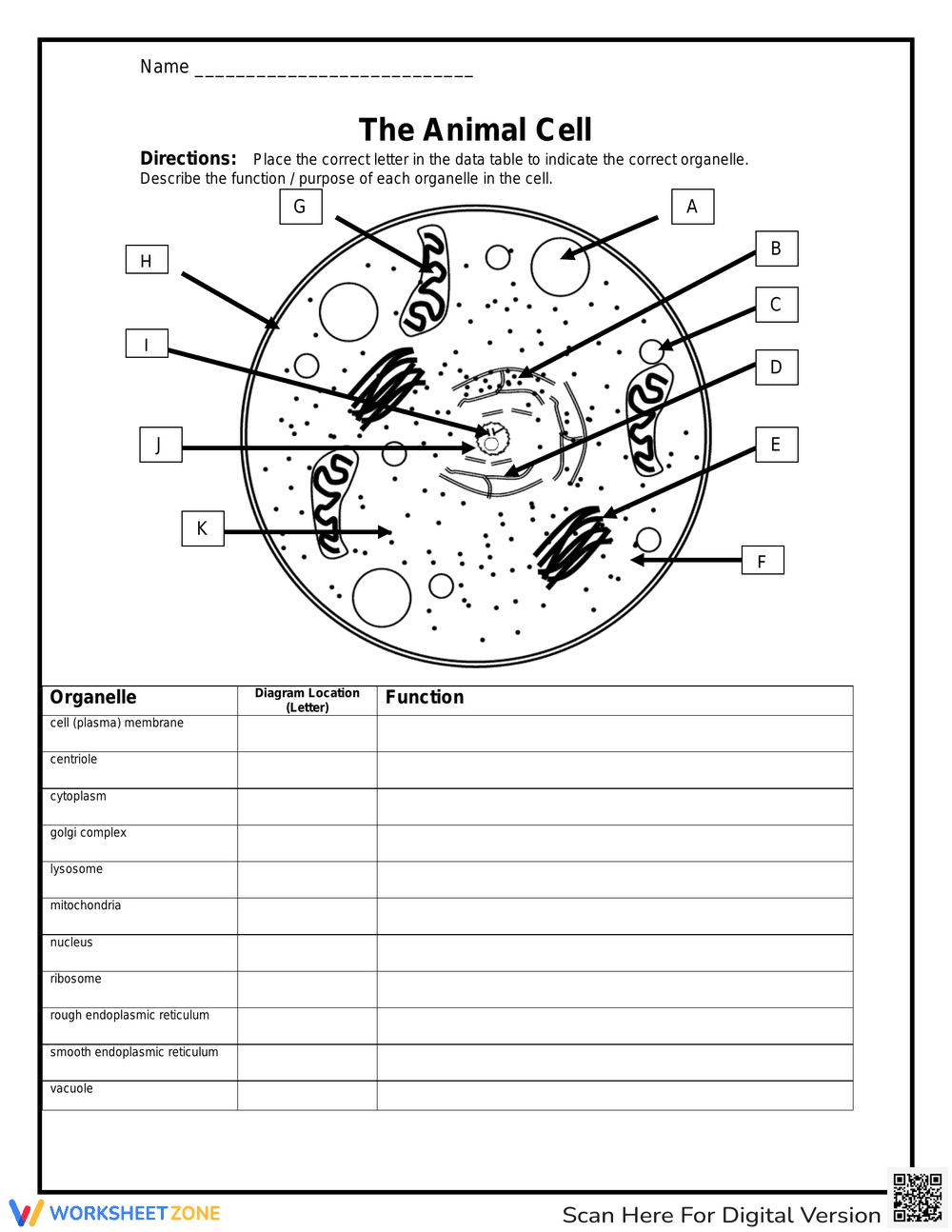
This is a worksheet about the animal cell. It features a diagram of an animal cell with different organelles labeled with letters A through M. Students are directed to match the letter of each organelle to its name in a table, and then describe the function of each organelle in the cell. The table includes organelles such as cell (plasma) membrane, centriole, cytoplasm, golgi complex, lysosome, mitochondria, nucleus, ribosome, rough endoplasmic reticulum, smooth endoplasmic reticulum, and vacuole.
Grade Level Suitability:
This worksheet is most suitable for grades 6-9. The complexity of the cell structure and the functions of the organelles are generally introduced in middle school life science or introductory biology courses.
Why Use It:
This worksheet helps students learn and reinforce their understanding of animal cell structure and function. It encourages active learning by requiring students to identify organelles in a diagram and describe their roles within the cell. This promotes critical thinking and helps solidify key biological concepts.
How to Use It:
First, have students identify each labeled organelle in the diagram (A-M). Then, they should write the corresponding letter in the 'Diagram Location (Letter)' column of the table next to the correct organelle name. Finally, they should research or recall the function of each organelle and describe it in the 'Function' column.
Target Users:
The target users are middle school and early high school students studying cell biology. It's also beneficial for teachers looking for a supplementary activity to reinforce cell structure and function concepts.
This is a worksheet about the animal cell. It features a diagram of an animal cell with different organelles labeled with letters A through M. Students are directed to match the letter of each organelle to its name in a table, and then describe the function of each organelle in the cell. The table includes organelles such as cell (plasma) membrane, centriole, cytoplasm, golgi complex, lysosome, mitochondria, nucleus, ribosome, rough endoplasmic reticulum, smooth endoplasmic reticulum, and vacuole.
Grade Level Suitability:
This worksheet is most suitable for grades 6-9. The complexity of the cell structure and the functions of the organelles are generally introduced in middle school life science or introductory biology courses.
Why Use It:
This worksheet helps students learn and reinforce their understanding of animal cell structure and function. It encourages active learning by requiring students to identify organelles in a diagram and describe their roles within the cell. This promotes critical thinking and helps solidify key biological concepts.
How to Use It:
First, have students identify each labeled organelle in the diagram (A-M). Then, they should write the corresponding letter in the 'Diagram Location (Letter)' column of the table next to the correct organelle name. Finally, they should research or recall the function of each organelle and describe it in the 'Function' column.
Target Users:
The target users are middle school and early high school students studying cell biology. It's also beneficial for teachers looking for a supplementary activity to reinforce cell structure and function concepts.


