


























1 / 2
0
Views
0
Downloads


0.0
0
0 Likes
Animal Cell Worksheet – Label and Define Cell Parts
0 Views
0 Downloads
Paste this activity's link or code into your existing LMS (Google Classroom, Canvas, Teams, Schoology, Moodle, etc.).
Students can open and work on the activity right away, with no student login required.
You'll still be able to track student progress and results from your teacher account.
Information
Description
What It Is:
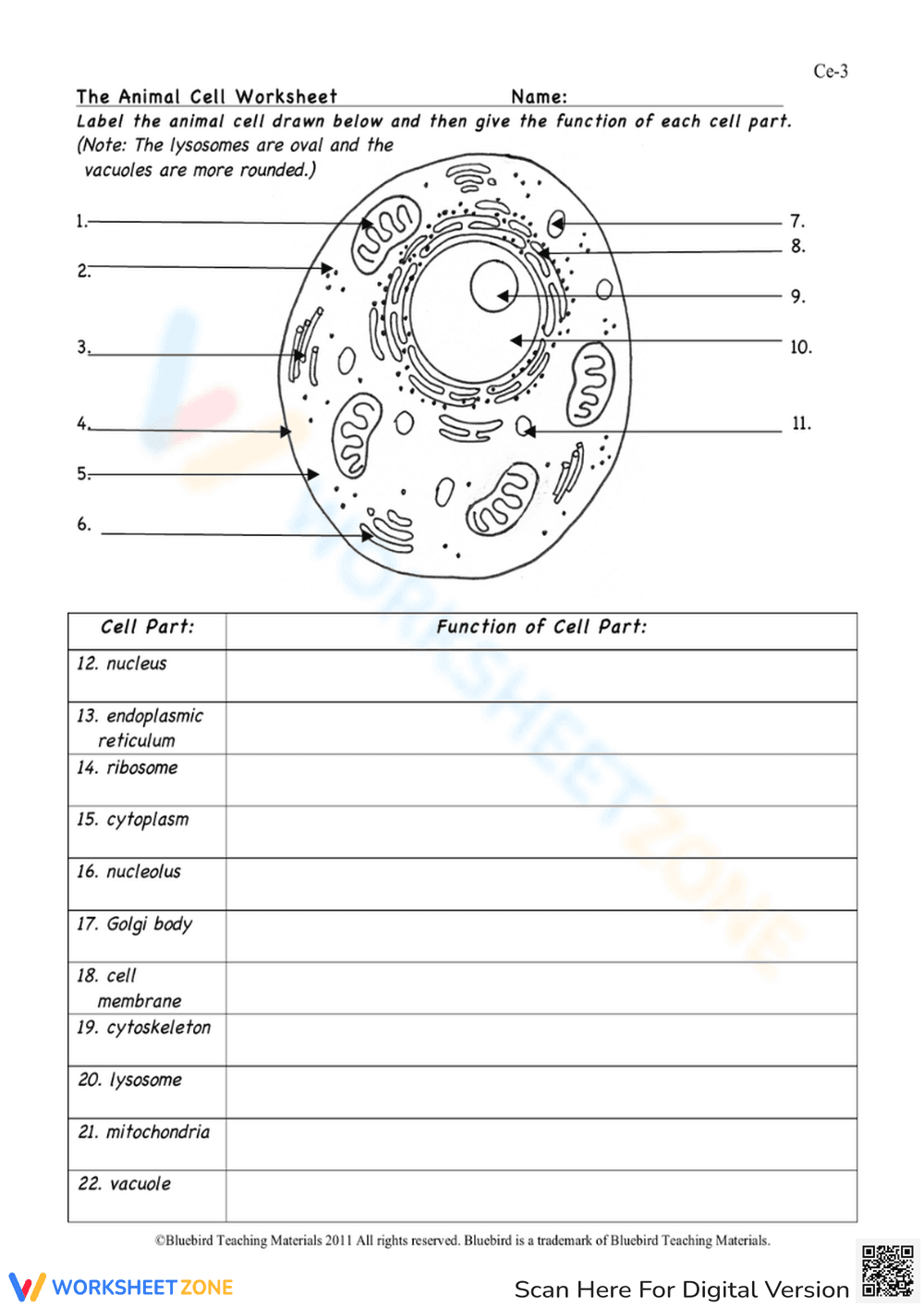
This is an animal cell worksheet. It features a diagram of an animal cell with 11 numbered labels pointing to different cell parts. Students are instructed to label these parts using their knowledge of cell biology. Below the diagram is a table with two columns: 'Cell Part' and 'Function of Cell Part.' The 'Cell Part' column lists 11 cell components (nucleus, endoplasmic reticulum, ribosome, cytoplasm, nucleolus, Golgi body, cell membrane, cytoskeleton, lysosome, mitochondria, and vacuole). Students must write the function of each listed cell part in the corresponding space.
Grade Level Suitability:
This worksheet is suitable for grades 6-9. The complexity of cell structures and functions aligns with middle school and early high school biology curricula. It requires understanding of basic cell biology concepts.
Why Use It:
This worksheet reinforces students' understanding of animal cell structure and function. It helps them identify and recall the different parts of a cell and their respective roles. The activity promotes critical thinking and memorization of key biological concepts.
How to Use It:
First, students should label the parts of the animal cell diagram by writing the correct name of the cell part next to the corresponding number. Then, using textbooks, notes, or online resources, they should research and write the function of each cell part listed in the table.
Target Users:
This worksheet is designed for middle and high school students studying cell biology. It is also useful for teachers looking for a comprehensive review or assessment tool for animal cell structure and function.
This is an animal cell worksheet. It features a diagram of an animal cell with 11 numbered labels pointing to different cell parts. Students are instructed to label these parts using their knowledge of cell biology. Below the diagram is a table with two columns: 'Cell Part' and 'Function of Cell Part.' The 'Cell Part' column lists 11 cell components (nucleus, endoplasmic reticulum, ribosome, cytoplasm, nucleolus, Golgi body, cell membrane, cytoskeleton, lysosome, mitochondria, and vacuole). Students must write the function of each listed cell part in the corresponding space.
Grade Level Suitability:
This worksheet is suitable for grades 6-9. The complexity of cell structures and functions aligns with middle school and early high school biology curricula. It requires understanding of basic cell biology concepts.
Why Use It:
This worksheet reinforces students' understanding of animal cell structure and function. It helps them identify and recall the different parts of a cell and their respective roles. The activity promotes critical thinking and memorization of key biological concepts.
How to Use It:
First, students should label the parts of the animal cell diagram by writing the correct name of the cell part next to the corresponding number. Then, using textbooks, notes, or online resources, they should research and write the function of each cell part listed in the table.
Target Users:
This worksheet is designed for middle and high school students studying cell biology. It is also useful for teachers looking for a comprehensive review or assessment tool for animal cell structure and function.


