


























1 / 8
0
Views
0
Downloads


0.0
0
0 Likes
Updated Electromagnetic Spectrum
0 Views
0 Downloads
Paste this activity's link or code into your existing LMS (Google Classroom, Canvas, Teams, Schoology, Moodle, etc.).
Students can open and work on the activity right away, with no student login required.
You'll still be able to track student progress and results from your teacher account.
Information
Description
What It Is:
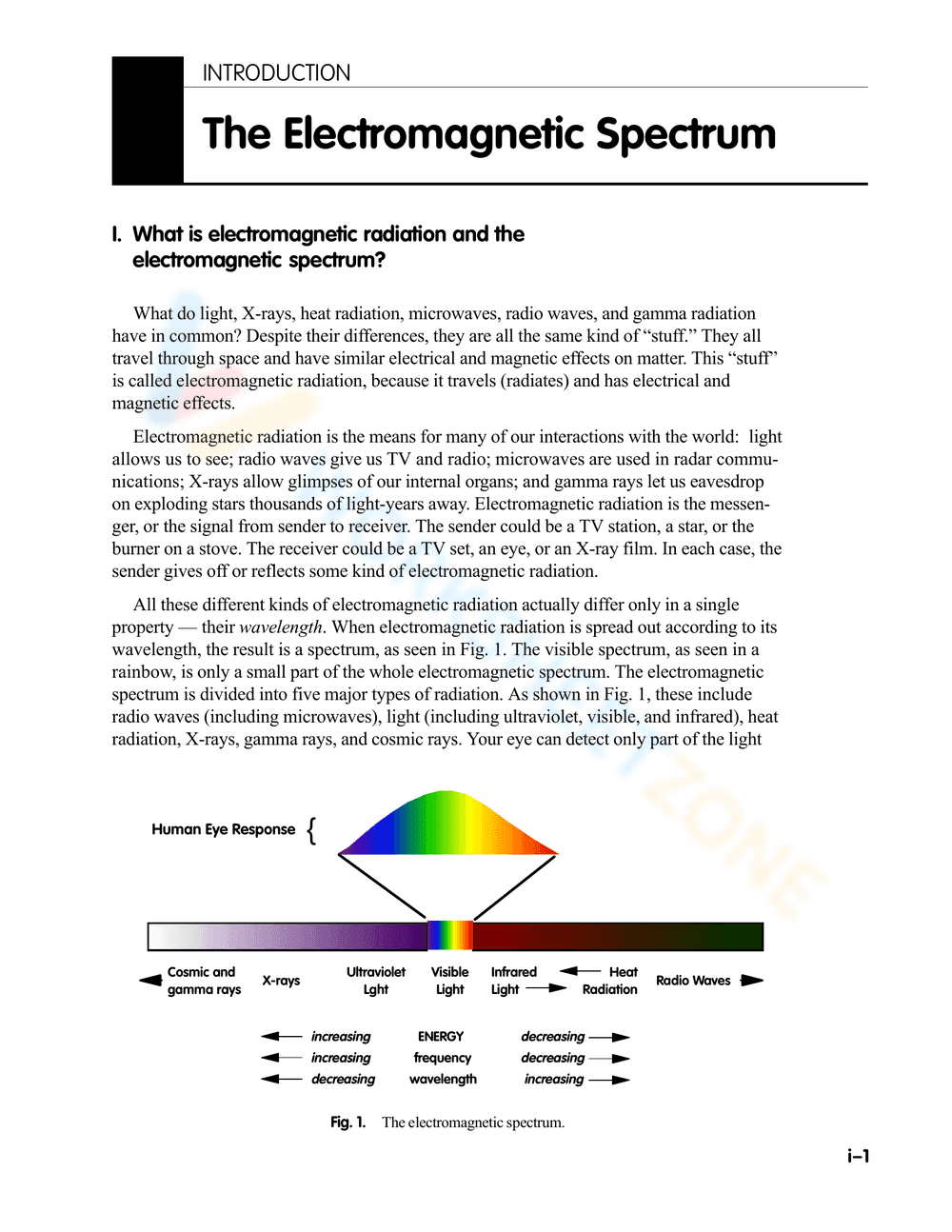
This is an educational worksheet page introducing the electromagnetic spectrum. It includes a question defining electromagnetic radiation and the electromagnetic spectrum. It provides examples of different types of electromagnetic radiation like light, X-rays, heat radiation, microwaves, radio waves, and gamma radiation, explaining their common properties and how they interact with the world. It also includes a diagram (Fig. 1) illustrating the electromagnetic spectrum, showing the relationship between energy, frequency, wavelength, and the different types of radiation, including the human eye response to visible light.
Grade Level Suitability:
This worksheet is suitable for grades 7-10 (middle school to early high school). The concepts require an understanding of basic physics and scientific terminology. The diagram and explanations are detailed enough for this age group to grasp the fundamentals of the electromagnetic spectrum.
Why Use It:
This worksheet helps students understand the concept of the electromagnetic spectrum, its different types of radiation, and their properties. It connects abstract scientific concepts to real-world applications, enhancing comprehension and engagement. It also visually represents the spectrum, aiding in visual learning and memory retention.
How to Use It:
Begin by reading the introductory text and answering the question. Analyze the diagram (Fig. 1) to understand the relationship between energy, frequency, and wavelength across the electromagnetic spectrum. Discuss the examples provided in the text to connect the concepts to real-world applications. This can be used as a pre-reading activity, in-class exercise, or homework assignment.
Target Users:
The target users are middle and high school students learning about physics, specifically electromagnetic radiation and the electromagnetic spectrum. It is also useful for teachers looking for introductory material on this topic.
This is an educational worksheet page introducing the electromagnetic spectrum. It includes a question defining electromagnetic radiation and the electromagnetic spectrum. It provides examples of different types of electromagnetic radiation like light, X-rays, heat radiation, microwaves, radio waves, and gamma radiation, explaining their common properties and how they interact with the world. It also includes a diagram (Fig. 1) illustrating the electromagnetic spectrum, showing the relationship between energy, frequency, wavelength, and the different types of radiation, including the human eye response to visible light.
Grade Level Suitability:
This worksheet is suitable for grades 7-10 (middle school to early high school). The concepts require an understanding of basic physics and scientific terminology. The diagram and explanations are detailed enough for this age group to grasp the fundamentals of the electromagnetic spectrum.
Why Use It:
This worksheet helps students understand the concept of the electromagnetic spectrum, its different types of radiation, and their properties. It connects abstract scientific concepts to real-world applications, enhancing comprehension and engagement. It also visually represents the spectrum, aiding in visual learning and memory retention.
How to Use It:
Begin by reading the introductory text and answering the question. Analyze the diagram (Fig. 1) to understand the relationship between energy, frequency, and wavelength across the electromagnetic spectrum. Discuss the examples provided in the text to connect the concepts to real-world applications. This can be used as a pre-reading activity, in-class exercise, or homework assignment.
Target Users:
The target users are middle and high school students learning about physics, specifically electromagnetic radiation and the electromagnetic spectrum. It is also useful for teachers looking for introductory material on this topic.


