


























1 / 7
0
Views
0
Downloads




0.0
0
0 Likes
Thermodynamics: Entropy, Free Energy, Equilibrium
0 Views
0 Downloads
Paste this activity's link or code into your existing LMS (Google Classroom, Canvas, Teams, Schoology, Moodle, etc.).
Students can open and work on the activity right away, with no student login required.
You'll still be able to track student progress and results from your teacher account.
Information
Description
What It Is:
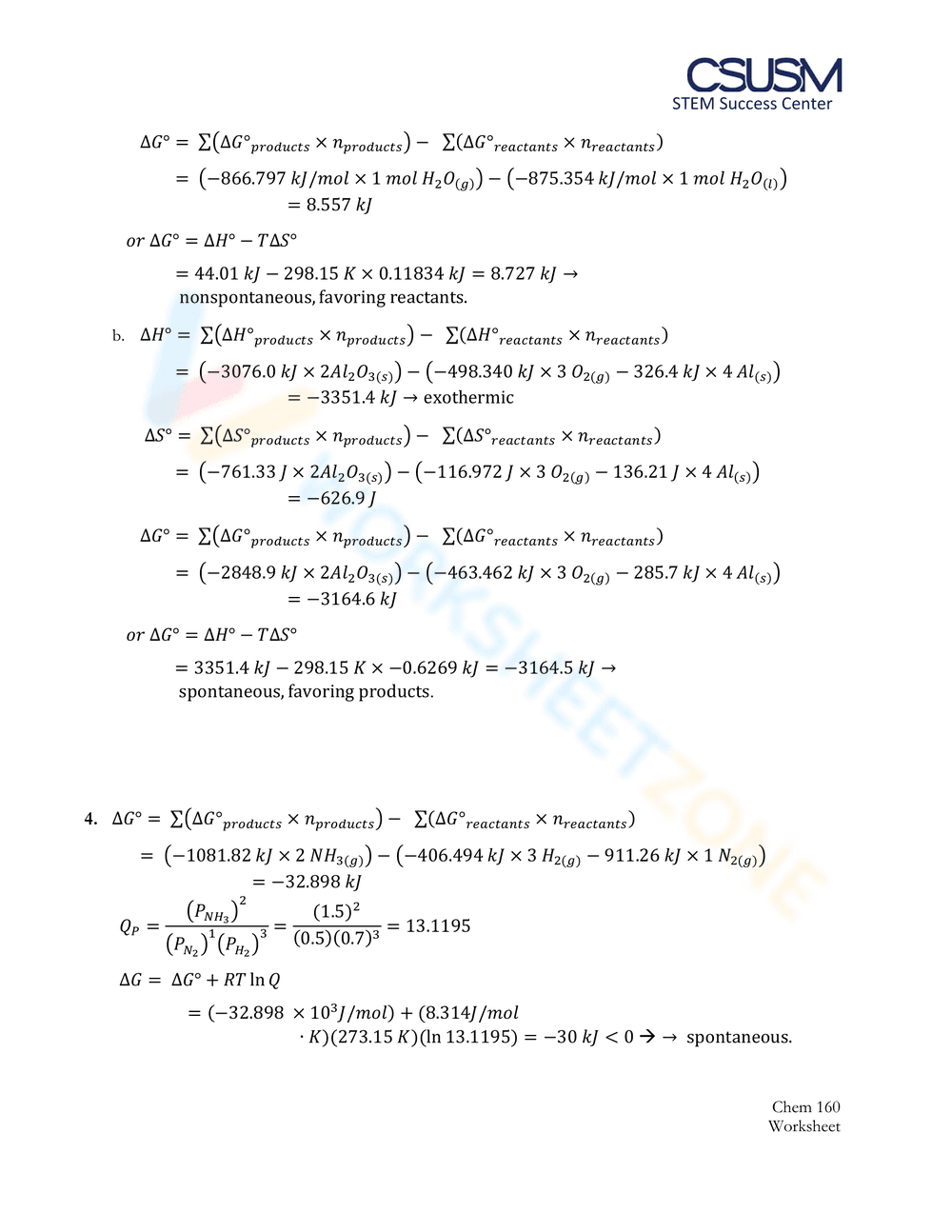
This is a chemistry worksheet focused on thermodynamics, entropy, free energy, and equilibrium. It includes questions asking students to define terms like Gibbs free energy, enthalpy, and entropy, and to explain the relationship between them. It also includes problems where students need to predict the sign of entropy change (ΔS) for various chemical processes, and calculate ΔS°, ΔH°, and ΔG° for reactions using standard values of formation.
Grade Level Suitability:
This worksheet is suitable for college level chemistry, specifically introductory physical chemistry courses (e.g., Chem 160 as noted on the sheet). The concepts covered, like Gibbs free energy and entropy, and the calculations required, are typically taught at the undergraduate level.
Why Use It:
This worksheet helps students to understand and apply the concepts of thermodynamics, including spontaneity, entropy, and Gibbs free energy. It reinforces their understanding of chemical reactions and their equilibrium states. By working through the problems, students can practice predicting entropy changes and calculating thermodynamic parameters, enhancing their problem-solving skills.
How to Use It:
Students should first review the relevant chapters or lecture notes on thermodynamics, entropy, and Gibbs free energy. They should then work through the questions sequentially, showing their work and providing explanations for their answers. For the calculation problems, they will need access to a table of standard values of formation.
Target Users:
The target users are college students enrolled in an introductory physical chemistry or general chemistry course covering thermodynamics. It is designed for students who need to practice and reinforce their understanding of thermodynamic concepts and calculations.
This is a chemistry worksheet focused on thermodynamics, entropy, free energy, and equilibrium. It includes questions asking students to define terms like Gibbs free energy, enthalpy, and entropy, and to explain the relationship between them. It also includes problems where students need to predict the sign of entropy change (ΔS) for various chemical processes, and calculate ΔS°, ΔH°, and ΔG° for reactions using standard values of formation.
Grade Level Suitability:
This worksheet is suitable for college level chemistry, specifically introductory physical chemistry courses (e.g., Chem 160 as noted on the sheet). The concepts covered, like Gibbs free energy and entropy, and the calculations required, are typically taught at the undergraduate level.
Why Use It:
This worksheet helps students to understand and apply the concepts of thermodynamics, including spontaneity, entropy, and Gibbs free energy. It reinforces their understanding of chemical reactions and their equilibrium states. By working through the problems, students can practice predicting entropy changes and calculating thermodynamic parameters, enhancing their problem-solving skills.
How to Use It:
Students should first review the relevant chapters or lecture notes on thermodynamics, entropy, and Gibbs free energy. They should then work through the questions sequentially, showing their work and providing explanations for their answers. For the calculation problems, they will need access to a table of standard values of formation.
Target Users:
The target users are college students enrolled in an introductory physical chemistry or general chemistry course covering thermodynamics. It is designed for students who need to practice and reinforce their understanding of thermodynamic concepts and calculations.


