


























1 / 2
0
Views
0
Downloads


0 Likes
Types of Intermolecular Forces Worksheet
0 Views
0 Downloads
Paste this activity's link or code into your existing LMS (Google Classroom, Canvas, Teams, Schoology, Moodle, etc.).
Students can open and work on the activity right away, with no student login required.
You'll still be able to track student progress and results from your teacher account.
Information
Description
What It Is:
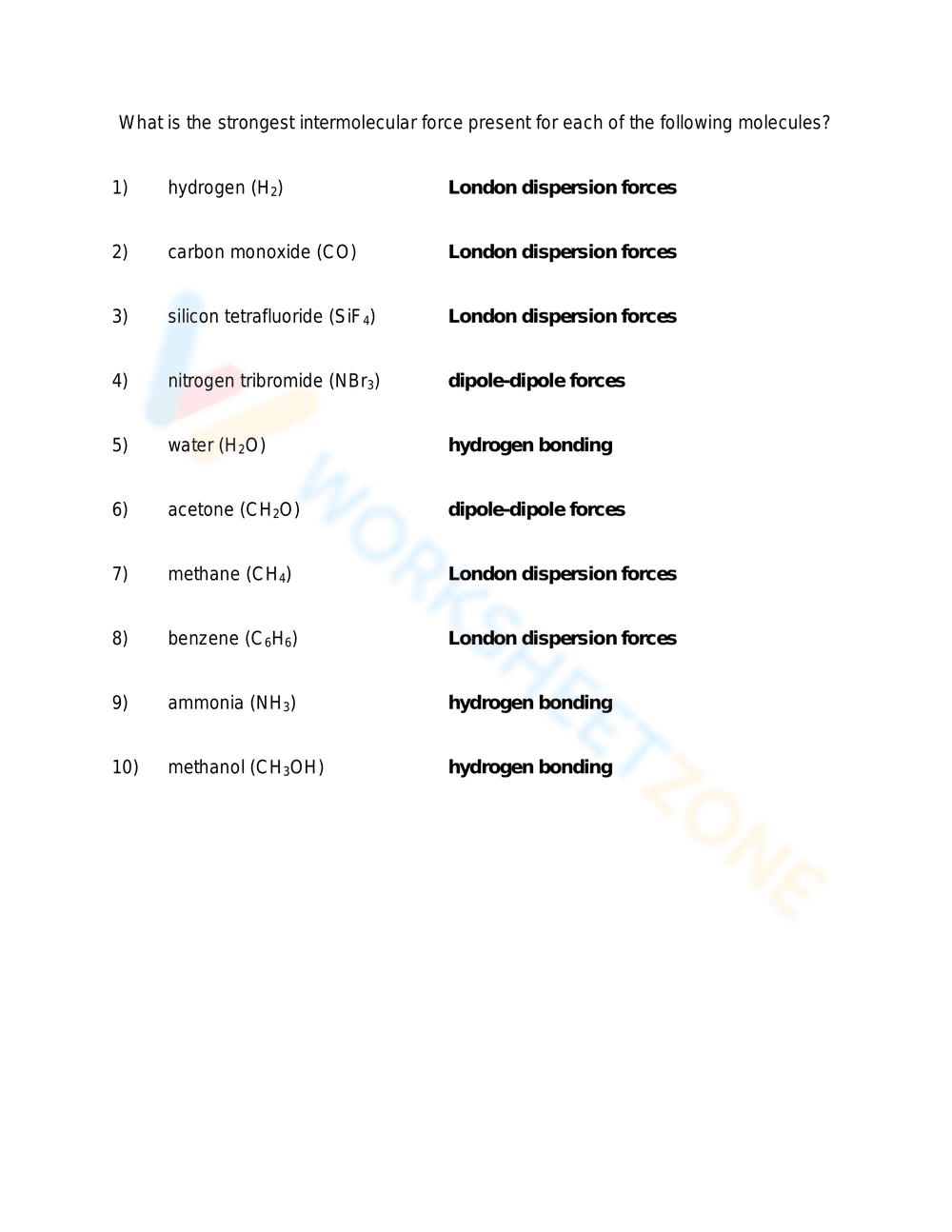
This is a worksheet titled 'Types of Intermolecular Forces.' It presents a list of ten different molecules, including hydrogen (H2), carbon monoxide (CO), silicon tetrafluoride (SiF4), nitrogen tribromide (NBr3), water (H2O), acetone (CH2O), methane (CH4), benzene (C6H6), ammonia (NH3), and methanol (CH3OH). The worksheet asks the student to identify the strongest intermolecular force present in each molecule by writing it on the provided line.
Grade Level Suitability:
This worksheet is suitable for high school and early college-level chemistry courses. The content requires an understanding of molecular structure, polarity, and the different types of intermolecular forces (e.g., London dispersion forces, dipole-dipole interactions, hydrogen bonding).
Why Use It:
This worksheet reinforces the understanding of intermolecular forces and their relationship to molecular structure. It helps students practice identifying the strongest intermolecular force present in different molecules, strengthening their grasp of these fundamental concepts in chemistry and preparing them for more advanced topics such as phase changes and properties of liquids.
How to Use It:
Students should analyze the molecular structure of each molecule listed and determine the types of intermolecular forces that could potentially be present. Based on the molecular polarity and presence of hydrogen bonding, they should identify the strongest intermolecular force for each molecule and write it on the provided line.
Target Users:
The target users are high school chemistry students, introductory college chemistry students, and anyone reviewing fundamental chemistry concepts related to intermolecular forces. It can be used as a homework assignment, in-class activity, or a review tool.
This is a worksheet titled 'Types of Intermolecular Forces.' It presents a list of ten different molecules, including hydrogen (H2), carbon monoxide (CO), silicon tetrafluoride (SiF4), nitrogen tribromide (NBr3), water (H2O), acetone (CH2O), methane (CH4), benzene (C6H6), ammonia (NH3), and methanol (CH3OH). The worksheet asks the student to identify the strongest intermolecular force present in each molecule by writing it on the provided line.
Grade Level Suitability:
This worksheet is suitable for high school and early college-level chemistry courses. The content requires an understanding of molecular structure, polarity, and the different types of intermolecular forces (e.g., London dispersion forces, dipole-dipole interactions, hydrogen bonding).
Why Use It:
This worksheet reinforces the understanding of intermolecular forces and their relationship to molecular structure. It helps students practice identifying the strongest intermolecular force present in different molecules, strengthening their grasp of these fundamental concepts in chemistry and preparing them for more advanced topics such as phase changes and properties of liquids.
How to Use It:
Students should analyze the molecular structure of each molecule listed and determine the types of intermolecular forces that could potentially be present. Based on the molecular polarity and presence of hydrogen bonding, they should identify the strongest intermolecular force for each molecule and write it on the provided line.
Target Users:
The target users are high school chemistry students, introductory college chemistry students, and anyone reviewing fundamental chemistry concepts related to intermolecular forces. It can be used as a homework assignment, in-class activity, or a review tool.


