


























0
Views
0
Downloads

0.0
0
0 Likes
Explore Endothermic and Exothermic Reactions
0 Views
0 Downloads
Paste this activity's link or code into your existing LMS (Google Classroom, Canvas, Teams, Schoology, Moodle, etc.).
Students can open and work on the activity right away, with no student login required.
You'll still be able to track student progress and results from your teacher account.
Information
Description
What It Is:
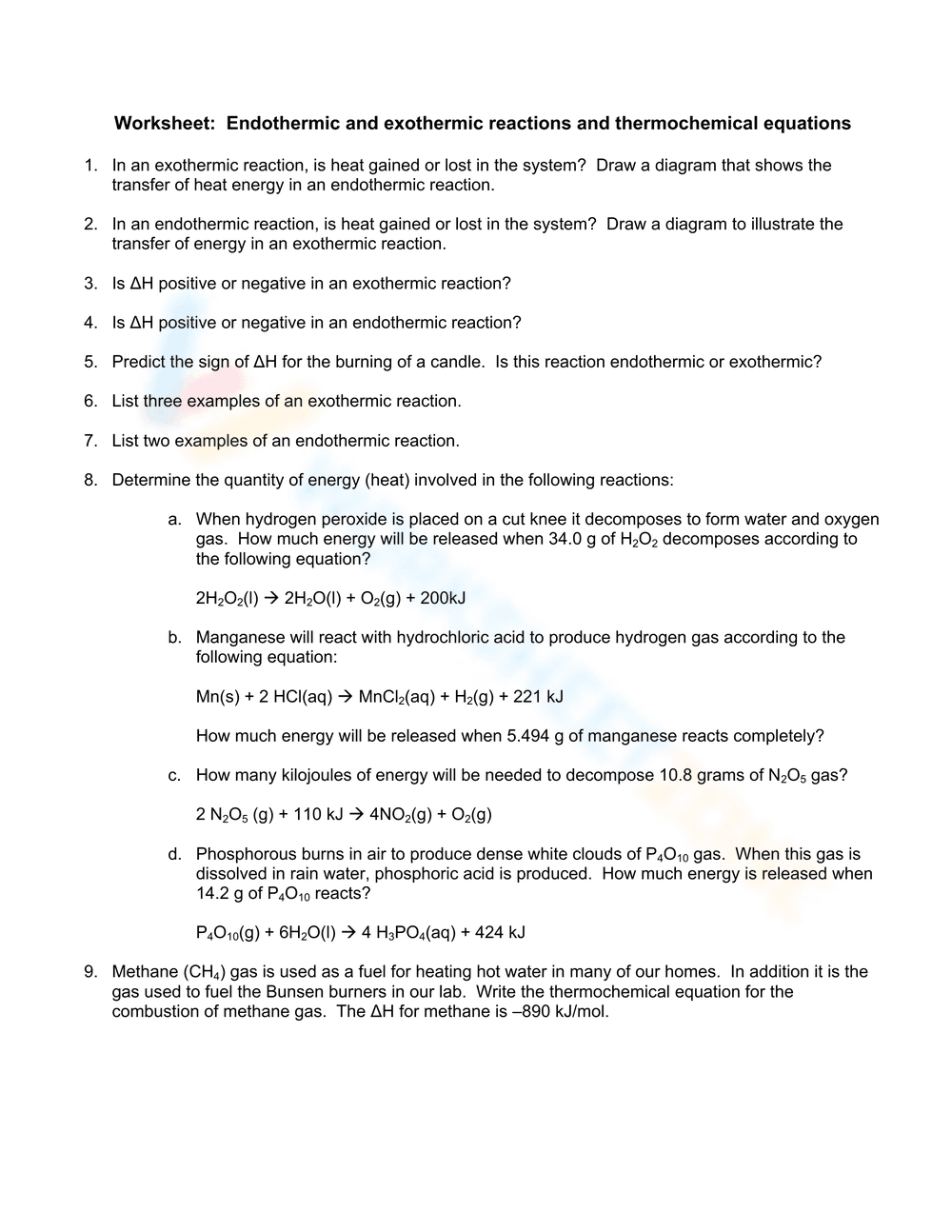
This is a chemistry worksheet focusing on endothermic and exothermic reactions and thermochemical equations. It includes questions about heat transfer, enthalpy changes (ΔH), and examples of both types of reactions. It also presents thermochemical equations and asks students to calculate the quantity of energy involved in various reactions like the decomposition of hydrogen peroxide, the reaction of manganese with hydrochloric acid, the decomposition of N2O5, and the reaction of P4O10 with water. Finally, it asks students to write the thermochemical equation for the combustion of methane.
Grade Level Suitability:
This worksheet is suitable for high school chemistry students, specifically grades 11-12. The concepts covered, such as enthalpy, thermochemical equations, and stoichiometry, are typically part of a high school chemistry curriculum. The calculations involved require a solid understanding of chemical equations and mole concepts.
Why Use It:
This worksheet reinforces understanding of endothermic and exothermic reactions, enthalpy changes, and thermochemical equations. It provides practice in applying these concepts to real-world examples and calculating energy changes in chemical reactions. It helps students develop problem-solving skills and deepen their understanding of thermodynamics.
How to Use It:
Students should first review the definitions of endothermic and exothermic reactions, enthalpy, and thermochemical equations. They can then work through the questions sequentially, using their knowledge of chemistry to answer the conceptual questions and perform the necessary calculations. For the calculation questions, students will need to use stoichiometry and the given thermochemical equations to determine the amount of energy released or absorbed. Diagrams can be drawn to illustrate heat transfer.
Target Users:
The target users are high school chemistry students learning about thermochemistry, as well as chemistry teachers who need practice problems for their students. It is also suitable for students reviewing for exams or preparing for college-level chemistry courses.
This is a chemistry worksheet focusing on endothermic and exothermic reactions and thermochemical equations. It includes questions about heat transfer, enthalpy changes (ΔH), and examples of both types of reactions. It also presents thermochemical equations and asks students to calculate the quantity of energy involved in various reactions like the decomposition of hydrogen peroxide, the reaction of manganese with hydrochloric acid, the decomposition of N2O5, and the reaction of P4O10 with water. Finally, it asks students to write the thermochemical equation for the combustion of methane.
Grade Level Suitability:
This worksheet is suitable for high school chemistry students, specifically grades 11-12. The concepts covered, such as enthalpy, thermochemical equations, and stoichiometry, are typically part of a high school chemistry curriculum. The calculations involved require a solid understanding of chemical equations and mole concepts.
Why Use It:
This worksheet reinforces understanding of endothermic and exothermic reactions, enthalpy changes, and thermochemical equations. It provides practice in applying these concepts to real-world examples and calculating energy changes in chemical reactions. It helps students develop problem-solving skills and deepen their understanding of thermodynamics.
How to Use It:
Students should first review the definitions of endothermic and exothermic reactions, enthalpy, and thermochemical equations. They can then work through the questions sequentially, using their knowledge of chemistry to answer the conceptual questions and perform the necessary calculations. For the calculation questions, students will need to use stoichiometry and the given thermochemical equations to determine the amount of energy released or absorbed. Diagrams can be drawn to illustrate heat transfer.
Target Users:
The target users are high school chemistry students learning about thermochemistry, as well as chemistry teachers who need practice problems for their students. It is also suitable for students reviewing for exams or preparing for college-level chemistry courses.


