


























0
Views
0
Downloads

0.0
0
0 Likes
Valentine's for Bea and Buzz Worksheet
0 Views
0 Downloads
Paste this activity's link or code into your existing LMS (Google Classroom, Canvas, Teams, Schoology, Moodle, etc.).
Students can open and work on the activity right away, with no student login required.
You'll still be able to track student progress and results from your teacher account.
Information
Description
What It Is:
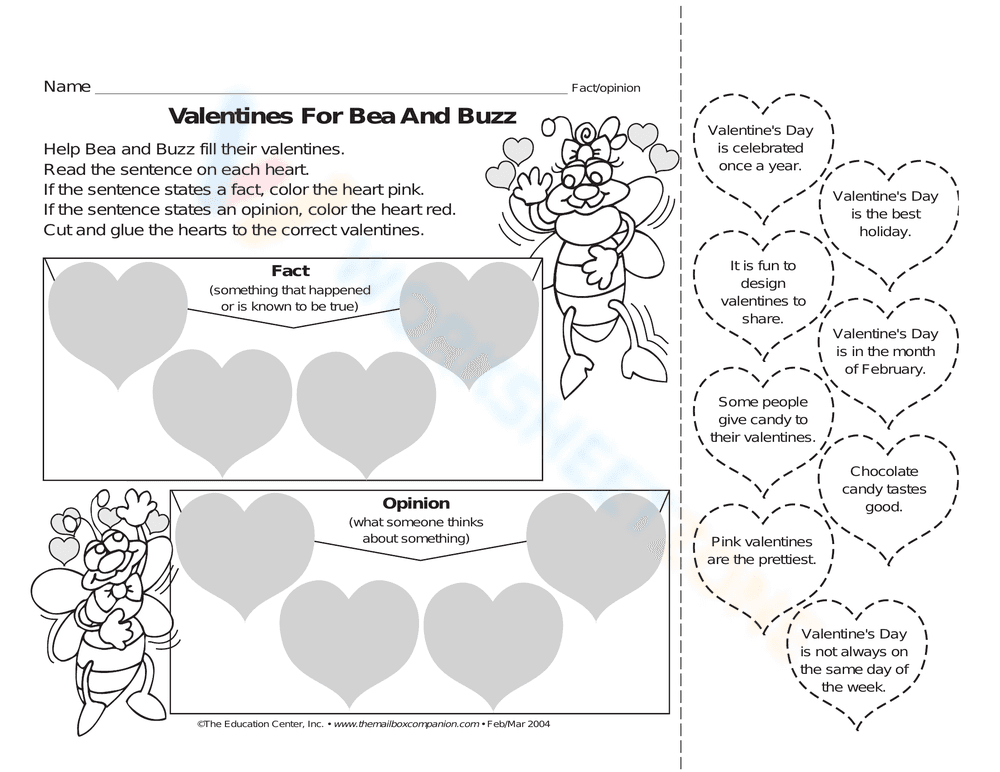
A printable worksheet titled 'Valentines For Bea And Buzz' focusing on distinguishing between facts and opinions. The worksheet features instructions to read sentences on hearts and color them pink if they state a fact and red if they state an opinion. There are designated spaces for gluing hearts labeled 'Fact' and 'Opinion'. A separate section of the worksheet contains multiple hearts with sentences such as 'Valentine's Day is celebrated once a year,' 'Valentine's Day is the best holiday,' and 'Chocolate candy tastes good.'
Grade Level Suitability:
Suitable for 1st to 3rd grade. The concepts of fact and opinion are introduced at this level, and the activity of coloring and gluing provides a hands-on learning experience. The simple sentence structure also makes it accessible for early readers.
Why Use It:
This worksheet helps students develop critical thinking skills by differentiating between facts and opinions. It reinforces reading comprehension and provides a fun, thematic activity related to Valentine's Day. It also enhances fine motor skills through cutting and gluing.
How to Use It:
First, have the student read each sentence on the hearts. Then, guide them to identify whether the sentence is a fact or an opinion. Next, instruct them to color the heart pink if it's a fact and red if it's an opinion. Finally, have them cut out the hearts and glue them into the appropriate sections labeled 'Fact' and 'Opinion.'
Target Users:
Elementary school students, particularly those in 1st, 2nd, or 3rd grade, who are learning about facts and opinions. Teachers can use this as a classroom activity, and parents can use it as a supplemental learning tool at home.
A printable worksheet titled 'Valentines For Bea And Buzz' focusing on distinguishing between facts and opinions. The worksheet features instructions to read sentences on hearts and color them pink if they state a fact and red if they state an opinion. There are designated spaces for gluing hearts labeled 'Fact' and 'Opinion'. A separate section of the worksheet contains multiple hearts with sentences such as 'Valentine's Day is celebrated once a year,' 'Valentine's Day is the best holiday,' and 'Chocolate candy tastes good.'
Grade Level Suitability:
Suitable for 1st to 3rd grade. The concepts of fact and opinion are introduced at this level, and the activity of coloring and gluing provides a hands-on learning experience. The simple sentence structure also makes it accessible for early readers.
Why Use It:
This worksheet helps students develop critical thinking skills by differentiating between facts and opinions. It reinforces reading comprehension and provides a fun, thematic activity related to Valentine's Day. It also enhances fine motor skills through cutting and gluing.
How to Use It:
First, have the student read each sentence on the hearts. Then, guide them to identify whether the sentence is a fact or an opinion. Next, instruct them to color the heart pink if it's a fact and red if it's an opinion. Finally, have them cut out the hearts and glue them into the appropriate sections labeled 'Fact' and 'Opinion.'
Target Users:
Elementary school students, particularly those in 1st, 2nd, or 3rd grade, who are learning about facts and opinions. Teachers can use this as a classroom activity, and parents can use it as a supplemental learning tool at home.


