


























1 / 2
0
Views
0
Downloads


0.0
0
0 Likes
Exploring Wave Properties: Worksheet for Physics Students
0 Views
0 Downloads
Paste this activity's link or code into your existing LMS (Google Classroom, Canvas, Teams, Schoology, Moodle, etc.).
Students can open and work on the activity right away, with no student login required.
You'll still be able to track student progress and results from your teacher account.
Information
Description
What It Is:
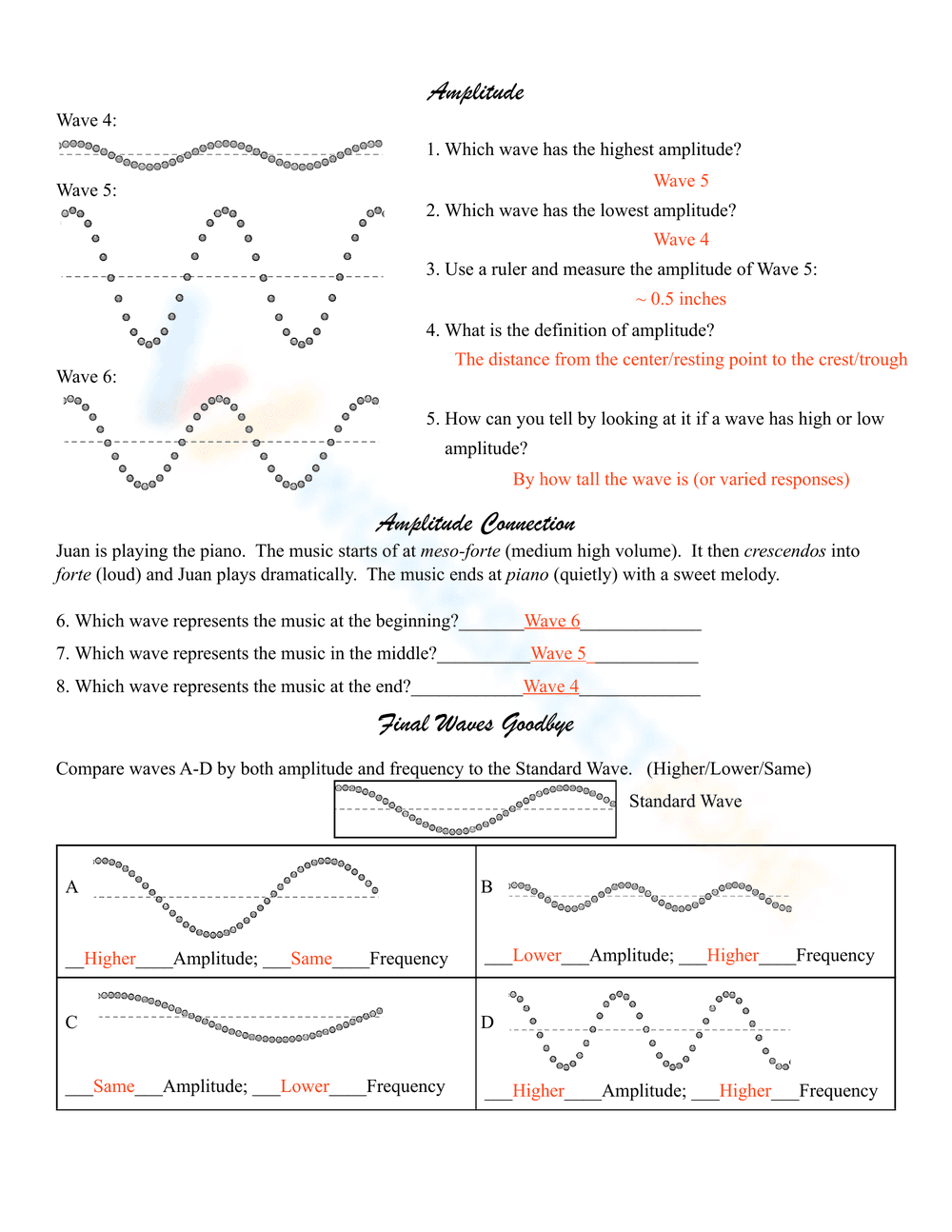
This is a science worksheet focused on waves. It includes sections for labeling parts of a wave (crest, wavelength, amplitude, trough), calculating wavelengths of different waves depicted in dotted lines, answering questions about frequency, and connecting wave frequency to different voices in a family. It appears to be an answer key.
Grade Level Suitability:
This worksheet is suitable for grades 6-8. The concepts of wavelength, amplitude, and frequency are typically introduced in middle school science. The questions require understanding and applying these concepts to different wave diagrams.
Why Use It:
This worksheet helps students learn and reinforce their understanding of wave properties such as wavelength, amplitude, and frequency. It provides visual examples and practical application through calculations and relating frequency to sound. It also introduces the concept of frequency in relation to sound.
How to Use It:
Students can use this worksheet to define wave parts, calculate wavelengths by visually measuring the provided wave diagrams, answer questions about frequency based on the provided waves, and connect wave frequency to real-world examples like voices. It can be used as a quiz, homework assignment, or in-class activity.
Target Users:
This worksheet is designed for middle school students learning about waves in a science class. It can also be used by teachers as a teaching aid or assessment tool, or by parents for supplemental learning at home.
This is a science worksheet focused on waves. It includes sections for labeling parts of a wave (crest, wavelength, amplitude, trough), calculating wavelengths of different waves depicted in dotted lines, answering questions about frequency, and connecting wave frequency to different voices in a family. It appears to be an answer key.
Grade Level Suitability:
This worksheet is suitable for grades 6-8. The concepts of wavelength, amplitude, and frequency are typically introduced in middle school science. The questions require understanding and applying these concepts to different wave diagrams.
Why Use It:
This worksheet helps students learn and reinforce their understanding of wave properties such as wavelength, amplitude, and frequency. It provides visual examples and practical application through calculations and relating frequency to sound. It also introduces the concept of frequency in relation to sound.
How to Use It:
Students can use this worksheet to define wave parts, calculate wavelengths by visually measuring the provided wave diagrams, answer questions about frequency based on the provided waves, and connect wave frequency to real-world examples like voices. It can be used as a quiz, homework assignment, or in-class activity.
Target Users:
This worksheet is designed for middle school students learning about waves in a science class. It can also be used by teachers as a teaching aid or assessment tool, or by parents for supplemental learning at home.


