


























0
Views
0
Downloads

0.0
0
0 Likes
Appreciating Others: Qualities We Value Worksheet
0 Views
0 Downloads
Paste this activity's link or code into your existing LMS (Google Classroom, Canvas, Teams, Schoology, Moodle, etc.).
Students can open and work on the activity right away, with no student login required.
You'll still be able to track student progress and results from your teacher account.
Information
Description
What It Is:
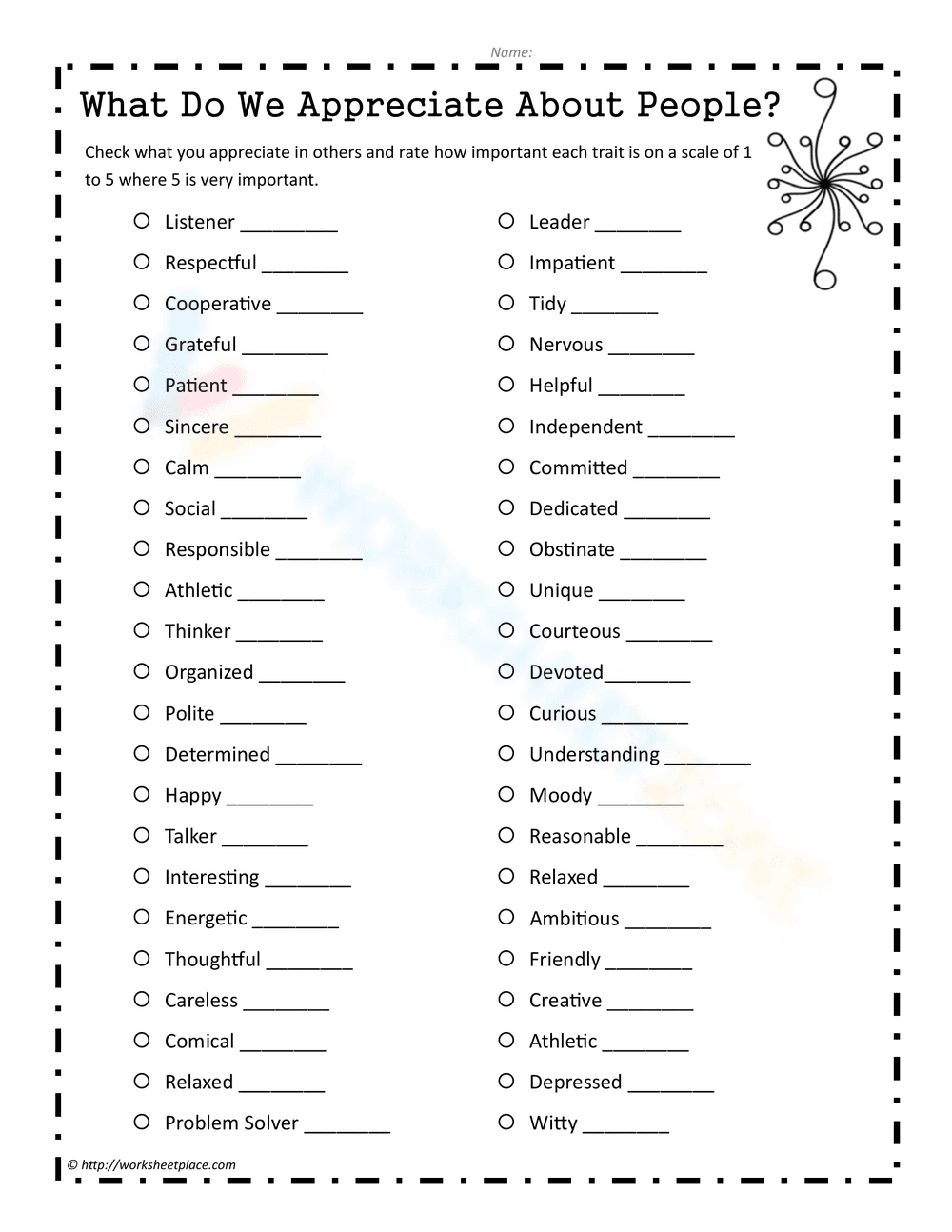
The worksheet is titled 'What Do We Appreciate About People?' and presents a list of character traits. Students are instructed to check the traits they appreciate in others and then rate the importance of each trait on a scale of 1 to 5, where 5 indicates very important. The traits include options like 'Listener,' 'Respectful,' 'Cooperative,' 'Leader,' 'Impatient,' 'Tidy,' 'Nervous,' and many others.
Grade Level Suitability:
This worksheet is suitable for grades 4-8. The vocabulary is appropriate for this age range, and the activity encourages self-reflection and social-emotional learning, which are beneficial for students in these grades as they develop their understanding of relationships and values.
Why Use It:
This worksheet helps students identify and appreciate positive character traits in others. It encourages critical thinking about personal values and promotes empathy and understanding in interpersonal relationships. It also facilitates discussions about the importance of different qualities in friends, family, and community members.
How to Use It:
Provide each student with a worksheet. Instruct them to read through the list of traits and check the ones they appreciate in others. After checking the traits, they should rate each checked trait on a scale of 1 to 5, writing the number in the provided blank space next to the trait. Facilitate a class discussion afterward to share insights and perspectives.
Target Users:
The target users are elementary and middle school students, counselors, teachers, and parents who want to encourage positive social skills, self-reflection, and empathy in children. It can be used in classroom settings, counseling sessions, or as a family activity.
The worksheet is titled 'What Do We Appreciate About People?' and presents a list of character traits. Students are instructed to check the traits they appreciate in others and then rate the importance of each trait on a scale of 1 to 5, where 5 indicates very important. The traits include options like 'Listener,' 'Respectful,' 'Cooperative,' 'Leader,' 'Impatient,' 'Tidy,' 'Nervous,' and many others.
Grade Level Suitability:
This worksheet is suitable for grades 4-8. The vocabulary is appropriate for this age range, and the activity encourages self-reflection and social-emotional learning, which are beneficial for students in these grades as they develop their understanding of relationships and values.
Why Use It:
This worksheet helps students identify and appreciate positive character traits in others. It encourages critical thinking about personal values and promotes empathy and understanding in interpersonal relationships. It also facilitates discussions about the importance of different qualities in friends, family, and community members.
How to Use It:
Provide each student with a worksheet. Instruct them to read through the list of traits and check the ones they appreciate in others. After checking the traits, they should rate each checked trait on a scale of 1 to 5, writing the number in the provided blank space next to the trait. Facilitate a class discussion afterward to share insights and perspectives.
Target Users:
The target users are elementary and middle school students, counselors, teachers, and parents who want to encourage positive social skills, self-reflection, and empathy in children. It can be used in classroom settings, counseling sessions, or as a family activity.


