


























0
Views
0
Downloads

0.0
0
0 Likes
Periodic Trends Answers: Worksheet Practice
0 Views
0 Downloads
Paste this activity's link or code into your existing LMS (Google Classroom, Canvas, Teams, Schoology, Moodle, etc.).
Students can open and work on the activity right away, with no student login required.
You'll still be able to track student progress and results from your teacher account.
Information
Description
What It Is:
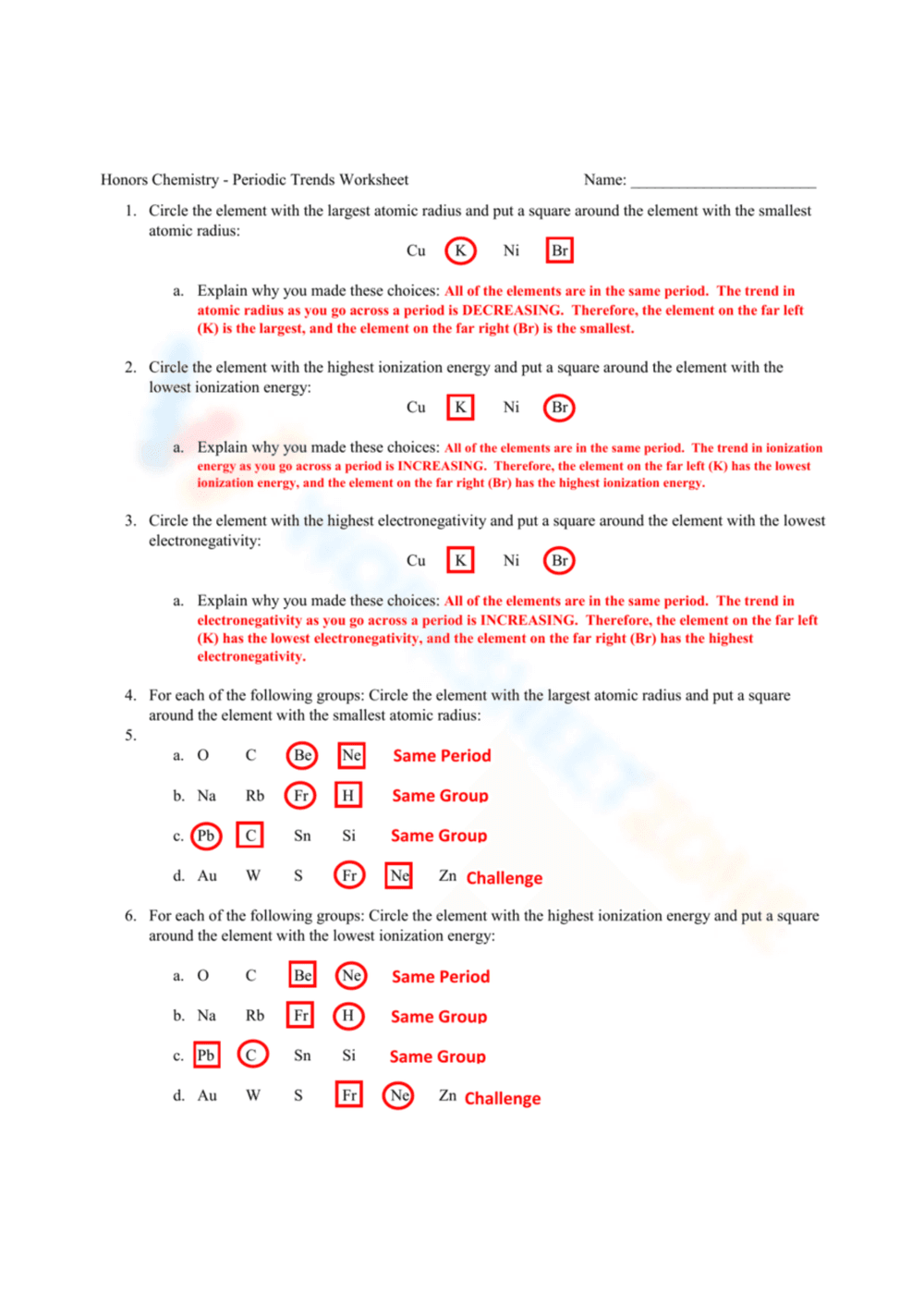
This is a chemistry worksheet focused on periodic trends. It includes questions asking students to identify elements with the largest/smallest atomic radius, highest ionization energy, and highest/lowest electronegativity. Some questions require explaining the reasoning behind the choices, referencing trends within the same period. The worksheet also includes group problems where students have to identify elements with the largest atomic radius or highest ionization energy within a given set of elements, and some are labeled as a 'Zn Challenge'.
Grade Level Suitability:
This worksheet appears suitable for high school students, specifically grades 10-12, taking an honors chemistry course. The concepts of atomic radius, ionization energy, and electronegativity are typically covered at this level, and the worksheet requires a deeper understanding of periodic trends.
Why Use It:
This worksheet helps students reinforce their understanding of periodic trends by applying them to specific elements. It encourages critical thinking by requiring students to explain their choices based on the principles of atomic radius, ionization energy, and electronegativity. The worksheet also tests the ability to identify these trends in groups of elements.
How to Use It:
Students should first review the concepts of atomic radius, ionization energy, and electronegativity and their trends on the periodic table. Then, they should work through each question, circling the element with the specified property and putting a square around the element with the opposite property. For questions with an explanation component, students should write a clear and concise explanation of their reasoning, referencing the relevant periodic trend.
Target Users:
The target users are high school chemistry students, particularly those in honors or advanced placement courses, who are learning about periodic trends and need practice applying these concepts. It would also be useful for teachers looking for practice problems to assign to their students.
This is a chemistry worksheet focused on periodic trends. It includes questions asking students to identify elements with the largest/smallest atomic radius, highest ionization energy, and highest/lowest electronegativity. Some questions require explaining the reasoning behind the choices, referencing trends within the same period. The worksheet also includes group problems where students have to identify elements with the largest atomic radius or highest ionization energy within a given set of elements, and some are labeled as a 'Zn Challenge'.
Grade Level Suitability:
This worksheet appears suitable for high school students, specifically grades 10-12, taking an honors chemistry course. The concepts of atomic radius, ionization energy, and electronegativity are typically covered at this level, and the worksheet requires a deeper understanding of periodic trends.
Why Use It:
This worksheet helps students reinforce their understanding of periodic trends by applying them to specific elements. It encourages critical thinking by requiring students to explain their choices based on the principles of atomic radius, ionization energy, and electronegativity. The worksheet also tests the ability to identify these trends in groups of elements.
How to Use It:
Students should first review the concepts of atomic radius, ionization energy, and electronegativity and their trends on the periodic table. Then, they should work through each question, circling the element with the specified property and putting a square around the element with the opposite property. For questions with an explanation component, students should write a clear and concise explanation of their reasoning, referencing the relevant periodic trend.
Target Users:
The target users are high school chemistry students, particularly those in honors or advanced placement courses, who are learning about periodic trends and need practice applying these concepts. It would also be useful for teachers looking for practice problems to assign to their students.


