


























1 / 5
0
Views
0
Downloads




0 Likes
Drawing Lewis Structures Worksheet
0 Views
0 Downloads
Paste this activity's link or code into your existing LMS (Google Classroom, Canvas, Teams, Schoology, Moodle, etc.).
Students can open and work on the activity right away, with no student login required.
You'll still be able to track student progress and results from your teacher account.
Information
Description
What It Is:
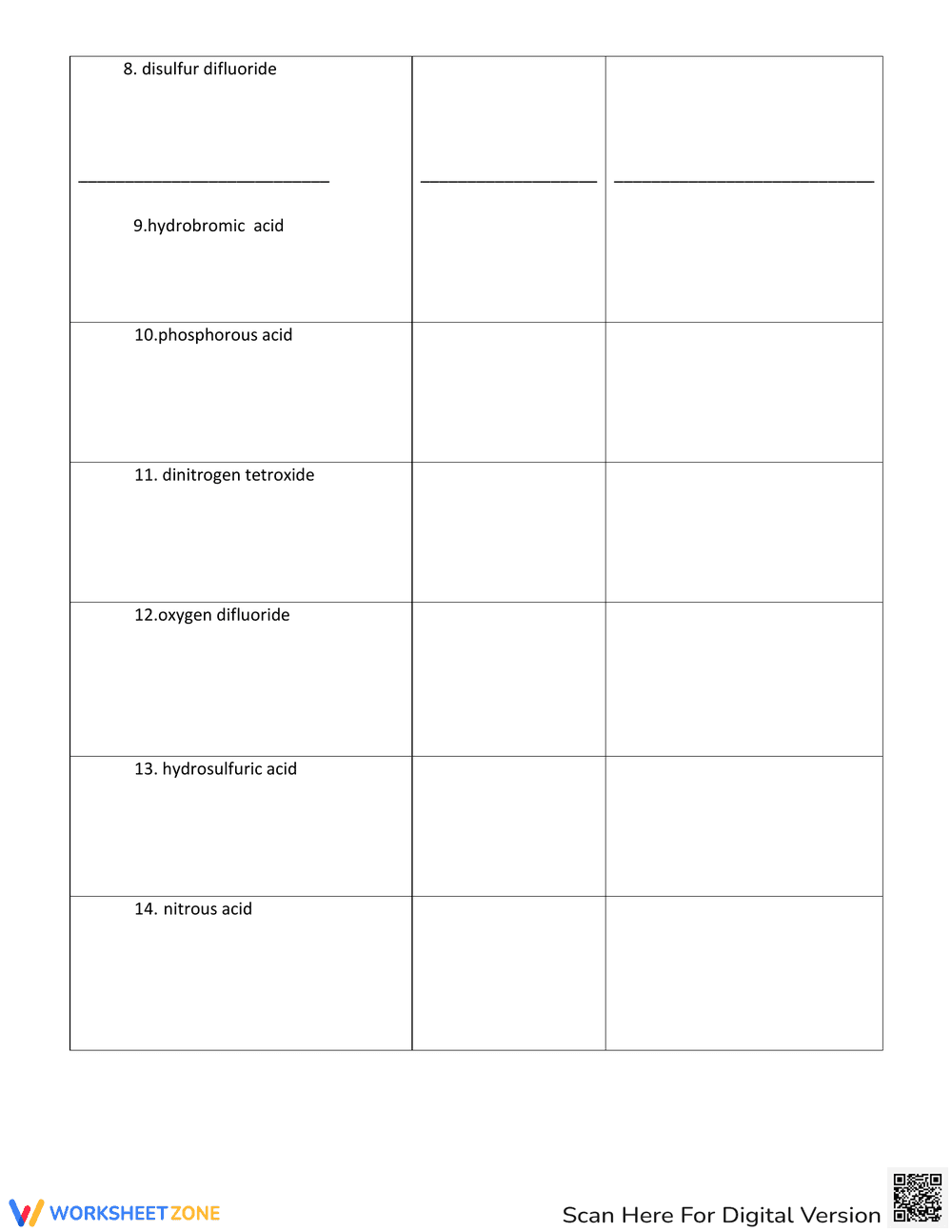
This is a chemistry worksheet focused on drawing Lewis structures. Students are given the names of seven different molecular compounds or acids, including phosphorus trifluoride, acetic acid, silicon tetrahydride, oxygen dichloride, nitric acid, hydrochloric acid, and dinitrogen tetrachloride. They are required to write the molecular formula for each compound and then draw its corresponding Lewis structure in the provided table.
Grade Level Suitability:
This worksheet is suitable for high school chemistry students (Grades 9-12) or introductory college chemistry courses. It requires knowledge of chemical nomenclature, valence electrons, and the rules for drawing Lewis structures, concepts typically covered in these grade levels.
Why Use It:
This worksheet reinforces understanding of chemical formulas and the ability to represent molecular structures using Lewis dot diagrams. It helps students visualize bonding, lone pairs, and the arrangement of atoms in molecules, which are crucial for understanding chemical properties and reactions.
How to Use It:
Students should first identify the elements present in each compound name. Then, they determine the molecular formula for each compound and write it in the 'Molecular formula' column. Next, using the rules for drawing Lewis structures, students should draw the correct Lewis structure for each compound in the corresponding 'Lewis structure' column, showing all bonding and non-bonding electrons.
Target Users:
The target users are high school or college students learning about chemical bonding and Lewis structures in a chemistry course. It is also beneficial for teachers looking for practice worksheets to reinforce these concepts.
This is a chemistry worksheet focused on drawing Lewis structures. Students are given the names of seven different molecular compounds or acids, including phosphorus trifluoride, acetic acid, silicon tetrahydride, oxygen dichloride, nitric acid, hydrochloric acid, and dinitrogen tetrachloride. They are required to write the molecular formula for each compound and then draw its corresponding Lewis structure in the provided table.
Grade Level Suitability:
This worksheet is suitable for high school chemistry students (Grades 9-12) or introductory college chemistry courses. It requires knowledge of chemical nomenclature, valence electrons, and the rules for drawing Lewis structures, concepts typically covered in these grade levels.
Why Use It:
This worksheet reinforces understanding of chemical formulas and the ability to represent molecular structures using Lewis dot diagrams. It helps students visualize bonding, lone pairs, and the arrangement of atoms in molecules, which are crucial for understanding chemical properties and reactions.
How to Use It:
Students should first identify the elements present in each compound name. Then, they determine the molecular formula for each compound and write it in the 'Molecular formula' column. Next, using the rules for drawing Lewis structures, students should draw the correct Lewis structure for each compound in the corresponding 'Lewis structure' column, showing all bonding and non-bonding electrons.
Target Users:
The target users are high school or college students learning about chemical bonding and Lewis structures in a chemistry course. It is also beneficial for teachers looking for practice worksheets to reinforce these concepts.


