


























1 / 4
0
Views
0
Downloads



0.0
0
0 Likes
Updated Worksheet: Dred Scott vs. Sanford (1857)
0 Views
0 Downloads
Paste this activity's link or code into your existing LMS (Google Classroom, Canvas, Teams, Schoology, Moodle, etc.).
Students can open and work on the activity right away, with no student login required.
You'll still be able to track student progress and results from your teacher account.
Information
Description
What It Is:
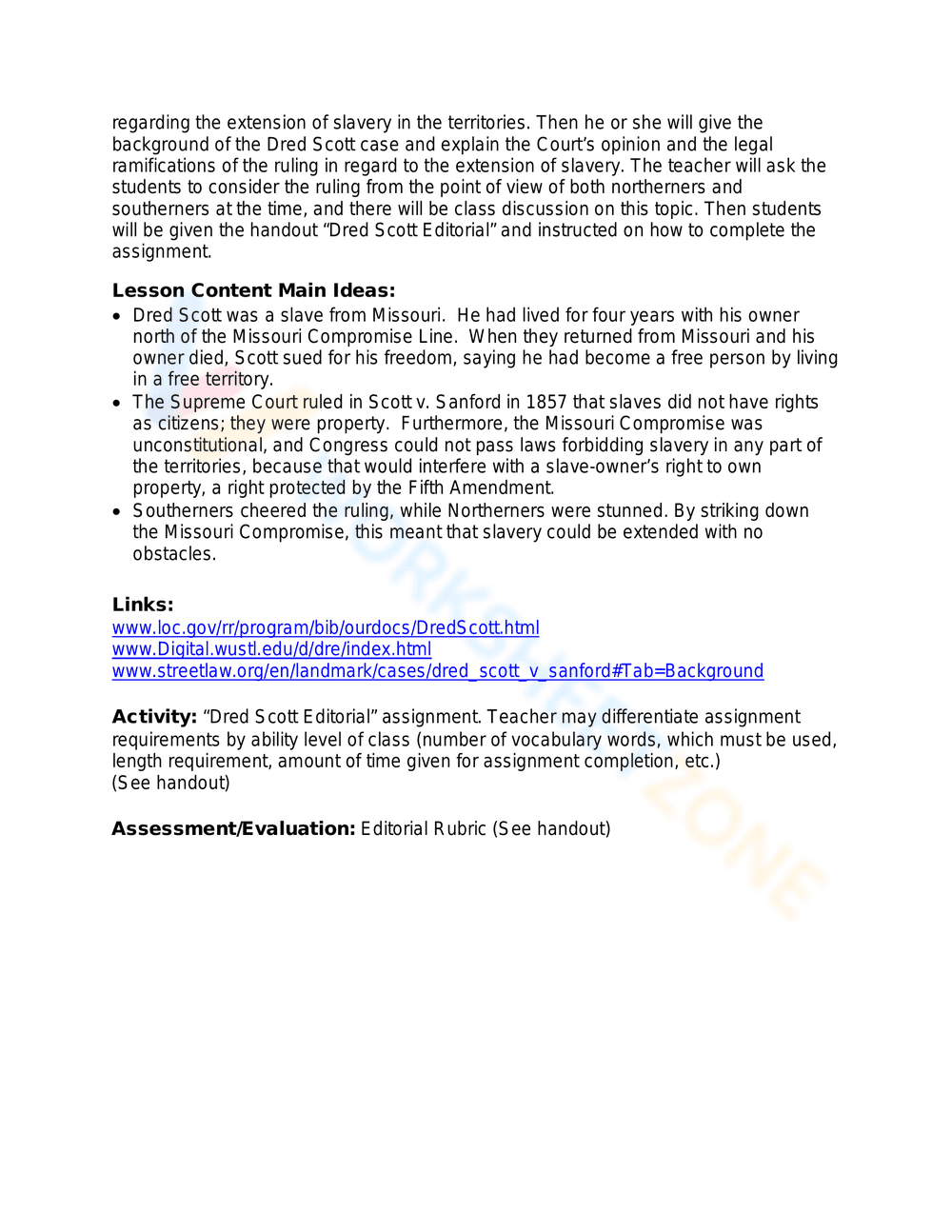
This is an educational worksheet focusing on the Dred Scott v. Sanford Supreme Court case of 1857. It includes an overview of the case, stating that the court held slaves were property and not citizens. It also outlines learning objectives for students to summarize the background of the case, evaluate its impact on events leading to the Civil War, and contrast views in Southern and Northern states regarding the ruling. Materials include a handout of a 'Dred Scott Editorial' and an 'Editorial Rubric.' The worksheet also mentions USHC-3.1 standards.
Grade Level Suitability:
This worksheet is suitable for 11th grade. The complexity of the historical context, legal implications, and analytical objectives (evaluating impact, contrasting views) are appropriate for high school students studying US History and the Constitution.
Why Use It:
This worksheet helps students understand the Dred Scott decision, its historical context, and its impact on the lead up to the American Civil War. It promotes critical thinking by encouraging students to evaluate the decision's impact and contrast different perspectives on it. It also helps to meet US History standards related to the causes of the Civil War.
How to Use It:
The teacher can use this worksheet as part of a lesson on the Dred Scott case. The teacher can use a presentation, lecture, or web quest to review the content. The student will read the provided 'Dred Scott Editorial' and then use the 'Editorial Rubric' to analyze it. The worksheet is designed to provide information and guide analysis and discussion.
Target Users:
The target users are 11th-grade students studying United States History and the Constitution. It is also useful for teachers looking for resources to teach about the Dred Scott decision and its significance in the lead-up to the Civil War.
This is an educational worksheet focusing on the Dred Scott v. Sanford Supreme Court case of 1857. It includes an overview of the case, stating that the court held slaves were property and not citizens. It also outlines learning objectives for students to summarize the background of the case, evaluate its impact on events leading to the Civil War, and contrast views in Southern and Northern states regarding the ruling. Materials include a handout of a 'Dred Scott Editorial' and an 'Editorial Rubric.' The worksheet also mentions USHC-3.1 standards.
Grade Level Suitability:
This worksheet is suitable for 11th grade. The complexity of the historical context, legal implications, and analytical objectives (evaluating impact, contrasting views) are appropriate for high school students studying US History and the Constitution.
Why Use It:
This worksheet helps students understand the Dred Scott decision, its historical context, and its impact on the lead up to the American Civil War. It promotes critical thinking by encouraging students to evaluate the decision's impact and contrast different perspectives on it. It also helps to meet US History standards related to the causes of the Civil War.
How to Use It:
The teacher can use this worksheet as part of a lesson on the Dred Scott case. The teacher can use a presentation, lecture, or web quest to review the content. The student will read the provided 'Dred Scott Editorial' and then use the 'Editorial Rubric' to analyze it. The worksheet is designed to provide information and guide analysis and discussion.
Target Users:
The target users are 11th-grade students studying United States History and the Constitution. It is also useful for teachers looking for resources to teach about the Dred Scott decision and its significance in the lead-up to the Civil War.


