


























1 / 3
0
Views
0
Downloads



0.0
0
0 Likes
Comprehending DNA Base Pairing Worksheet
0 Views
0 Downloads
Paste this activity's link or code into your existing LMS (Google Classroom, Canvas, Teams, Schoology, Moodle, etc.).
Students can open and work on the activity right away, with no student login required.
You'll still be able to track student progress and results from your teacher account.
Information
Description
What It Is:
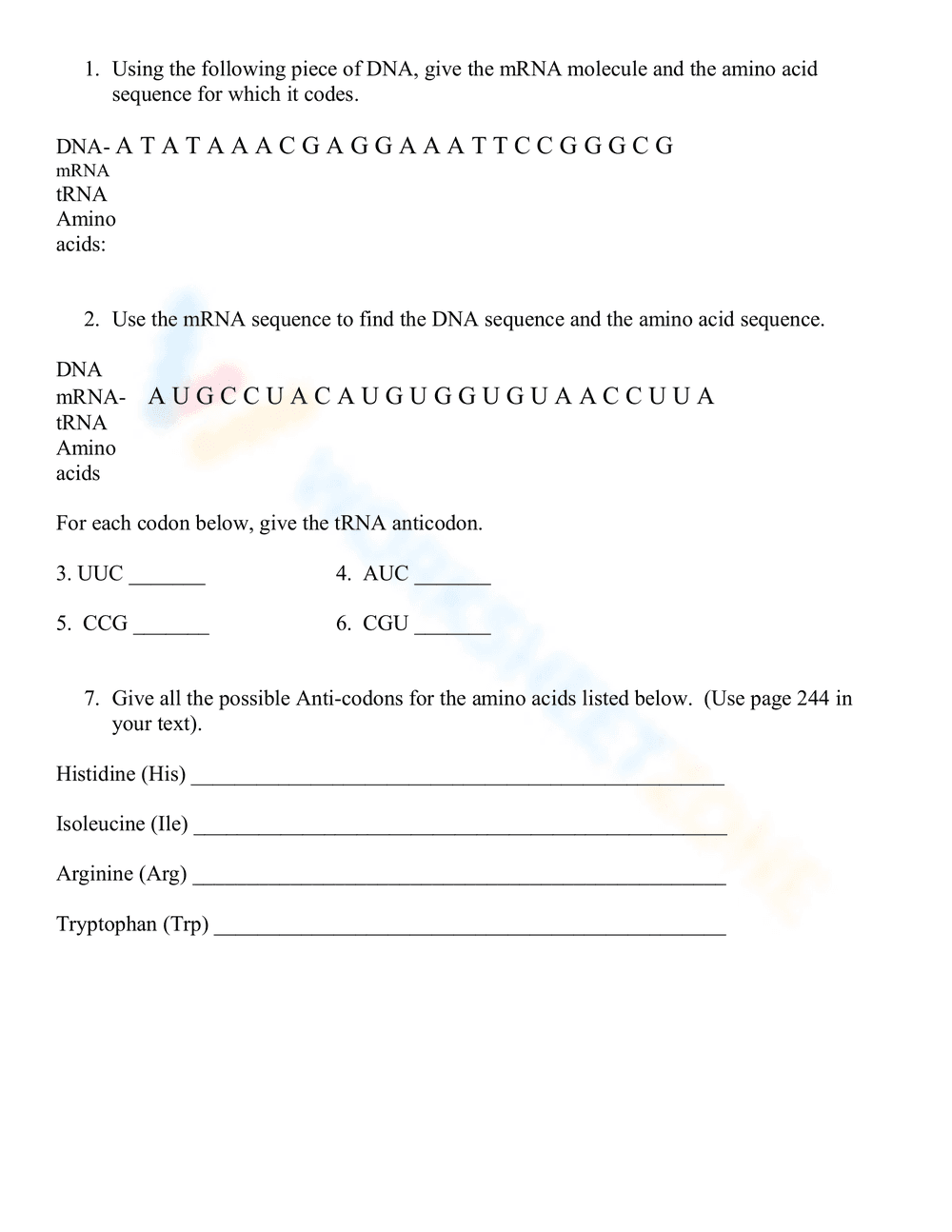
This is a DNA Base Pairing Worksheet. It presents the rules for base pairing: Adenine (A) pairs with Thymine (T), and Cytosine (C) pairs with Guanine (G). It also states that in RNA, Adenine (A) pairs with Uracil (U) instead of Thymine (T). The worksheet contains two sections: The first section asks students to write the complementary DNA strand for six given DNA sequences. The second section asks students to write the mRNA strand for six given DNA sequences.
Grade Level Suitability:
This worksheet is suitable for high school biology (Grades 9-12) and introductory college biology courses. It requires an understanding of DNA and RNA structure and base pairing rules, typically covered in these grades.
Why Use It:
This worksheet reinforces understanding of DNA and RNA base pairing rules. It helps students practice applying these rules to determine complementary DNA sequences and mRNA sequences, strengthening their comprehension of molecular biology concepts.
How to Use It:
Students should first review the base pairing rules provided at the top of the worksheet. For questions 1-6, they should write the complementary DNA sequence by pairing A with T, T with A, C with G, and G with C. For questions 7-12, they should write the mRNA sequence by pairing A with U, T with A, C with G, and G with C.
Target Users:
The target users are high school and college students learning about DNA, RNA, and molecular biology. It is also useful for teachers and tutors who need practice materials for their students.
This is a DNA Base Pairing Worksheet. It presents the rules for base pairing: Adenine (A) pairs with Thymine (T), and Cytosine (C) pairs with Guanine (G). It also states that in RNA, Adenine (A) pairs with Uracil (U) instead of Thymine (T). The worksheet contains two sections: The first section asks students to write the complementary DNA strand for six given DNA sequences. The second section asks students to write the mRNA strand for six given DNA sequences.
Grade Level Suitability:
This worksheet is suitable for high school biology (Grades 9-12) and introductory college biology courses. It requires an understanding of DNA and RNA structure and base pairing rules, typically covered in these grades.
Why Use It:
This worksheet reinforces understanding of DNA and RNA base pairing rules. It helps students practice applying these rules to determine complementary DNA sequences and mRNA sequences, strengthening their comprehension of molecular biology concepts.
How to Use It:
Students should first review the base pairing rules provided at the top of the worksheet. For questions 1-6, they should write the complementary DNA sequence by pairing A with T, T with A, C with G, and G with C. For questions 7-12, they should write the mRNA sequence by pairing A with U, T with A, C with G, and G with C.
Target Users:
The target users are high school and college students learning about DNA, RNA, and molecular biology. It is also useful for teachers and tutors who need practice materials for their students.


