


























1 / 6
0
Views
0
Downloads





0.0
0
0 Likes
Karyotype and Lions Review Quiz
0 Views
0 Downloads
Paste this activity's link or code into your existing LMS (Google Classroom, Canvas, Teams, Schoology, Moodle, etc.).
Students can open and work on the activity right away, with no student login required.
You'll still be able to track student progress and results from your teacher account.
Information
Description
What It Is:
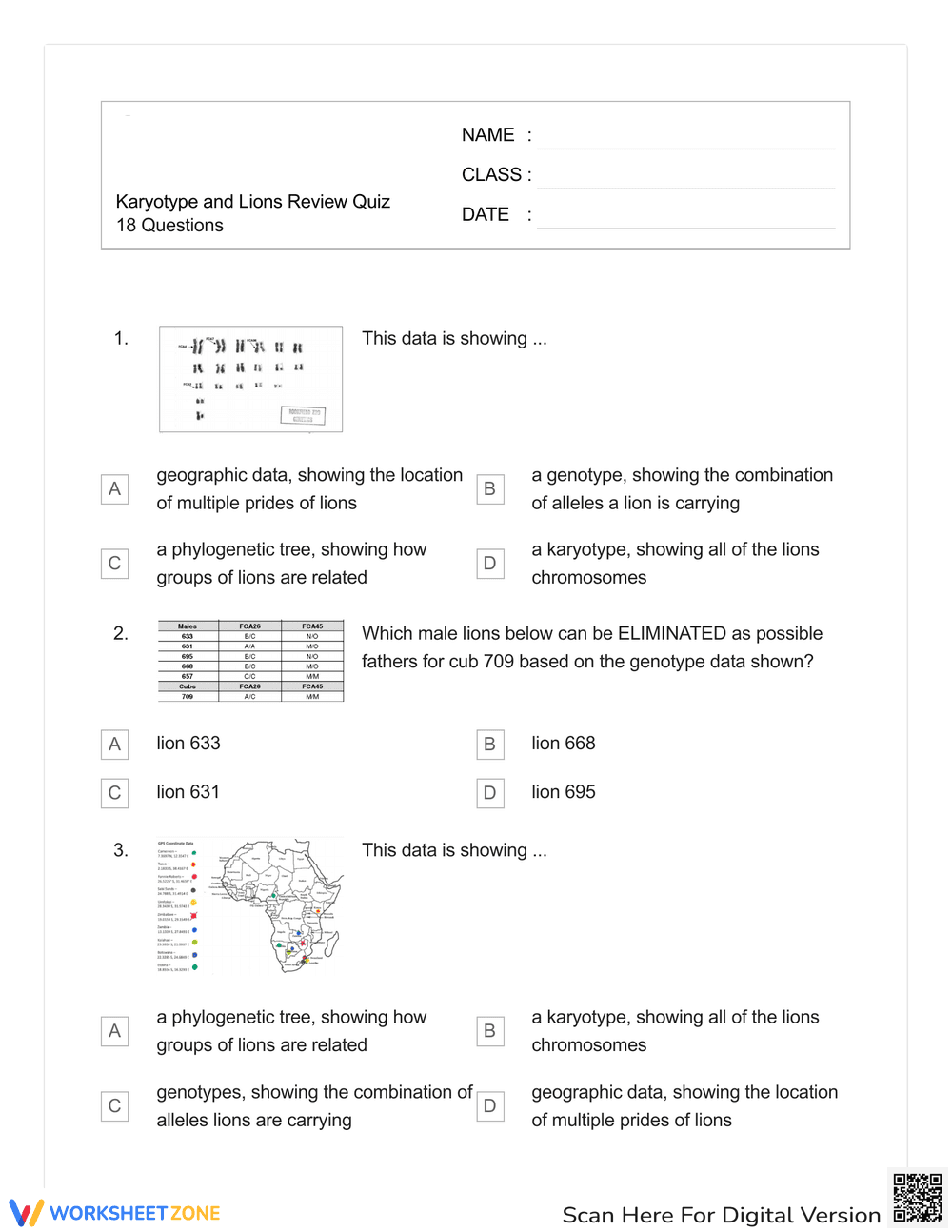
This is a review quiz titled 'Karyotype and Lions Review Quiz' with 18 questions. The worksheet contains multiple-choice questions about genetics, specifically focusing on karyotypes, genotypes, and lion populations. One question involves interpreting a karyotype image, another involves analyzing a table of genotype data to determine possible fathers of a lion cub, and a third asks what a map of Africa showing colored dots represents.
Grade Level Suitability:
This worksheet is suitable for high school biology students (Grades 9-12). The concepts of karyotypes, genotypes, phylogenetic trees, and geographic distribution of species are typically covered in high school biology courses. The complexity of the questions and the need to interpret data tables and images make it appropriate for this age group.
Why Use It:
This worksheet helps students review and reinforce their understanding of genetics concepts such as karyotypes, genotypes, and their application to real-world examples, like lion populations. It encourages critical thinking and data interpretation skills. It also assesses students' ability to connect genetic information to geographic distribution and evolutionary relationships.
How to Use It:
Students should read each question carefully and select the best answer from the multiple-choice options provided. They need to interpret the provided images (karyotype, map) and data tables to make informed decisions. The worksheet can be used as an in-class activity, a homework assignment, or as a review tool before a test.
Target Users:
The target users are high school biology students, particularly those studying genetics, evolution, and animal populations. It is also useful for teachers looking for review materials or assessments on these topics.
This is a review quiz titled 'Karyotype and Lions Review Quiz' with 18 questions. The worksheet contains multiple-choice questions about genetics, specifically focusing on karyotypes, genotypes, and lion populations. One question involves interpreting a karyotype image, another involves analyzing a table of genotype data to determine possible fathers of a lion cub, and a third asks what a map of Africa showing colored dots represents.
Grade Level Suitability:
This worksheet is suitable for high school biology students (Grades 9-12). The concepts of karyotypes, genotypes, phylogenetic trees, and geographic distribution of species are typically covered in high school biology courses. The complexity of the questions and the need to interpret data tables and images make it appropriate for this age group.
Why Use It:
This worksheet helps students review and reinforce their understanding of genetics concepts such as karyotypes, genotypes, and their application to real-world examples, like lion populations. It encourages critical thinking and data interpretation skills. It also assesses students' ability to connect genetic information to geographic distribution and evolutionary relationships.
How to Use It:
Students should read each question carefully and select the best answer from the multiple-choice options provided. They need to interpret the provided images (karyotype, map) and data tables to make informed decisions. The worksheet can be used as an in-class activity, a homework assignment, or as a review tool before a test.
Target Users:
The target users are high school biology students, particularly those studying genetics, evolution, and animal populations. It is also useful for teachers looking for review materials or assessments on these topics.


