


























1 / 2
0
Views
0
Plays


0.0
0
0 Likes
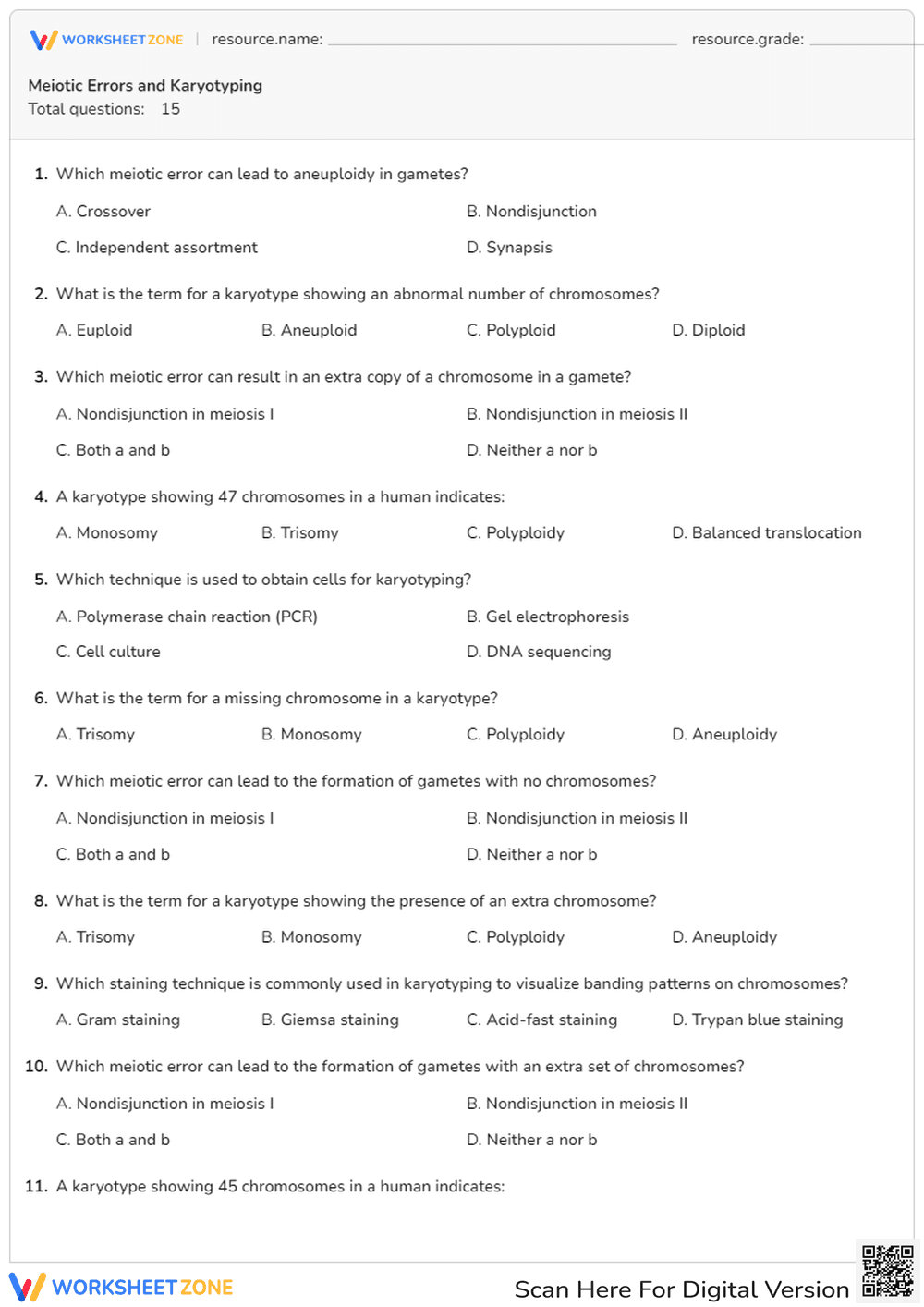
Meiotic Errors and Karyotyping
0 Views
0 Plays
Paste this activity's link or code into your existing LMS (Google Classroom, Canvas, Teams, Schoology, Moodle, etc.).
Students can open and work on the activity right away, with no student login required.
You'll still be able to track student progress and results from your teacher account.
Information
Description
What It Is:
This is a visual representation of a human karyotype, showing all 23 pairs of chromosomes arranged in order from 1 to 22, plus the sex chromosomes (X and Y). The image depicts chromosomes 1-5 in blue, 6-12 in purple, 13-18 in pink, and 19-22 and the sex chromosomes in red. Chromosome pair 21 is circled, indicating a potential abnormality (trisomy).
Grade Level Suitability:
Suitable for grades 9-12, particularly in biology or genetics classes. It requires an understanding of basic cell biology, DNA, and heredity, making it appropriate for high school students.
Why Use It:
This image helps students visualize the organization of human chromosomes and understand the concept of a karyotype. It can be used to illustrate genetic disorders like Down syndrome (trisomy 21), which is visually represented by the extra chromosome on pair 21. It promotes understanding of genetic variation and chromosomal abnormalities.
How to Use It:
Use this image as a visual aid when teaching about chromosomes, karyotypes, and genetic disorders. Students can analyze the image to identify chromosome pairs, note any abnormalities (like the extra chromosome 21), and discuss the implications of such abnormalities. The image can be used for discussions, presentations, or as a reference for completing genetics-related assignments.
Target Users:
High school biology students, genetics students, and teachers who need a visual aid for explaining karyotypes and chromosomal abnormalities. It can also be helpful for anyone interested in learning about human genetics.
This is a visual representation of a human karyotype, showing all 23 pairs of chromosomes arranged in order from 1 to 22, plus the sex chromosomes (X and Y). The image depicts chromosomes 1-5 in blue, 6-12 in purple, 13-18 in pink, and 19-22 and the sex chromosomes in red. Chromosome pair 21 is circled, indicating a potential abnormality (trisomy).
Grade Level Suitability:
Suitable for grades 9-12, particularly in biology or genetics classes. It requires an understanding of basic cell biology, DNA, and heredity, making it appropriate for high school students.
Why Use It:
This image helps students visualize the organization of human chromosomes and understand the concept of a karyotype. It can be used to illustrate genetic disorders like Down syndrome (trisomy 21), which is visually represented by the extra chromosome on pair 21. It promotes understanding of genetic variation and chromosomal abnormalities.
How to Use It:
Use this image as a visual aid when teaching about chromosomes, karyotypes, and genetic disorders. Students can analyze the image to identify chromosome pairs, note any abnormalities (like the extra chromosome 21), and discuss the implications of such abnormalities. The image can be used for discussions, presentations, or as a reference for completing genetics-related assignments.
Target Users:
High school biology students, genetics students, and teachers who need a visual aid for explaining karyotypes and chromosomal abnormalities. It can also be helpful for anyone interested in learning about human genetics.


